
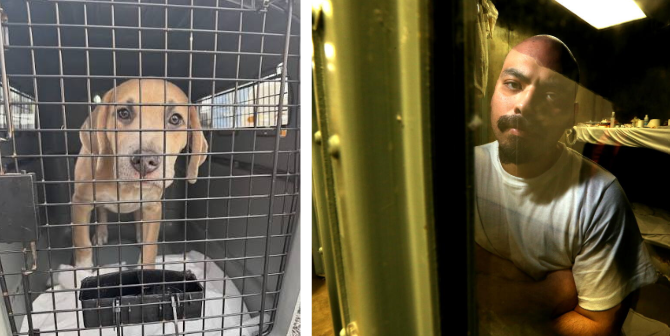
After watching The Strike, the prison hunger strike documentary, I got to thinking about how the conditions in prisons are worse than we allow for animals.
My family and I have trouble leaving our dogs alone for more than 5 hours. We have had many conversations regarding our schedules and making sure someone is with them so they aren’t kept in their cages or left alone for too long. When left at home, we make sure they have fresh water, snacks, a bed, pee pads, entertainment, and the companionship of each other. That seems normal to a lot of pet owners, and anything less could be considered inhumane treatment, yet that same view isn’t true for prisoner treatment.
The documentary discussed how dehumanizing prisons are in the United States. Prisoners can be sent to solitary confinement for little to no reason, with no action commited by them to be there. There is evident racial discrimination and bias to who prisons send to solitary confinement. Additionally inmates would put kept in solitary confinement for incredibly long periods, with some inmates staying in there for 30 years. Some inmates were in solitary confinement longer then I have been alive. The documentary talked about the social and mental effects this had on them and how the possible death during a hunger strike wasn’t scary when they felt that they were already dead. Before this documentary, I didn’t question the impact solitary confinement could have on a person’s ability to function, think, or live. I also didn’t understand just how long people were sentenced there, but why didn’t we find any amount of time over one day troublesome.
I have three dogs and two of them have had rough pasts of neglection. One of my dogs, Walle, was left in a cage most of his life with his former owners. They neglected him, favoring their other dog giving that dog much more attention and resources than Walle. Another one of my dogs, Maurice, has a very tragic story. For the first year and a half of his life, Maurice was left outside and chained to a fence 24/7 with barely any food or water. When we adopted him he was so skinny you could see every one of his ribs. He was alone a lot of the time and it still shows through how he acts in social situations with humans and other dogs. When I tell these stories it brings out a lot of sad emotions. Who would do that to a vulnerable dog? Why is it okay for the government to do it to vulnerable inmates?
Society, especially the state prison systems, view inmakes as powerless once in prison. The only form of legal slavery left in the U.S. is in prisons, and its justified in a consitional amendment. Prisons have limited labor laws that don’t require safe conditions and adequate compensation. Food in prisons are not held to the same standards as regular society with there being common cases of prisons serving spoiled or contaminated meals. Despite this, there are laws in most states that penalizes animal cruelty, neglect, and failure to provide proper food, water, or shelter. While animal welfare is important, humans are being treated not just less than human but less than animals. Animal welfare is a more popular and supported issue than inmate welfare, because pets are seen as more deserving of humane treatment then prisoners.

Many organizations like the ASPCA and Humane Society push their emotional and gut-wrenching commercials of dogs stuck in cages, with severe injuries, and isolated from the outside world. I always have to change the channel because they make me so incredibly sad. Yet if we saw images or commercials of prisoners behind bars in inhumane conditions and solitary confinement the public reaction wouldn’t be the same. The first thought wouldn’t be “it’s inhumane for people to be living like this”. A more common thought would be “I wonder what awful crime put them there” or “I am glad this dangerous person is off the streets”. Most people probably wouldn’t notice the conditions at all. And that says something to how we treat prisoners as less than human. One of the things that really stuck with me when watching the documentary, was how it didn’t focus on the crimes or personal failings of these individuals. It saw them and treated them as human first, more than how society treats them in their everyday lives.
How does society determine who is deserving of humane treatment and isn’t it hypocritical that it doesn’t apply to everyone? Why when seeing someone suffer do we try to label that suffering as deserved versus undeserved? Does a criminal record forfeit someone’s right to humanity and humane treatment? How we procieve someone and their surroundings can be a determating factor to if they have rights. Shouldn’t their breathing human body, their life, be enough for us to care?

