
Because a bunch of people have asked, here is a link to my final paper on mpreg, or male pregnancy fan fiction. Please be gentle- it’s not a prefect paper, and only scratches the surface on this subject, theoretically and otherwise. In the end, fan fiction represents a fascinating place for intersectional theories to do their thing- I wish I had more time to dig deeper on it.
Author: Steve Ammidown
Henry Hyde’s Dark Legacy

Henry Hyde (R-Illinois) had a remarkably long career of 37 years in the U.S. House of Representatives, garnering his fair share of damnation and praise, celebration and scandal. He was a Republican from Chicago who kept getting reelected, which was an achievement unto itself. He led the calls for President Clinton’s impeachment trial, although it was later revealed that he himself had at least one extramarital affair.
History, however, will remember Henry Hyde for a singular amendment that he attached to an appropriations bill in 1976, which barred federal funds from being used to pay for abortion services for Medicaid recipients, except in cases of rape, incest, or when the life of the woman was endangered. Hyde was staunchly anti-abortion- this amendment was his way of trying to limit access to the newly-legal procedure by closing off the federal purse strings for it. The law was upheld as constitutional by the Supreme Court in 1980, and has been attached to every appropriations bill for Medicaid since.
The Hyde Amendment was the first major victory for the anti-abortion movement, and this new tactic became a popular approach across government. The Hyde language no longer covers just Medicaid recipients, but also those covered by Indian Health Services, the Tricare program for active duty and retired military, and every single health insurance plan offered to federal employees, just to name a few. Hyde was even the inspiration for the Stupak-Pitts Amendment to the recent Affordable Care Act, which further reiterates that anyone who receives health insurance from the federal government will be prevented from seeking abortion care except in the most dire of circumstances.
It is perhaps the ultimate mark of a patriarchal government to control so completely the reproductive lives of those who are most directly connected to it, be they a Medicaid recipient or a front line soldier. What is perhaps the most shocking thing is the complacency with which the average American faces this fact. The majority of the individuals involved here- the poor, minorities, government employees, Native Americans- are part of groups so vilified by the media and public sentiment that it took many mainstream reproductive rights organizations until the arrival of the Stupak-Pitts Amendment, with its much broader reach, to raise the issue on a national level and tap into public outrage.
Still, the fight against Hyde is not a popular one. There is a sense that those who rely so much on the government should be subjected to its rules, as though they were living under the roof of a strict parent. Smaller organizations such as Sistersong, INCITE! and the National Network of Abortion Funds (NNAF) continue to press for the repeal of Hyde as part of a larger reproductive justice framework, and they are starting to gain some traction among younger activists. In April, affiliates of NNAF raised almost half a million dollars through dozens of popular fundraisers to provide direct assistance to women who cannot afford abortion services because their insurance (in whatever form) does not cover abortion services. The rising need seems to be being greeted by a rising tide of activism.
Henry Hyde left us an unfortunate legacy that far too many have ignored. Here’s hoping there’s still time to reverse it.
Design improved by (dis)ability
So we’ve talked quite a bit about how architecture and spaces treat (dis)ability as an afterthought, defining a norm and making often weak attempts to accommodate those who do not fit inside the normative box. But this doesn’t always have to be the case. There are some really smart designers who have flipped this script- collaborating with people of different abilities in order to come up with design that is beneficial to everyone.
Take for example the OXO Good Grips line of kitchen utensils. We’ve all seen  them- peelers with really thick handles, unusually shaped can openers. Cool looking, but not the norm in utensil design. It turns out, this entire line was designed in consultation with arthritis sufferers, in order to create kitchen tools that they could easily and comfortably use at a reasonable price. Now, OXO Good Grips is one of the best selling brands of kitchen utensils around the world. A simple thought- making an easier to use potato peeler- leads to better design.
But what about architecture? How can it be impacted by collaboration across abilities? At DC’s Gallaudet University, which specializes in educating those with hearing impairments, new buildings are showing innovative design meant to help the deaf that could end up in your new office building or classroom. Walking and talking is one of the cornerstone experiences of college life- but this becomes a bit trickier when you’re speaking a language that is visually based. Buildings offer numerous obstacles to these conversations- narrow hallways, doors that have to be opened. Gallaudet is creating buildings with wider hallways and wider sliding doors to better accommodate students’ social life. Eye strain, again a common college problem exacerbated by needing to use your eyes to take in every second of classroom interaction, is dealt with by thinking of light sources and room color. Each innovation is driven by thinking of (dis)ability first, and each one something that could be valuable to the world at large.
Is this a next stage in industrial design? Instead of trying to make a product comply to Americans with Disabilities Act standards, should we instead focus on making products more inclusive from the start? It’s a bit of a rhetorical question, sure, but the real question is, why aren’t more people thinking this way?
Sharing the Experience? The Menstruation Machine.
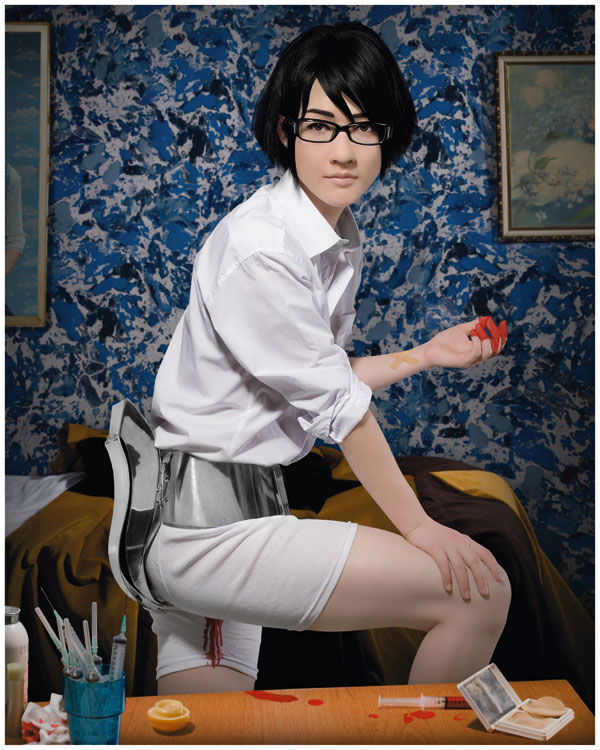
To the phenotypical male, menstruation will always be a mystery that we will never experience. Or is it?
Growing up as a boy, the only information I received about menstruation was by eavesdropping on girls whispering to each other, or the odd incomprehensible schoolyard insults about PMS. Television provided images of pads (with wings!) that women were supposed to wear in order to catch an unnaturally blue liquid, but no indication of where those pads went, or what that odd liquid actually was. Sitcoms taught men to just stay out of the way during “that time of the month,” lest all hell break loose. It wasn’t until many years later, when I screwed up my courage and started to ask questions of my partner, that I was able to come to understand what happened. Sort of. I mean, I could be sympathetic, but how can one be empathetic of a bodily process you can never experience?
Performance artist Sputniko! (aka Hiromi Ozaki) seems to have developed a solution of sorts to this conundrum. The Menstruation Machine, a gleaming chrome device that straps to the abdomen, is meant to simulate menstruation for those who would not otherwise experience it. Prior to putting it on, a vial inside the machine is filled with the wearer’s own blood. Once on, the strap around the abdomen simulates cramps, and the vial inside slowly drips blood into the wearer’s underwear. Sputniko! created a music video of Takashi, a drag performer, wearing the machine out on the town and experiencing cramps and bleeding:
On the surface, this seems like a really interesting opportunity for someone who doesn’t menstruate (whatever their gender identity) to experience what goes on during this part of the menstrual cycle. But in the end, it is just a simulation, and like all simulations, it can be stopped. And it has limitations- it does not simulate the anxiety of a late period, or account for variations in severity over time.
Obviously, Sputniko! created this as an art piece to stimulate discussion. Can such a machine be used to bring about empathy in those who don’t menstruate? Or would it create a sort of false empathy because the experience of menstruation is a fully embodied, ongoing experience? I find myself sort of in-between these two stances. What do you think?
Who gets to talk about bodies?

(author’s note: I fully acknowledge the irony of writing this piece while being someone who identifies as male.)
Over the past two weeks, there have been two very different public showdowns over different parts of women’s bodies. In the first, the Susan G. Komen Foundation found itself under fire for its decision to stop funding grants to Planned Parenthood because of a politically-motivated Congressional investigation into the federal funding the latter organization receives. The second, more recent firestorm has arisen over a provision in the new federalhealth care regulations that would essentially require religious organizations that perform non-religious work to provide birth control coverage for their employees.
The real difference between these two events has been whose voices have been raised in anger, and who has garnered the media’s attention. The Komen controversy began largely through social media channels, promulgated by well-known feminist activists as well as networks of those involved in the various breast cancer movements. When the issue was brought to the attention of the mainstream media, the angry voices and stories of women both famous and not were splashed everywhere, supporting Planned Parenthood in a nearly unprecedented way.
Compare and contrast those scenes with what we have seen since the US Council of Catholic Bishops started to speak out against the administration’s birth control policy. Not only have the public faces been overwhelmingly white and conservative, but they have also, almost universally, been men (with the exception of New Hampshire Senator Kelly Ayotte, best known for her previous encounter with Planned Parenthood). It doesn’t matter the network, you’re almost guaranteed that they have relied on a white conservative member of the clergy, politician, or talking head. ThinkProgress tallied it up and published a report last week showing that over the course of three days, the cable networks relied on male voices more than two to one over women’s voices in the debate.
Given that the focus was on reproductive self-determination, shouldn’t the focus have been on the voices of women? Surely, the Komen controversy showed us the value of women’s stories in understanding the impact of policy decisions? The fundamental difference turns on the public role of men and male privilege in the areas of reproductive health versus their public roles relating to breast cancer. When it comes to breast cancer, men and women have the shared goal of prevention. For women, it is about the preservation of their health, while for men it is about the preservation of one of society’s most fetishized body parts. Increasing access to breast cancer screening is thus a net win for both parties.
But birth control is a different story. Men held an extreme advantage in sexual power relations prior to the mass marketing of hormonal birth control. In a heterosexual relationship, it was only the male who was able to avoid the reproductive consequences of sex, by simply walking away. But with the pill, women were suddenly able to control more accurately when, where, and with whom they would have a child. Suddenly, there was a certain level of sexual equality. The most misogynistic corners of our society, ably represented by the Catholic hierarchy and social conservative politicians, have yet to recover from this remarkable shift. As a result, when the Obama administration presented them with this golden opportunity to limit access to birth control, they could not resist. Throwing their privilege around, they were able to dominate media conversation, framing it as an issue of “religious liberty” instead of the attack on personal freedom it actually is.
Where the debate will end up has yet to be seen, but one can’t help but hope that women will actually be able to get a word in edgewise.

