“If you don’t respect yourself and you don’t demand what you believe in for yourself, you’re not gonna get it.” -Judy Heumann
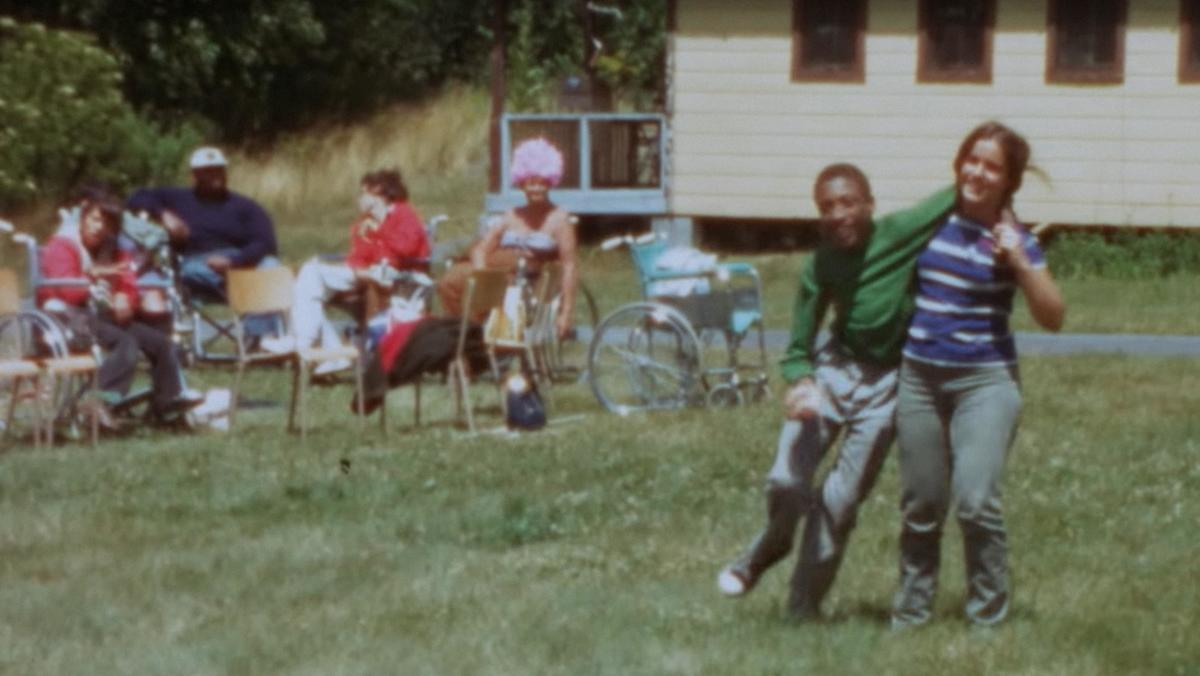
A photo taken at camp Jened. In the foreground to the right are two people, one of which supports the other via an arm slung around the neck. In the background are four figures sitting in wheelchairs.
An accepting environment is the backbone to an unfractured society. For marginalized communities, the opportunity to exist wholly – to present as you wish to without masking, trying to fit in, to just be without fear of discrimination or worse – is few and far between. Camp Jened was a safe space to meet other people who knew the struggle of living in a world that is majorly inaccessible; some campers even stated that it felt like a second home to them. For Woodyard, it was one of exposure, a different way of living than he’d known in Alabama. LeBrecht explained feeling as though he had to fit into a world that wasn’t made for him. O’Toole told about how she would pretend to be able-bodied, hiding her cane under the couch. The weight of masking’s burden remains unknown until you no longer have to pretend. Only once that weight is removed do you realize the damage its done, yet how freeing it feels to live without it.
Heumann, explaining how she took special education classes that were in the basement of her school, stated that “in some way, even when we were that young, we knew that we were all being sidelined”. Similarly to Heumann, I also took special education classes in high school. My experience with them was quite frankly horrible and my teacher brought students to tears multiple times due to a short temper with questions regarding the material. Jened was empowering: an environment curated specifically with those cast to the sidelines in mind, encouraging them to raise up their bat and knock able-bodied expectations out of the park. A topic discussed amongst the campers in the film was parents. One camper expressed distaste for her parents’ overprotectiveness, and another raised that many parents often wish to conceal the disabledness of their child out of fear. The coddling you face as a disabled person is endlessly frustrating, and when you speak out about it, you’re likely to be told that “well, it’s coming from a place of love, so you can’t be mad”. A parent should of course protect their children, but there is a line between protection and infantilization, and too often does it cross the line into the latter.