
Someone told me once that lighter colored eyes–the blues and greens and greys–are more sensitive to the sun than darker eyes, and the reason for this is the way that irises scatter and transmit light into the retina. For me, stepping out into the sun each day is so rough. I groan and gripe to myself every morning while attempting to shield my eyes until they’ve adjusted to what always seems like the most brutal brightness. Continue reading
death
I Got My Dad In a Box
*This post contains mentions of, and some descriptions of, death and sick-related stuff*
Death is unfortunately not a new phenomenon in my life. I’ve seen a lot of my family members get sick, a lot of friends die suddenly. I’ve spent a lot of time sitting in intensive care waiting rooms, getting to know the staff, the smell, learning to walk around like I know where I’m going so no one will bother me. I’ve spent way more time than I should have perfecting my small talk in funeral homes, not knowing how long to kneel at the open casket, hugging distant relatives in stiff clothes they only wear to these functions. I’ve sunk into a lot of grave dirt in some really uncomfortable shoes. My advice is to have a sense of humor about it. Continue reading
Excuse me while I Mosh
So if anyone has ever been to a concert or show you might be familiar with the practice of Moshing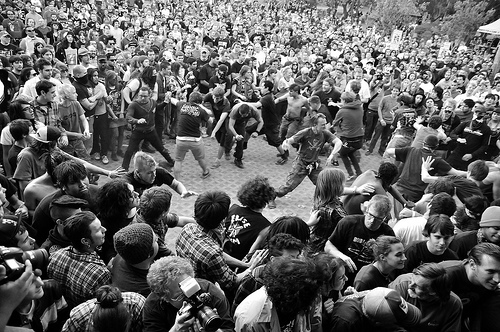 .
.
Deceased “Etiquette”
The media heavily covered the death of legendary singer Whitney Houston. There was much speculation about the circumstances surrounding her death all of which were reported on in the media. The latest story about the singer’s death is the National Enquirer publishing a photo of the late singer in her casket. There is an article on Celebritology on the Washington Post which reports on this latest media frenzy. Where do we draw the line when it comes to respect of the deceased? Is showing their body in a casket appropriate, especially when her family did not authorize such a photograph to be published let alone taken?
The singer’s entire life was in front of paparazzi as is any other celeb’s. But is this same extreme invasion of privacy acceptable after death when the star is no longer her to be a voice for herself? The media feeling the need to publish such a picture is extremely indicative of how we view bodies. Whitney was famous mostly for her voice, however the voice went with the face and body. At one point in time she was a model, however her notoriety came from her vocal skills and stylings. So following death people do not separate the two? The deceased corpse is no longer able to produce the angelic sounds that it once did, however there is such a focus on the body.
In my opinion it is extremely disrespectful of not only the celebrity but her family as well to post pictures of her body in a casket. Why does the media feel such a need to be so intrusive into the lives of people? There should be more of a line drawn between reporting on what needs to be known or what is of interest and respect of the privacy of those being reported on.
The Embodiment of Death
The chapter for next week about the embodiment of death – in terms of finding ground between the ‘body’ and the ‘self’ – resonated with me for various reasons. One of the biggest things I noticed was the unwillingness to deny that a person’s identity has left the body after death, which is a theme that has become prominent in various science fiction stories. Iconic characters such as the vampire or zombie relate the idea that after death we do not have to give up our bodies. Reanimated bodies, such as Frankenstein’s monster, also seem to feed into a belief that the remains of a body can be recycled to create new life (or something similar). Furthermore, the father in Pet Sematary who buried his dead son’s body within the grounds that were known to reanimate bodies did so to cling to the fact that his son would return once again after identity and body united.
These representations in literature and media walk a line between trying to beat death and keeping claim over your body, but ultimately there is something in the characters that lacks humanness. Vampires, zombies, Frankenstein’s monster, and the little dead boy from Pet Sematary all lost their identities after death and were changed completely. Something about the mysterious nature of death – one that we cannot completely have knowledge about, yet we all will experience – feeds into these representations of bodies that face the unknown. The characters definitely find an imbalance between the ‘self’ and ‘body’ being continuously connected, but for the most part these characters illuminate a world where bodies are meat and fodder. Identity may change after the cross between life and death, but the body will withstand composition (albeit disfigured and sutured, I suppose).

