
“You’re not a girl!”

After reading “Throwing like girl’ and listening to everyone’s stories about how they grew up being treated as less than a girl or too much like a girl by their male peers had me thinking about my experiences when I was a kid and how I was treated just because I had different interests from other girls and had the same interests as some boys.

I remember in elementary school all the girls would play and talk about boys under the playground, but me I was that one girl on the basketball court or the football field trying to show out and out play the boys. Now this came with a lot of difficulties for me because at some points the boys would go easy on me and be like “well you’re a girl and I don’t want to hurt you”. But on the other hand they would undermine my skills in the sport after I beat them by saying “I went easy on you so I don’t hurt your feelings” now both of these sayings would hurt my feelings pretty bad and would make me feel like I truly couldn’t be apart of their little sports groups so it would push me away a little bit to try and hang out with the girls thinking that it would be different but come to find out I was very wrong about that.

As I gravitated under the playground so I could talk with the girls, it very quickly showed me just how uninterested I was in what they were talking about. All of the conversations consisted of them talking about how good the boys looked playing basketball or what new dress their mom bought them that week . And little old me would just sit there and listen and soon after all the girls started realizing that I wasn’t speaking in any of their conversations so they started to catch on and tried to single me out just as much as the boys. It got worse for me when we played this “girls vs boys” which was any game but with girls on one side and boys on the other, I would try and join the girls team when we would do this and the first thing I would hear was “you’re not a girl” and they would force me to be on the boys team completely altering the way I thought and I would try to change myself and act like I liked boys to please them.

Honestly as time went on the playing with boys part left after middle school and I was able to play sports freely in high school but the way that girls felt about me never fully changed because once I entered 10th grade I started becoming more masculine as I found myself so if anything it got worse. Girls wouldn’t let me say the word bitch, some girls didn’t want to change in front of me, I couldn’t be feminine, I couldn’t talk about periods because they “forgot” I got them and definitely couldn’t wear anything remotely feminine or I would get weird looks. They basically looked at me as a man and put me into a box but let me try and switch it up and be feminine it was always a problem so in the end I could never win. But as I got older I stopped caring what people had to say and it let me be as expressive as I want to be and happy in my body, masculinity and femininity.
Case Study and Character Analysis: Joe Swanson

Case Study and Character Analysis: Joe Swanson

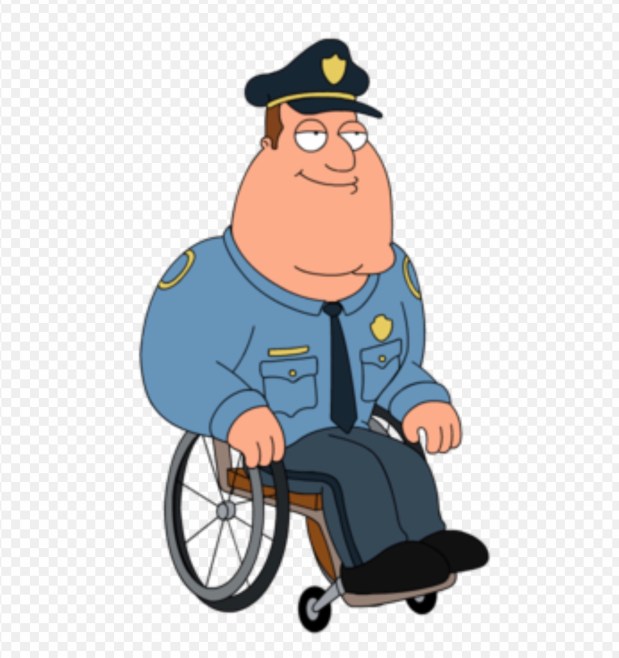
“Men with physical disabilities are marginalized and stigmatized in American society.” This is the first line written by Thomas Gerschick and Stephen Miller in their chapter titled “Coming to Terms”. And for Joe Swanson, a character in the popular cartoon show “Family Guy”, this hits close to home. For those unfamiliar, “Family Guy” focuses on a crazy family pictured here. 

The husband named Peter Griffin, wife named Lois, and three kids named Chris, Meg, and Stewie live in a Rhode Island home on Spooner Street. They get into all sorts of crazy shenanigans but them aside, ever since I started watching, my favorite character has always been Joe. This deep voiced and friendly neighborhood cop, that also happens to be paraplegic, consistently struggles with his physically impaired identity. This, in part, is because of the inconsiderate and sometimes plain mean people around him. In fact, many jokes on this show directly make fun of his disability. Here, for example. Poor Joe…

Coincidentally, this character reflects some of the things that Gerschick and Miller had to say about the relationships between men, disability, and masculinity. According to these anthropologists for disabled men, because of societal stereotypes, “being recognized as masculine is especially difficult, if not impossible.” And in Joe’s case, this proves to be especially true. Countless times, he is shown to be in need of care from his wife, Bonnie. Others in the show, including his friends Peter, Quagmire, and Cleveland, repeatedly make fun of him for this and portray him as useless. Multiple times, he has relationship troubles with Bonnie with the inability to sexually pleasure her being the issue of contention. As Gershick and Miller have established, Joe’s “hegemonic masculinity” is being endlessly challenged. Many times he reacts violently and harshly when his masculinity is questioned, shouting loudly, and shooting his gun. In these times, in the logic of these authors, he could be described as someone in the state of “reliance”, where he “internalizes” hypermasculine ideals and acts with those in mind.

However, what is lovable about this character is that ultimately, he always disproves the stereotypes of disabled men being “weak, pitiful, passive, and dependent”. And often times, he does so not with internalized social expectations of masculinity but with grace. A prime example is the episode of when Joe and Bonnie were fighting about Joe’s disability, thus a perceived of the lack of masculinity, hindering their love and they were close to divorce. Joe recalls when he he first met Bonnie when she was a stripper in a police bust of a strip club, a time when he was still able to walk. She gave him a lap dance. To make things right, Peter took the initiative to plan to have both Bonnie and Joe go to the same strip club that day to recreate such a romantic scene. But when he gets there, instead of having her give him another lap dance, he gave her a lap dance instead using his hands to maneuver his legs. I would say that Joe is in a state of “rejection” at this point. He refuses the social expectations of masculinity and able-bodiedness and instead, developed his own masculine and disabled identity by doing a lap dance which is normally seen as feminine but is masculine to him in that he is assertively trying to fix his marriage. And it works. They go home together afterwards.

Instances like these happen time after time again to Joe. And this leads me to believe that his depiction is relatable to the “Coming to Terms” article. He constantly goes through both physical and emotional hardships and reacts in ways that are consistent with the patterns of literally coming to terms with his disability and living on. And that is what he does each and every time. Say what you want but Joe Swanson is inspiring to me. I’m not going to say that he ever gets to live happily ever after. But he is challenged with societal challenges that attempt to invalidate and debilitate his very being, his very identity. Disabled. Male. Husband. Person. But through utter defiance and a strong will, he is able to live on, defy these restrictive and problematic notions, and ultimately overcome.

I’m Really Not Gay Tho

I’m Really Not Gay Tho

The connections between race and sexuality that Patricia Collins mentions, for me, are really relatable. Even though she and many other feminist studies writers have focused on African American men and prison power dynamics, as an Asian man, I can see exactly what they might be talking about in my own history.

When I was growing up, I had a really high voice; it was really really high. Some people might have said things such as, “You sound like a girl”. It really was that high pitched. And ultimately, many people at my school assumed that “He must be gay”. It’s true. People even asked me about it.

When I told them “No”, many of my peers were confounded. “That can’t be!”, they said. They assumed I must be lying and this was big issue for them for a long while. But then, many people suddenly turned around and said that I wasn’t lying after all. And I was confused.

It turns out, according to some individuals, that my voice was so “feminine” because I was Asian. “Asian men are just much less masculine and we should just accept you because you can’t help but be that way”.

Now, I realize that this was an example of the connectedness between race and sexuality. Like African American women or the less masculine African American men that were called “bitch” or “dicksucker”, my say on who I was was ignored by my surroundings but instead got replaced by peoples assumptions. And conversely to African Americans who were threatened because of their race, I was “validated” as acceptable because of mine.

No one paused to think that my sexuality, a private issue, was being violated. And then no one stopped to think that “blaming” a whole race of people for my “situation” was sort of racist. Reading such passage has enlightened me that, in this scenario, there were interlocking systems of power at play. Race and gender, in my case and many others, were used as intersectional societal methods of control at the expense of those affected by such assumptions.

Male/Female: To be or Not to Be

After reading Dean Spade Mutilating Gender essay I am baffled and saddened. It seems as if gender binary is causing more strife in society than one cares to recognize or admit. Why does every entity in life need to be categorized in order to be accepted? Due to the ancient history of gender roles/identity and my new achievement of joining Biologist I am sure the discovery of karyotyping is throwing a wrench in the system. Continue reading

How Should I React?

In my first blog post, I talked about women’s bodies in public being viewed as public property. As this assignment has progressed, I have been really impressed and inspired by the personal stories that everyone else has shared, so I want to end my blog by talking about a few of my own experiences of my body being seen as public property. *tw sexual harassment/salty language* Continue reading