
 Warning: this post does contain mention of self-injury.
I recently came across this article on scarification. Scarification is a process that involves using a scalpel to carve patterns into flesh. This may seem gruesome to some, but some who are attracted to it are looking for a way to disguise old wounds. One person who had scarification had been a youth who had engaged in self-injury and said that scarification was a form of reclamation.
What is the purpose of disguising scars with more scars? The idea of putting more scars on top of preexisting scars being reclamation is baffling to me. I can’t help but think that scarification may make self-injury worse, or, at least, make people believe that placing scars on their body is a healthy coping mechanism.
What if someone got a tattoo to cover their scars, though?
 While scarification carries stigma, the cultural status of tattooing has evolved from an anti-social activity to a fashion statement. Tattooing involves placing needles into the body instead of scalpels. Since both processes involve piercing the body, one may wonder which one is worse – or if they are both processes that are equal in magnitude (i.e. in terms of harmlessness, morals, destructiveness of the body, etc.). To me, tattooing is better than scarification, as in my view, no matter the method, producing a scar as opposed to producing an image that does not resemble a scar (given that one is not attempting to tattoo what looks like a scar onto the body) encourages self-harm. However, I am aware that I can’t speak for everyone.
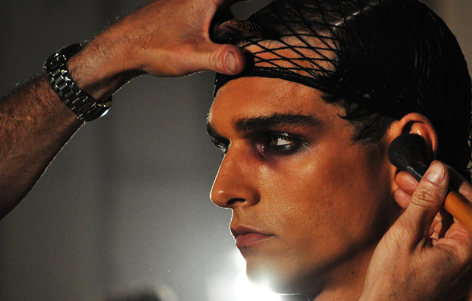 On a different note, while thinking about the process of scarification, I wondered about the body as a work of art, or at least a canvas upon which practices such as scarification, which is done in the name of art may be carried out. Another practice is tattoo art, and one may be able to perceive plastic surgery as a procedure that makes the body a work of art or creates art upon it as it sculpts parts of the body. However, more subtle forms of art/processes that make the body art can be simply applying makeup or combing one’s hair. These processes, although they may be viewed as mundane parts of daily life, all involve “fixing” or “adjusting” the body to create a certain visual image for the viewer (whether that viewer may be oneself looking in the mirror or others). That, to me, is art.
I remain on the fence about scarification. However, I believe the practice can bring about some interesting discourse on what makes a body practice acceptable or not, and on the body as art/a canvas for art.


Although painful to think about, the results of scarification are normally beautiful to me. I understand reclaiming scars for people to self-injure. In my opinion, this theory is similar to reclaiming a word like “queer”. I think the point is taking control of your body. In one way, you hurt yourself and left scars. In the other way, scarification, you scarred your body to create art.
Scarification also causes me to think about branding. I have seen branding in historically black fraternities, but I believe other Greek organizations do so as well. At first, I could not understand why someone would willingly burn their flesh to create a scar. Now, I see it as a physical manifestation of a commitment and a bond. I absolutely understand branding and love brands.
You bring up an interesting point about the differences in perception between needles and scalpels. I think that perhaps since needles are associated with more routine medical procedures- shots and the like- they are seen as more benign and less risky. Needles also seem to imply more complex and “civilized” medicine. Surgeries, of course, are incredibly complex, but scalpels are really just blades, which have existed for thousands of years.
Also, tattoos are very similar to scars (and they can, in fact, scar if they aren’t applied and cared for properly). You’re essentially placing a small amount of ink beneath the first layers of skin. It’s interesting how differently scarification and tattooing are received. I think it has to do with lasting evidence of the physical pain; logically, we know that tattoos tend to hurt, but it’s not as obvious when looking at a tattoo versus looking at a scar. Tattoos, since they are basically colored (or grey scale) graphic images, fit more easily with our existing understandings of art.
But I also think it’s important to consider the history of various body modification practices. Nearly all of them are appropriated from other cultures, and I think the status of that culture has something to do with how the practice is perceived. I’m not familiar enough with the history to really test that theory, however.