
Disclaimer: While I have never experienced baldness personally, drawing from the literature on disability and class discussions I felt an affinity with the topic. If I indirectly offend anyone I offer an apology in advance.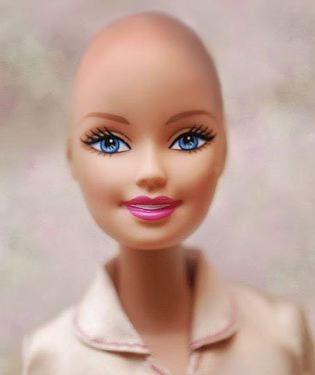
Recently I’ve noticed a lot of rabble on facebook about a topic I never thought would pop up in my newsfeed: Bald Barbie.
There’s a facebook group dedicated to pressuring Mattel to create the Bald Barbie for children who suffer from hair loss due to cancer as well as Alopecia, and Trichotillomania. Mattel has finally released a statement saying they will create Bald Barbie but it, “will be a friend of Barbie, which will include wigs, hats, scarves and other fashion accessories to provide girls with a traditional fashion play experience.”
Hm. So, the new doll cannot be labeled a “Barbie” and she still has to have fashion accessories which, in my interpretation, (and perhaps this is my raging feminist coming out) means people who have hair loss still have to cover up their scalp since baldness cannot be accepted as normal.
Not only will Mattel’s new doll not be a “Barbie”, she will also only be distributed to children’s hospital for reasons of “directly reaching girls who are most affected by hair loss”. But what about the children who are not in hospitals who have experienced hair loss? And how does a hospital reinforcing to the children that they’re still beautiful actually combat the main message that Mattel sends out to the general public on a day-to-day basis, i.e. beauty has a certain standard, and if you don’t have the hair and body for it, you will never be beautiful.
Could placing the doll on the shelves of a toy store create too much of a sense of normalcy towards hair loss?
From the past course discussions on disability, and the invisibility and inaccessibility that many disabled people have expressed they have experienced; I don’t think that Bald Barbie does much to enhance the lives of children who have experienced baldness.
By only distributing these dolls to hospitals Mattel is stating that baldness is still a disability and is associated only with illness. Mattel could release Bald Barbie in mainstream stores and allow Bald Barbie to be viewed right next to a Barbie with hair but then what message would Mattel be sending to the children that experience baldness? Beauty standards can actually deviate from what Mattel portrays them to be?
If Bald Barbie were to be considered equal and sold in the mainstream market right next to a Barbie with hair I think children who experience hair loss could actually feel acceptance and beauty towards their baldness, especially when Barbie is such an icon for female children for femininity and glamour.
I think Mattel’s creation and distribution of Bald Barbie is just another way to emphasize disability rather than accept it.


Great points. I didn’t realize that they were only going to be distributing this to hospitals. That seems like a bit of a cop out. It keeps the condition medicalized, instead of accepting it as a form of difference that some people have.
This actually got me thinking about dolls and hair in general- once you leave a doll’s head, there simply is no hair. Part of this is a practical consideration- how weird (and expensive for Mattel) would it be to have random patches of hair glued onto Barbie and Ken? But the underlying message reinforces the idea that body hair is foreign to these idealized bodies.
So a lack of body hair is perfection, but a lack of head hair should be confined to the hospital. What an odd society we live in.
I agree bald Barbie should be sold next to the traditional Barbie doll. Separating these dolls displays the standard of American beauty as a rigid customary phenomenon. This narrow accepted view of beauty is detrimental to girls’ self-esteem and may cause girls to feel abnormal compared to their peer group.
I think this is an interesting point about the marketing of the doll, however, in some respect it also goes back to the conversation we had about visibility. It offers children who have the opportunity to interact with the doll to have some sort of image of representation that they can identify with (even if the beauty standards are higher). It’s a small feat there, but it is harmful that there is a lack of wider expansion because it creates a visibility only seen in spaces where it is accepted as reality – not those that need to confront their notions of idealism.
A bald Barbie, what an interesting idea; I think it would be fantastic! I think bald Barbies would be good for sick children, but what about girls who simply like being bald? I think bald Barbies will stand for more than just positive role models for a medical condition, but also for being proud of being unique and different and standing up for what you want. I agree though, that it’s unfortunate that these Barbies are only considered “normal” if it’s for a medical condition.
I don’t like that this Barbie will not be labeled a Barbie and will in fact simply be a “friend of Barbie”. It also upsets me, and probably other people as well, that these Barbies will only be distributed to hospitals. Unlike what the company says, that this is so those who are affected by it can be near it, I think this is to avoid having girls think that it is acceptable to be bald. For this reason, it also upsets me that the doll will come with wigs and hairbrushes. Once again, they’re perpetuating the idea that being bald is wrong and having hair is good.
I also think it’s interesting that Barbie has hair only on her head, and ken’s hair is simply made of plastic and cannot be moved. I think there are children with siblings in the hospital, or children who have been let out of the hospital for a condition that they have, who would also benefit from having the dolls for a medical purpose, but in addition, I think the dolls would simply have a positive influence on everyone who came in contact with them.