
Bald Barbies

Disclaimer: While I have never experienced baldness personally, drawing from the literature on disability and class discussions I felt an affinity with the topic. If I indirectly offend anyone I offer an apology in advance.Image
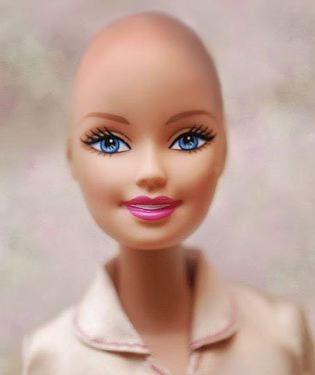
Recently I’ve noticed a lot of rabble on facebook about a topic I never thought would pop up in my newsfeed: Bald Barbie.

There’s a facebook group dedicated to pressuring Mattel to create the Bald Barbie for children who suffer from hair loss due to cancer as well as Alopecia, and Trichotillomania. Mattel has finally released a statement saying they will create Bald Barbie but it, “will be a friend of Barbie, which will include wigs, hats, scarves and other fashion accessories to provide girls with a traditional fashion play experience.”

Hm. So, the new doll cannot be labeled a “Barbie” and she still has to have fashion accessories which, in my interpretation, (and perhaps this is my raging feminist coming out) means people who have hair loss still have to cover up their scalp since baldness cannot be accepted as normal.

Not only will Mattel’s new doll not be a “Barbie”, she will also only be distributed to children’s hospital for reasons of “directly reaching girls who are most affected by hair loss”. But what about the children who are not in hospitals who have experienced hair loss? And how does a hospital reinforcing to the children that they’re still beautiful actually combat the main message that Mattel sends out to the general public on a day-to-day basis, i.e. beauty has a certain standard, and if you don’t have the hair and body for it, you will never be beautiful.

Could placing the doll on the shelves of a toy store create too much of a sense of normalcy towards hair loss?

From the past course discussions on disability, and the invisibility and inaccessibility that many disabled people have expressed they have experienced; I don’t think that Bald Barbie does much to enhance the lives of children who have experienced baldness.

By only distributing these dolls to hospitals Mattel is stating that baldness is still a disability and is associated only with illness. Mattel could release Bald Barbie in mainstream stores and allow Bald Barbie to be viewed right next to a Barbie with hair but then what message would Mattel be sending to the children that experience baldness? Beauty standards can actually deviate from what Mattel portrays them to be?

If Bald Barbie were to be considered equal and sold in the mainstream market right next to a Barbie with hair I think children who experience hair loss could actually feel acceptance and beauty towards their baldness, especially when Barbie is such an icon for female children for femininity and glamour.

I think Mattel’s creation and distribution of Bald Barbie is just another way to emphasize disability rather than accept it.

Hijabs and Hoodies

After we discussed the horrific and tragic murder of Trayvon Martin in class today, this article in particular caught my attention:

Shaima Alawadi, a resident of San Diego, California, was found beaten unconscious in her home last Wednesday and died of her wounds this past Saturday.  A note was found saying, “Go back to your own country. You’re a terrorist”.

Shaima was a stay at home mother with five children.

http://www.reuters.com/article/2012/03/28/us-california-iraqi-memorial-idUSBRE82R01N20120328.

This happened less than a week ago.

There was mention in class of how certain ideas in society become normalized, for better or for worse. In Trayvon and Shaima’s case there is no question these ideas create a poisonous environment.

But in both cases there was a similarity: clothing.

Trayvon was wearing a hoodie; which according to sources across the spectrum, most notably Geraldo Rivera, made him a target for suspicion. Last I checked wearing a hooded sweatshirt left no one with the ability to label someone as “suspicious” and cause cruel loss of life to another.

Shaima also had an article of clothing that marked her; a hijab. For those who are unfamiliar with a hijab, it is a head covering traditionally worn by Muslim women for reasons of modesty. Yet by wearing a hijab Shaima marked herself as “other”.

I find myself wondering if we can draw parallels between Shaima’s and Trayvon’s murders. They were both marginalized members of society, Trayvon was black and Shaima was an Iraqi-American immigrant. Both were wearing articles of clothing that are innocuous (although a hijab may stand out for those unfamiliar with the garb) but these clothes became threatening to those with prejudices and stereotypes.

I think we, as a Western society, are not past our cultural and racial biases when two murders are committed within a month of each other on the basis of race and ethnicity, with the flimsy excuses of clothing as reasoning. (By the way, I’m not ignoring that there are far, far too many of these crimes that go purposely unnoticed or are unreported).

In response to this hate crime there has been an out pour on social media and I found a group on facebook that seemed particularly fitting: http://www.facebook.com/pages/One-Million-Hijabs-for-Shaima-Alawadi/137306256397032.

When women are told, “you were asking for it”, if they are raped and happened to be wearing a miniskirt, when young black men are shot for wearing hoodies, and a woman is beaten to death in California for wearing a hijab because it “makes her a terrorist”, I have to wonder about the emphasis placed on clothing and the body-the cycle of violence around the clothing people wear for religious or personal reasons and why people use these articles of clothing as excuses for committing atrocities.

I find myself sick at heart with the violence, the hate, the prejudice, and the inbred bias. I send loving and peaceful wishes to the members of Trayvon Martin and Shaima Alawadi’s families.

Bows and Arrows vs. Vampire Fangs

If you’re a nerd like me and spent this past Thursday night eagerly waiting for The Hunger Games midnight premier, you might recognize the name Katniss Everdeen. Katniss is the heroine of the wildly popular Hunger Games series by Suzanne Collins. If you haven’t had the opportunity to read these books yet I highly recommend checking them out at your local library.

Recently, I’ve noticed a lot of media comparing Stephanie Meyer’s Twilight with Suzanne Collin’s The Hunger Games, or more specifically, Katniss vs. Bella.

I did a little research and I found this article: http://www.washingtonpost.com/lifestyle/style/in-katniss-of-hunger-games-a-lasting-heroine/2012/03/20/gIQAXvVbUS_story.html

The main point of the article is Katniss is not a new character, her physical and emotional strength are not new concepts to female heroines. However, many of the “sheroes” depicted in present day teen fiction, such as Bella Swan, are the exact opposite of the force that is Katniss Everdeen. Bella doesn’t push herself forward, and fight. Bella’s route is different, but her choices are her own. I am not a Twilight fan in any sense of the word but this article had a fascinating insight: there is room for both sheroes. Katniss needs to exist alongside Bella, both are representational of different aspects of feminism and the choices it allows women to have.

I appreciated the article for having the insight to point out characters like Katniss, who defy the norm, have existed in literature for ages. Has anyone besides me read Little Women? Jo and Katniss would have been best friends.

Ultimately I have to agree with the Washington Post article; Jo, from Little Women is remembered as is Alana from  Tamora Pierce novels, and I don’t think anyone will ever forget the brilliant Hermione Granger from Harry Potter. These women, along with Katniss Everdeen, are powerful, dynamic creatures who put their complete selves into a struggle against all odds.

So I offer up the question, of all the female characters in modern day literature, whom do you think will be remembered?  Will our daughters read about Bella Swan while Katniss fades quietly into the background and is eventually forgotten? Or will it be characters like Bella, who passively accept their surroundings, who will eventually be forgotten?

Full Throttle Exercise: The Impossible Standard.

A few days ago class discussion touched on a topic that has always been sensitive to me: exercise.

Modern culture if full of ads and products for getting fit, working out, and losing excess weight, all which will lead to a better and more beautiful you. The more you work your body out, the better the results and the better life you will have, or so says all the diet and exercise literature that I have read.

But is this true?

Every magazine I pass in the grocery store offers at least one full spread of exercises that will transform your body for all to see while low-fat, fat-free and zero calorie food and drink are everywhere. In society’s drive to be “healthy” are we really just pushing ourselves beyond the scope of what we are actually supposed to look and feel like?

Throughout history women’s bodies have been viewed from a skewed lens; as chattel, as something that must be covered lest it seduce man, as dangerous, and now as something that must be shaped to fit a standard. That standard being a skinny, tall, large-breasted but without curves, form. The religion of Exercise has only given credence to this standard, with the abundance of gyms and fitness classes there is no reason not to have a “perfect” body, no reason not to count every calorie and run a mile for every slice of pizza eaten.
Are these expectations even possible to meet?

I recently saw an ad for a gym that read, “It’s not Fitness. It’s Life.” This ad made me angry, from a larger societal standpoint and as a woman I should not have to view exercise, or “fitness” as a lifestyle. Some days I may choose to take a walk, go to a yoga class or run and other days I may not do much at all in the realm of exercise. I’m not advocating for laziness or avoidance of physical activity, I believe an active lifestyle is healthy and beneficial in many ways, it’s the overabundance and extremes that are almost forced down our throats that frustrates me. You aren’t running every day? Le gasp. How about abs and shoulders, when will those become bikini body toned? Have some ‘extra’ poundage? There’s a pill/drink/diet/exercise for that.

Learning to love my body is hard being surrounded by the mantra of fitness=life, when for the majority of women fitness is really an impossible standard instead of just being a healthy BMI.

Fitness is not life; life is friends, family, beautiful days, meeting new people and moving because it makes your body feel good and not because you want to maintain an impossible and ridiculous standard.

Thoughts/Disagreements?