I Can Has Material Bodies

The construction of bodies is based on an assumption of materiality which manifests itself in the image of Da Vinci’s sketches of man. With arms and legs, the body is type cast as a spectacle to be witnessed, constructed, and cultivated. The importance of this construction of the body in this manner is we have the privilege of assigning these traits to other objects and animate images. Personification of forms in this manner speaks to our ability to systematically idealize an “imagined other” to reinforce the  traits we value in ourselves.

This academic jargon is a round about way to ground a discussion of LOLcats. Icanhascheezburger.com is an online community in which various posters contribute and caption pictures of adorable cats. I believe that the ways in which we attribute human qualities to the cats is indicative of our nature to cultivate bodies that matter. There is a particular drive in trying to personify cats as human, giving them contextual markers of human-like reactions and even (although adorably misspelled) speech, that we make these bodies bodies that matter – bodies that gain meaning of contextual placement and situational histories. These are taken from generous readings of the visual texts that we apply our own experiential lenses to and draw meaning from.
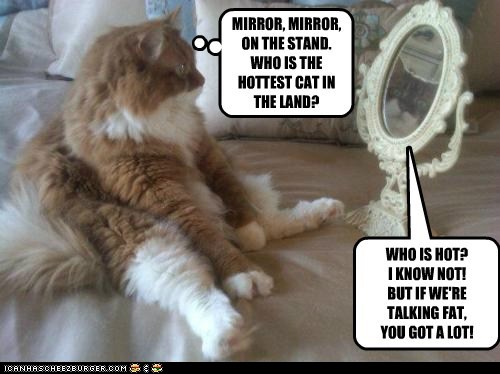
This cat, for instance, is sitting and looking into a mirror. His position is very atypical of cats and is closer to the posture of a person sitting. But what is more important is the text overlay that points to humanness: vanity, attractiveness, body image, and even self-recognition. These traits work in a way to humanize the cat and make it a body that matters because we can essentially connect with what the cat is asking – validity of attractiveness. The incorporation of body image (the fat) is also a reflexive way in which we think about other bodies because to be honest, hell, how can we say a cat is fat? Are there really standards by which we can measure animals in the same way we measure humans and try to denounce an average as an idealize weight? Do cats even have the same desires to compare versus other cats? I doubt this.
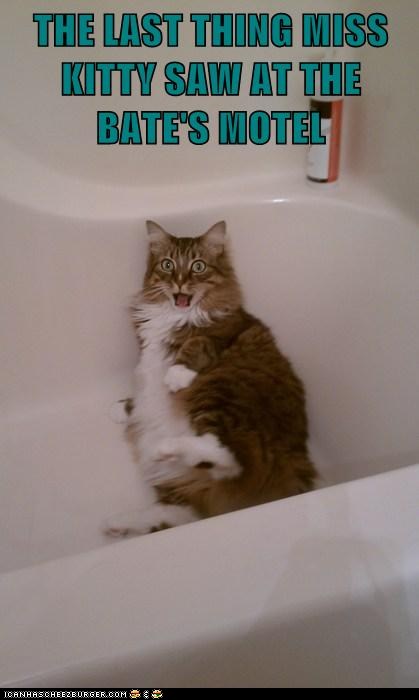
This cat I am using to illustrate the contextual clues that we apply to the bodies as if they are relevant even across situations. This cat is sitting in the bathtub probably mid-meow, but based on the assumed look of shock (fear? surprise?) we attribute to the look and the almost defensive looking pose, we situate the body in the same context as the woman from Pyscho who had been stabbed by Norman Bates. I think it is interesting the way we transpose the meanings of the body to read emotion and intent in the bodies that aren’t even of human nature. By this proximity, we are animating real life to construct a mindset that everything operates in the same nature that the human body does which is problematic. We cannot control or assess the intent of other bodies in the same way, but based on these situational clues, we try to read into images the same meaning we would if they were human – materializing the bodies through history and experience.


Or maybe I just need some more cats and accept my fate.
Henry Hyde’s Dark Legacy

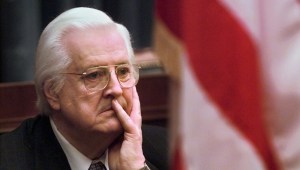
Henry Hyde (R-Illinois) had a remarkably long career of 37 years in the U.S. House of Representatives, garnering his fair share of damnation and praise, celebration and scandal.  He was a Republican from Chicago who kept getting reelected, which was an achievement unto itself. He led the calls for President Clinton’s impeachment trial, although it was later revealed that he himself had at least one extramarital affair.

History, however, will remember Henry Hyde for a singular amendment that he attached to an appropriations bill in 1976, which barred federal funds from being used to pay for abortion services for Medicaid recipients, except in cases of rape, incest, or when the life of the woman was endangered.  Hyde was staunchly anti-abortion- this amendment was his way of trying to limit access to the newly-legal procedure by closing off the federal purse strings for it.  The law was upheld as constitutional by the Supreme Court in 1980, and has been attached to every appropriations bill for Medicaid since.

The Hyde Amendment was the first major victory for the anti-abortion movement, and this new tactic became a popular approach across government.  The Hyde language no longer covers just Medicaid recipients, but also those covered by Indian Health Services, the Tricare program for active duty and retired military, and every single health insurance plan offered to federal employees, just to name a few.  Hyde was even the inspiration for the Stupak-Pitts Amendment to the recent Affordable Care Act, which further reiterates that anyone who receives health insurance from the federal government will be prevented from seeking abortion care except in the most dire of circumstances.

It is perhaps the ultimate mark of a patriarchal government to control so completely the reproductive lives of those who are most directly connected to it, be they a Medicaid recipient or a front line soldier.  What is perhaps the most shocking thing is the complacency with which the average American faces this fact.  The majority of the individuals involved here- the poor, minorities, government employees, Native Americans- are part of groups so vilified by the media and public sentiment that it took many mainstream reproductive rights organizations until the arrival of the Stupak-Pitts Amendment, with its much broader reach, to raise the issue on a national level and tap into public outrage.

Still, the fight against Hyde is not a popular one.  There is a sense that those who rely so much on the government should be subjected to its rules, as though they were living under the roof of a strict parent.  Smaller organizations such as SistersongINCITE! and the National Network of Abortion Funds (NNAF) continue to press for the repeal of Hyde as part of a larger reproductive justice framework, and they are starting to gain some traction among younger activists.  In April, affiliates of NNAF raised almost half a million dollars through dozens of popular fundraisers to provide direct assistance to women who cannot afford abortion services because their insurance (in whatever form) does not cover abortion services.  The rising need seems to be being greeted by a rising tide of activism.

Henry Hyde left us an unfortunate legacy that far too many have ignored. Here’s hoping there’s still time to reverse it.

Are you tough enough to compete with the guys??

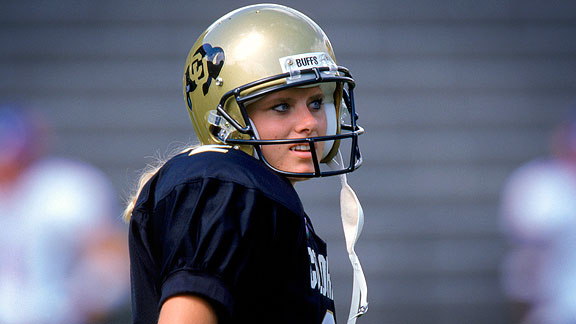
I was reading this article on espn discussing women trying to break the barrier and play football. when I started reading it I became excited that this is even a topic on espn because I know a lot of women who really enjoy playing this sport. Women who do play for a team that is not an all women’s league are mainly kickers for their program which is coincidentally the less contact position.

What I guess I don’t understand is why men feel they need to subject women as this delicate flower that will get crushed if they play football. there are very tough women out here who are even as tough as their male counterparts. Another thing that interested me is that their would be conflicts off the field if women were to play in the NFL. one thing that really stuck out was the lockeroom and how most of the bonding goes on their. even though that is true im sure the coaches and the players can find a way to bond with the opposite sex outside of the lockeroom, it has already been proven because men and women do it everyday. I don’t think that the lockeroom is the biggest situation so I think they are just trying to find ways to keep women out of the only sport that is male dominated.

another problem I have is when they discussed coaches telling females they can’t play football in high school because they don’t want them to get hurt. is that a stereotype or what i think if we were given the chance a lot of women can beat a man at any sport and hit and run with the best of them.

I guess with me being an athlete and playing football when I was younger, I just don’t see the problem with a female joining the sport