
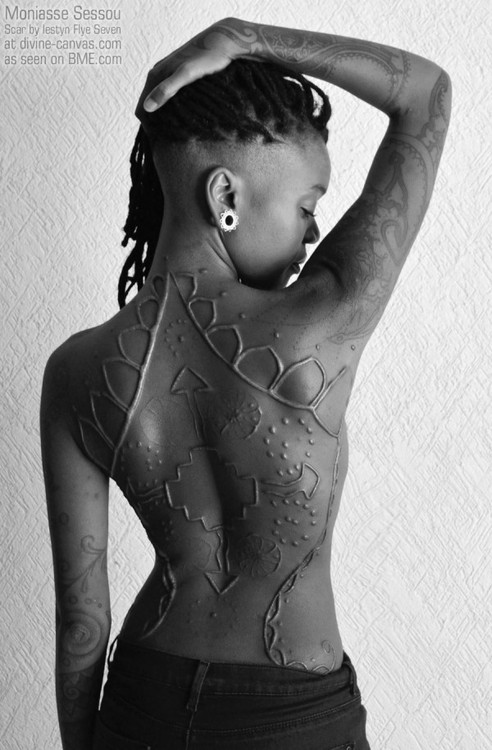
Scarification, the process of creating raised designs on the body by cutting, branding, burning, or freezing the skin, is a body modification practice widely unheard of (compared to the more popular practices such as piercing and tattooing) in the Western world. Its practice in the U.S., originally adopted by the gay and lesbian subcultures of mid-1980s San Francisco, was revived by the neotribal movement of the early 1990s in an attempt to create a more “authentic” aesthetic while also romanticizing exoticism.
TW: blood, mildly graphic description of scarification process
Due to the uncommon nature of this art form, finding a professional who is experienced in scarification practices is often a difficult task. Artists who specialize in scarification have seen a rise in clientele in recent years, however. Potential explanations for this recent increase in interested individuals are that scarification allows those who are unable to inject into their skin (i.e. military personnel) to modify their bodies, lets people create a piece of art out of existing scars, and allows body modification enthusiasts to try something new. Despite this apparent increase, many artists believe that scarification will continue to carry a negative stigma into the indefinite future, mostly due to the interpretation of scars as disfigurements. If this art form continues to spread and eventually mimics the popularity of tattooing, professionally-created scars could eventually be seen not as self-mutilation, but as self-beautification.
The process of scarification is not only done for aesthetic value; it could even be described as a spiritual event. Much like how Mary Kosut described “traveling to inner space” during a hook pull in her essay “Extreme Bodies/Extreme Culture,” individuals who have experienced a scarification procedure may feel as if they have reached a “euphoric state.” This is due to the immense rush of endorphins the body creates in order to balance the hours of physical stress it is facing in the name of art. Neotribalists reasoned that this state of euphoria made the “primitive” body rituals they were reenacting helpful in creating a stronger relationship with the physical body. In some West African tribes, scarification has social as well as spiritual meaning. Members of these tribes may display scarification pieces to symbolize significant milestones and/or social, political, and religious identity, much like how members of Western society may get tattoos for these same reasons.
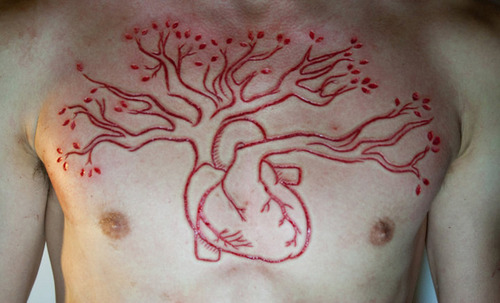
Personally, I prefer to admire the beauty of these unconventional body mods from a distance. I have a remarkably low pain tolerance, and just the sight of my own blood makes me queasy, much less the thought of little piles of my own epidermis after an artist performs a self-explanatory “skin peel.” In addition, my compromised immune system translates into a higher risk of infection during the healing process, so for me, scarification is not worth the potential hazard. My personal choice not to engage in this practice does not mean that I find those who enjoy scarification are inherently wrong, however. The act of intentionally having a near stranger cutting into my flesh for an extended period of time does not sound like fun to me, but as long as the individual undergoing the procedure is willing and able to consent to it and understands the consequences that it entails, who am I to say that their view of what is beautiful is criminal?


Working at a restaurant I can relate to how scars have a social meaning. Where I work you have to stick your hand in a bread oven thats set at 375 all day. If you reach to far it and flinch or even worse get stuck you can end up with a pretty nasty scar. You can usually tell who’s been there the longest by the number of scars on their arms. It’s almost like our battle wounds at work!
I can not handle pain such as intentionally scarring your body. I often find myself thinking how someone could handle such an endeavor. I often see people with tattoos all over their bodies and marvel at their bravery for having a stranger poke a needle into their skin. How can someone destroy your own skin like this? But as you said, “Who am I to say that their view of what is beautiful is criminal?”
I have both of my thighs tattooed, a sleeve, and half of my back tattooed so I’ve been exposed to scarification before. However, I learned a lot from this post that I never would have thought about. For me getting tattooed has a deeper meaning that makes the temporary physical pain worth it. For example, my sleeve is a dedication to my struggle with depression 2 years ago. It is so worth the 16 hours I’ve spent getting tattooed because now its a source of pride for me instead of shame.