
At the beginning of this class’ section on disability studies, we created a list of a variety of disabilities that may or may not be recognized by society. We listed the ones most people think of, like physical and mental disabilities, but when we began talking about “invisible” disabilities, something struck a chord in me.
TW: Blood mention

An example of an ostomy bag.
I have Ulcerative Colitis and Celiac Disease, both autoimmune diseases affecting my digestive tract and ability to absorb nutrients. UC (short for Ulcerative Colitis) is when your immune system attacks your colon and rectum, resulting in bloody ulcers that can occur solely in your lower colon or throughout the large intestine. UC is treated through a variety of medications that compromise your immune system even further, and if these do not work, part or all of of the colon may be surgically removed through a colectomy or proctocolectomy, respectively. Those who resort to this option may live with an ostomy pouch that collects their internal waste for a relatively short time and then have a “J pouch” implanted to mimic the removed intestine, or they may have to live with this bag for the rest of their life. Luckily for me, my disease was responsive to the variety of medications I was prescribed, and I’ve been in remission for about 2 ½ years. Celiac Disease, on the other hand, causes the ingestion of gluten to act as a poison and erode the villi in one’s small intestine. The only treatment for this disease is a gluten-free diet. Because the villi are unable to produce lactase when they are blunted, lactose intolerance is likely to occur in those with Celiac Disease. I am one of those with this condition who experiences this phenomenon.
I have heard of my conditions being referred to as “invisible illnesses” because of their physically internalized nature and the “embarrassing” consequences of diarrhea and flatulence they entail, but I have never thought of them as disabilities. Even when I was at my worst during my senior year of high school, going to the bathroom upwards of 15 times a day, having to wear a diaper to bed, and suffering from chronic pain and fatigue, it was just another part of life that I learned to cope with. Now that I realize how much of a difference being in remission makes, I can see how UC and Celiac Disease affected my relationship
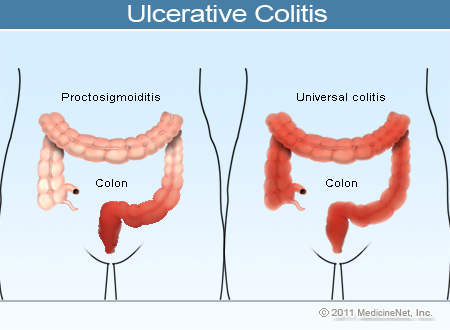
When I was first “scoped,” my colon looked like the one on the right.
to the “normal” world around me. I couldn’t focus in class because I was always in pain, tired, and constantly thinking about the next time I’d be able to run to the toilet. I seemed flakey when making plans with friends because I frequently canceled in order to get some rest. I pushed myself too hard sometimes so that the people around me wouldn’t think of me as lazy. My mother, who also has UC, had to intervene on occasion because of my intense self-criticism. Although staying in bed all weekend seems like fun for some people, it was torture to me because I have a stereotypical Capricorn’s personality. Lying around in my pajamas made me feel like a “sick person,” a label that I was constantly trying to fight. I wasn’t one of those kids staying in the hospital for weeks on end, having multiple surgeries and walking around with an IV permanently stuck in their arm. Only sometimes would I admit that I was really sick, like when my mother occasionally broke down over passing along her health issues to me, when I explained my conditions to others, when I started seeing blood when I went to the bathroom, or when I was given a crocheted blanket and stuffed animal after a procedure from an organization that I had made a donation to only a year prior. Despite the gravity in these moments, I felt a sick pleasure that I was somehow “special” because of my health-related difference.
I never considered the spectrum of disability that one can experience over a lifetime until our class’ discussions. Although I don’t actively experience the effects of my diseases like I did three years ago, I still have to be aware of my illnesses and take preventative measures through my diet, the seven different medications I take every day, and the amount of rest I require. My experience with my disease has necessitated that I quickly develop an intense relationship with my body that some may never have to cultivate, but in the long run, this supremely conscious embodiment has provided me with the tools to prevent and detect a detested “flare up” before or when it happens.


This is a really great post. As missmisandry wrote a few days ago, our mom has Chronic Fatigue Syndrome, which is an invisible illness. Even though I recognize the fact that CFS has often dictated what she can and can’t do and where she can and can’t go, I have never thought of her illness as a disability. After our discussions of disability and invisible illness, I’ve been left with a weird sense of cognitive dissonance, and I think your post has done a really good job of addressing/articulating the varying degrees of disability one can experience.