
I think it’s safe to say that our society has a pretty ridiculous obsession with breasts. Breasts are shoved in our faces all the time—through screens, billboards, pages of magazines, what have you. They have become something of a paragon of beauty in our society; so many women today are dissatisfied with their natural breasts and go to great lengths to have them molded into “beautiful” breasts. I don’t know if we ask it enough: Why does our society put such a premium on breasts?
Many women I know are baffled by the appeal that breasts hold. I have often heard women respond to qualifying or sexualizing comments about breasts with statements such as “Why do people care what breasts look like?” or “What is so sexy about breasts? They’re only there so we can feed our children” or, my favorite, “They’re just sacks of milk.” *shudder*
I get the biological retort; it is a bit silly that we’re essentially sexualizing our udders (gross, but true). But at the same time, I can see how they came to hold the power that they have. Breasts are life-givers, really. They are how we provide for our offspring. No matter how many modern advancements are put forth in child care, the essential bond between a mother and child will always be associated with the act of breastfeeding.
So this begs the question: does the power of breasts only lie in their ability to “function”? Are breasts only glorious and powerful if they can nourish a child? I ask this because there is a strong possibility I will not be able to breastfeed my children.
Neither my mother nor my maternal grandmother could produce breast milk. In the past, I hadn’t thought of this as a big deal. In fact, in my own immature way, I thought of it as being kind of a good thing. My mom and grandma were able to avoid the “pains” of breastfeeding and I might be able to do the same. But as I get older and continue to form a clearer concept of what breastfeeding means in our culture, I feel more and more saddened at the prospect of not being able to feed my child with my body. And my mom’s story that I used to not think twice about—her sitting in a hospital bed holding my sister and struggling to produce milk, while the new mothers around her fed their babies effortlessly—now makes my heart sink.
The classic image of mother and child, of an infant latched on to its mother’s breast, connected to her, is one that we see often, and we associate motherhood with this image in a big way. So how must my mother and grandmother have felt when they could not live up to this culturally-ingrained and time-honored image? My mother has never fully expressed how her inability to breastfeed made her feel; I can only remember a statement she once made that she felt like she had done something wrong, that she felt like a “bad mother.” I don’t know this feeling and I’m uncertain if I ever will, but I know that my mother, despite her inability to breastfeed, did not fail to forge a strong bond with her children. I never breastfed, but was still able to connect to my mother, feel totally loved by her, and somehow fit into that classic mother and child image.
Our class’s disability unit got me thinking about the history of breastfeeding in my family. I know that the bodily disabilities we have discussed in class can impact people’s lives in a much more totalizing way than the inability to breastfeed, but I saw similarities in the cases—when your body doesn’t do what it’s meant to, what society expects it to, and what you expect it to, it’s easy to harbor feelings of inadequacy and shame. It has to be devastating to sit in a hospital bed with your newborn baby and already feel like a bad mother because of something your body cannot do. I suppose the fact that both my sister and I have a good, close relationship with our mother is proof that breastfeeding as the “ultimate connection” between mother and child is not all it seems. Our relationship with her did not depend on functioning breasts (and none do), but on love, attention, encouragement, and compassion. It’s like with any case when one’s body does not function the way it is meant to; one finds strength in other places.
So if a woman can successfully raise children and form strong relationships with them without having that ability we so associate with motherhood, maybe the “power of breasts” is all an illusion. Maybe it doesn’t matter how a woman’s breasts function, but how she herself functions.
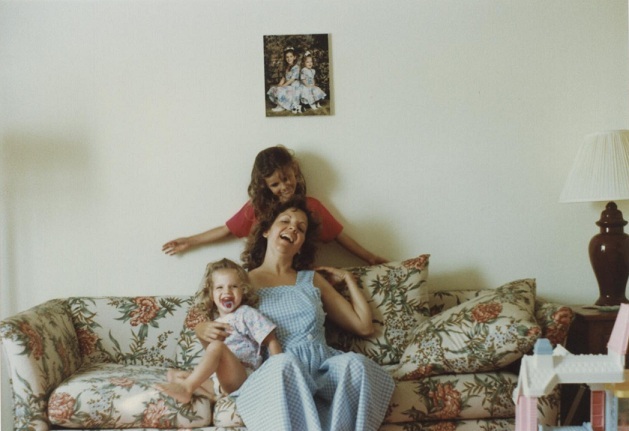
My mom, my sister and I—bonded regardless.


The idea of breasts being a notion of beauty used to baffle me as a kid, but now that I am an adult I tend to fall in to that ridiculous notion. Breasts are used to feed our offspring, not just with humans but in animals too. So why do we find the need to sexualize such an important part of women’s bodies? I feel that these notions of beauty are created for the soul purpose of creating jobs. Think about it. When people get an idea of what is considered “beautiful” they want it. Like breasts, whether women want big or small breasts, they go to a plastic surgeon. This is a result of a consumer society.