
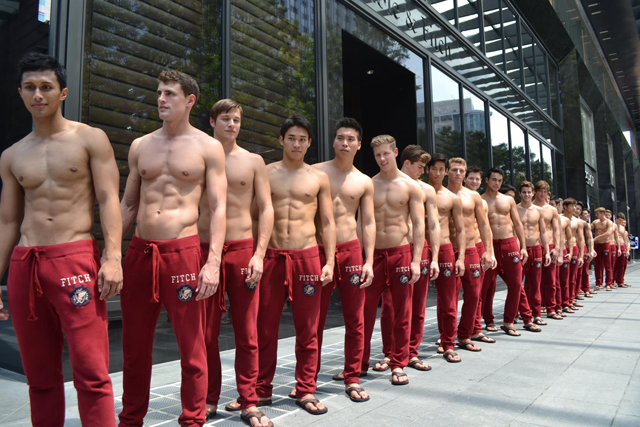
I remember in high school that it was “hot” for both guys and girls to have “abs” especially a “six-pack”. It was especially attractive if a guy or a girl had abs at all. It was almost like a major plus. I remember having conversations with my male classmates and they would often talk about going to the gym just to get “abs” so that they could get more girls to notice them and be more sexually attracted to them. However, it seemed to me that they also wanted to get “abs” just so that could feel better about themselves and their own body. It was almost as if they would feel more comfortable in their own skin if they had “abs”. One of my closest friends in high school had “abs”. My friend loved her “abs” because many guys thought that her abs were “hot”. She would always talk about how her abs really turned guys on when she would have sex with them. Having other guys express their excitement and arousal towards her body and her “abs” really made her feel good about herself. It often makes me wonder if those same guys would feel the same if she did not have “abs” and her stomach was just flat.
In our society and culture, a man or a woman who has an “athletic” body with abs is believed to be the most attractive, desirable, and “ideal” body. Lets face it, abs are pretty sexy but we don’t all have abs. All of our bodies are different. So for the people who don’t have “abs” how should we feel? Should we all get “abs” just because our society and culture deems them be sexy and desirable? Or should we all have the right to feel comfortable with our own bodies whether we have “abs” or not?
It wasn’t until fairly recently that a new beauty trend began to rise within American culture and that is the “V” muscle. The “V” muscle is a diagonal muscle line around the hip and forms between the legs, torso, and leads towards the crotch. It is also a muscle that both men and women can have. However, the “V” is a beauty trend that is more focused on the male body. This made me think about Jean Kilbourne’s documentary, Killing Us Softly 4. In documentary, Kilbourne briefly talks about how she began to notice a growing trend of images of men’s bodies slowly starting to become objectified in various ads just as images of women’s bodies have been objectified in our society and culture for decades. In Abercrombie & Fitch ads, every male model has both “six-pack abs” and the “V” muscle. I looked online and there is even a “How to Guide” for men to get an Abercrombie body! Am I the only one that thinks this is crazy!?
I have also began to notice within the past year or so that more women and even men find the “V” muscle to be insanely sexy. This past summer, while playing tennis I heard a girl outside the fence of the tennis court talking about another guy playing tennis shirtless, and she said, “Omg he is so hot! I love his “V” !”. I think that because of ads from very popular and profitable clothing companies such as Abercrombie & Fitch, that we as a culture have become so obsessed with “abs” as well as the “V” muscle. It’s not very surprising that last year, the CEO of Abercrombie & Fitch made controversial comments in an interview stating that he didn’t want “fat” or “not so cool” kids wearing his company’s clothes.


I’ve heard those “V” lines referred to as “penis pointers,” which makes me giggle because I’m secretly twelve, but also might be a factor in their attraction.
I like that you put “abs” in quotes because of course the abdominal muscles themselves are a standard part of human anatomy but it’s only a particular configuration of them that calls our attention to them.
To me it’s strange from a marketing perspective why a CEO would want fewer people buying their clothes? I understand the concept of creating an aspirational “Abercrombie body” for the masses to covet, but I thought the point of aspirational consumerism was for more people to pay more money for your product because of the status it’s perceived to confer?
Personally, I absolutely loved it when my significant other had the “v”. It was like a sign on his body screaming, “Ravish Me!”. But I think the obsession with the “v” is similar to a fad. It’s unnecessary to put in so much time and effort in order to obtain something that is mainly for appearance. I notice that people who go through such “extremes” with dieting and exercising, do it for the status symbol- so that they can be one of those *special* people who have a six-pack or the “v”. If someone is in constant need of external confirmation, it’s not surprising they will feel pressured to achieve the “ideal” body or “perfect” body.
The name is new, the concept is not. It is sometimes called ‘Adonis’ Belt’ because they feature prominenly in greek sculpture seeking to idealise the human form. That’s anicent greek, meaning that people were obsessing over it well over two thousand years ago.
Abs and the V difficult to achieve because bodyfat tends to accumulate in those areas first. If you eat too much chocolate, your body will store the unused energy all over the body, but not equally. However much you eat, your elbows or the bottom of your feet will not get very fat. But your stomach and thighs will, very quickly.
This is why these areas are so noticable. Showing abs essentially guarantees you have less than around 10% bodyfat and probably less than that. If you are at that level, as long as your muscles are somewhat developed, you are probably quite fit. Therefore, showing abs or a V is a good general indicator of fitness.
Fitness is a powerful attraction because biologically we are hardwired to find fitter, healthier partners in the hope our children will share some of that health.
That’s why these areas are important. They are not a fad. This article needs more research – did you actually try to find out what was actually seen as physically attractive decades or centuries ago? You don’t seem to offer any evidence other than ‘I remember it being different at school’.