
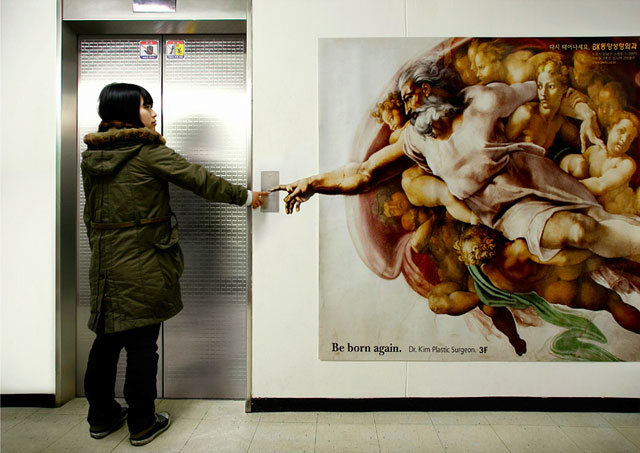
I was sitting out on my grandma’s porch when she decided to tell me that I would apparently look perfect if I got double-eyelid surgery.
My grandpa, dad, and mom were all there as well, but they just shrugged it off. A comment like the one my grandma had just made did not come off as strange or out of the ordinary to anyone, including myself. So I just smiled, nodded, and sipped my tea.
It only recently occurred to me that the casual nature of this conversation could be perceived as something “extreme” within the context of our readings on “extreme” cultures and body projects. But the fact is that many South Korean people are not inherently happy with the way they naturally look, and their appearances are essentially perceived as projects that constantly need to be edited and improved upon. Mono-lids (note: this is the lack of a “crease” or fold on the eyelid; most white and black people have these, and within Korean circles they are commonly referred to as double-eyelids), noses lacking a prominent bridge, and rounded, almost circular faces are the most common physical features among Korean people. It is these same features that Korean people often request to have operated on in order to achieve a more “marketable,” Westernized look.
As a child, my parents actually told me that if I was unhappy with the way I looked, I could easily change my undesirable features when I was old enough to get plastic surgery. So I would periodically update a mental list of things I could potentially fix through plastic surgery, since, like most growing girls, I struggled with my own fair share of body image issues as I progressed into adulthood: rhinoplasty to fix my “overly prominent” nose, a jaw shave to further elongate my face and define my chin, and of course, double eyelid surgery to make my eyes appear larger.
But something about the way many of the Korean girls I grew up with had re-defined themselves through plastic surgery was unsettling for me. In all honesty, I have a hard time telling them apart, since they were all pressured to change the same things to fit the same beauty standards. Personally, I’ve learned to love the unique qualities that I kind of despised throughout most of my childhood and adolescence, and I don’t feel the need to “fix” them through a series of invasive operations (in fact, as an aspiring physician, I am actually much more interested in performing plastic surgery than I am in having it done on me…but more on that some other time). Nowadays, I am a lot more comfortable with my face, as well as my body, and I do what I can to “cultivate my garden” I suppose. I exercise, I (try to) eat healthy, and I’ve grown to accept my somewhat square-shaped face, my abnormally (at least by Korean standards) prominent nose, and my eyelids. Frankly, even if I may not look as perfect as my family thinks I could be, I’m happy enough with my appearance that I no longer feel the need to keep that mental list anymore.


I found this highly relatable. It was definitely difficult growing up with monolid eyes and other ethnic features, especially in a predominantly white/black area. When I think back to elementary school, even kindergarten, I can still remember when kids would pull the corners of their eyes back and click their tongue, shout “ching-chong” and other gibberish at me when they saw me. They thought it was funny. They still thought it was funny in middle school. Same shit, different toilet. Eventually, they grew out of the blunt, in-your-face mocking, into something a bit more subtle, deniable, and arguably more hurtful. And you know what? That sticks with you, the feeling of being undesirable and ugly, and having a target painted on your back just because you looked different. Even when you grow past that point, and become confident in who you are and what you’re worth, you’ll still remember the days when you learned what it meant to be a “chink”. I’ve grown fonder of my eyes, my features–but there are still days where you feel like the ugly little kid in the back, just wishing they could look like the other kids.
Thank you for sharing this! I can definitely relate to this and I think this is a common problem amongst a lot of minorities (whether the dispora communities or the local ones). For me, I moved to America when I was starting puberty (it was bad timing in hindsight) and I was so confused and almost horrified when I realised how radically different I looked from the white girls in my high school. Being an Arab (especially one who’s half-Egyptian), we’re known for our curves (since Egyptian girls are typically the most vivacious? of the region). I struggled with this for so many years because I couldn’t understand why my body didn’t fit the American/Western typical female body. It took me years, and I mean years, to finally realise the reason I didn’t look like these girls is because I’m not them. I’m not white, not Western, none of it. It took me even longer to fully re-emerge myself into my culture and meet other Arabs again to finally be comfortable with my body because seeing them, seeing girls who looked like me, ate the same food as me, had the same culture as me, etc made it so much easier and more comforting when I was going through my mental process of figuring my body out. Eventually I ended up not only becoming comfortable but truly loving my body, my curves, all of my “ethnic” features that make me more Arab.
There are numerous ethnic groups and individuals overall that are constantly attempting to obtain a feature that the to not naturally possess. And I often wonder what are the perfect characteristics/ features. Africans want Brazilian hair, white women wan to be tan and have full lips while African American women are constantly trying to shrink theirs. Their are features the every ethnic group should be proud of, and I hope that we wil all be able able to appreciate.
I also have grown to appreciate abe be comfortable with my body. While growing up I have always had extremely full lips. At the time I didnt appreciate what I was born with because my peers were so different