
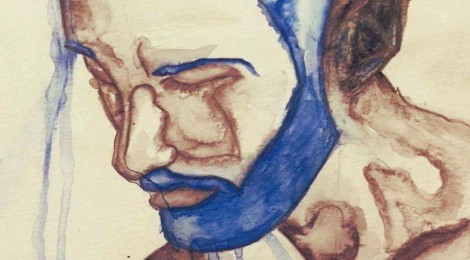
Image Source: http://trauma.blog.yorku.ca/2015/12/south-asian-queer-community-lacks-visibility/ (Artist – Jinesh Patel)
(Content and Trigger Warning: Self Harm, Suicide, Substance Abuse, Emotional Abuse, Intimate Partner Violence, Bullying)
.
.
I often find that mental illness and queerness aren’t addressed properly or constructively when talked about together. So often the public at large would have us believe that queerness is a result of mental illness or that mental illness is the result of queerness exclusively. With this in mind, the queer community will often push back on society’s behavior by talking about the two exclusively from each other, frequently ignoring all the ways mental illness intersect. That’s does not go to say that queerness is the result of mental illness or vice versa at all, but rather it shouldn’t be ignored that many people in the queer community go through both because of the way society has constructed and reacted towards queerness. For example, queerness has often been perceived as a deviant thing, it has historically been punished and worked against in a variety of ways. The way society punishes queerness (see: bullying, micro aggressions, conversion therapy, erasure, verbal and physical violence, institutional oppression, etc. etc.) can have a profound effect on someone’s mental health by invoking internalized phobias, depression, anxiety, personality disorders, paranoia, dissociation, suicide, OCD, inferiority complexes, etc. Further symptoms that can snowball and create a feedback cycle of hurting one’s mental health that often intersect with the queer community include but are not limited to poverty, low or no income, high risk jobs, hunger, substance abuse, intimate partner violence, emotional abuse, self harm, etc.
To give [a couple] personal examples:
- A large portion of people in our society, including most of my family, either thinks transgender identities are a farce or equate them to being a mental illness. This created a delay in realizing who I was, it has made me dislike and hate being trans in the past, it makes it more difficult to be accepted as a trans person in my personal life and in my academic/career oriented life, etc. etc.
- society’s creation of the gender binary and the construction of hegemony directly contributes to my gender dysphoria as a transmasculine person.
As someone who experiences most of the symptoms, conditions of living, mental illness, etc. listed in the first paragraph I’m not going to sit here and say society’s reaction to my queerness to it is the sole reason for all of my problems, or even the sole creator of some individual problems within my state of mental health. BUT the conditions of my life that I face because of my queerness directly and profoundly affect my mental health, my mental illnesses, and the symptoms of them. When I or someone else dismisses this fact it only deals more damage to me. This reality is crucial to recognize if I am to address these obstacles I face as well as I can and I don’t want to neglect the intersection of my mental illnesses, my mental health, and my queerness; they are parallel to each other and exist in the same plane of reality that is my life.


This definitely makes a good point on how we structure these identities as sepereaye from each other or when talked about it’s seen that queerness is a mental illness or being trans is a mental illness. I can see how these identities don’t get talked about properly because we are leaving out an important factor when these topics are being talked about which is, who’s bodies are these information coming from. We see mental problems coming from white, CIA bodies and queer problems coming from more white bodies. There is a lack of intersection of identities when these issues are being spoken about. It’s like these problems don’t exceed beyond white bodies but whiteness is the creation of all thing destructive to bodies. I guess it kind of contradicts how white bodies can still be queer because there are other parts of them like gender that may fall under the queer category. Mental health issues are rarely spoken from bodies of color but we are the ones who suffer the most. The lack intersectionality from mental health and queerness does effect each other but when the bodies are contradicting the meaning it can be hard to understand.