
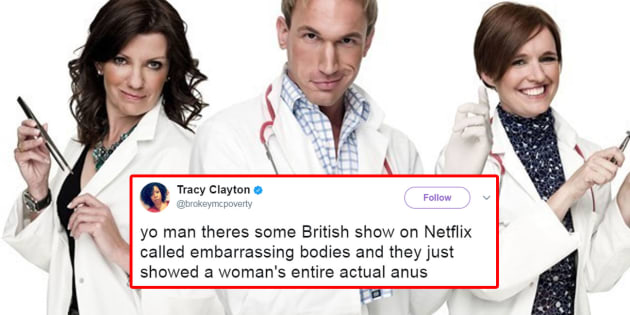

Netflix now carries the British series: Embarrassing Bodies, a show about three doctors who travel through Britain, opening pop-up clinics for passersby seeking cures for a wide array of ailments or deformities. The show documents one-on-one consults, large group Q and A sessions on specific health-related topics (these are often set in schools, pubs, or other common public gathering places), street interviews on topics such as “baldness” or “boobs” and exhibits set up outside the medical tents where people can learn more about the inner workings of the body. All of these interventions are designed to make people less worried about their bodies, while setting up expectations about what is “normal” versus what requires medical intervention.
It is hard to think of an American equivalent of this show, though there have been other international spin-offs: Wikipedia lists Embarrassing Bodies Down Under, Dit is mijn lijf (This is my body) in the Netherlands and the strikingly named Я соромлюсь свого тіла (“I’m ashamed of my body”) in the Ukraine.
A Daily Beast article, written now almost nine years ago, suggests that there could perhaps be an American version of Embarrassing Bodies lurking around the corner, but Americans don’t seem likely to develop an appetite for this much reality.
Read the Daily Beast article here
In the article, one of the show’s doctors provides reasons why a person might appear on the show (with no payment, only treatment on offer). Dr. Jessen states: “Some haven’t got anywhere with their own doctors…others genuinely want to raise awareness and help other people.” Both of these suggestions seem viable, though it strikes this casual viewer that most participants act on more universal motivations, hoping to escape pain and isolation. I wonder if Americans, so typically starved for fame and notice, would be able to overcome the cultural mores about exposing their human bodies for a show like this, even to counteract physical discomfort and loneliness.
“If you’re squeamish, look away now.” So says the show’s narrator, on a fairly regular basis. Having taken a cursory look at the motivations of the show’s participants, it next makes sense to wonder about the show’s audience. Is there a certain amount of sensationalism or voyeurism involved in selecting this show, or can you really learn more about your own body and become more comfortable in your skin after watching the experiences of others?
People’s conditions and accompanying graphic surgeries take the viewer into what Mary Kosut calls the “interiorized body” that Americans would normally encounter in CSI or a similar forensic evidence- based crime show or a “body project” show like nip-tuck. Americans are used to going in for proof and improvement, but to have a more universal experience of the human body, as people get dental surgery, have warts removed or get pelvic exams? This may still be quite cringe-worthy.

After all, Americans are hoping for the kinds of outcomes that Kosut describes as “spectacularized bodies” which undergo an “extreme transformation.” That is not the goal here: people sometimes present a different appearance after treatment, but mostly they gain confidence and seem better able to co-exist with their bodies.
For all the pros—and undoubtedly are a host of them—of this show, it is striking how similar it is in construction to Rosemarie Garland Thomson’s description of the American freak-show of the nineteenth through mid-twentieth centuries. In her work on disability studies, she draws on the stories of the “freak” and the freak-show as part of the cultural narrative of disability in America. She notes:
“Together, the staging, the pitchman’s mediating spiel, the scientific testimony, and the written narrative fixed the mute freak as a figure of otherness upon which the spectators could displace anxieties and uncertainties about their own identities. Embroidered by such elaborate conventions, the sideshow freak was made to exceed wildly the common, familiar expectations set by the spectator’s own ordinary body.” (Garland Thomson, 61)
Two of Garland Thomson’s categories “the pitchman’s mediating spiel and the scientific testimony” are covered by the Embarrassing Bodies’ narrator, who spews stats, cheeky banter and very practical instructions. Though the show is resolutely medical, the language is not: “check your balls at least once a month” is advice provided by the narrator in Season 1, Episode 4.
The doctors themselves also fill the functions of “pitchman” and “scientist.” Out in front of crowds, sometimes wearing exaggerated costumes, they pander and amuse, as pleasant medical court jesters. In moments of direct camera address, they teach about disease, encourage healthy habits and even try new medical tests on each other.

There is no “written narrative” in the sense that Garland Thomson describes, where illustrated pamphlets were sold to give the life story of each freak in the show. Having said that, though, the show does weave a narrative for several of its patients—showing the towns where they are from or their workplaces, homes, families and “backstories.” It would make for an interesting cultural studies project to track which patients of the literally hundreds profiled receive this sort of narrative expression. Are the “stories” saved for the real oddities?
What Garland Thomson calls staging is extremely important: there are multiple modalities here, from on-the-street interviews, crowd engagement with exhibits, group Q and A’s and the curtained off pop-up clinic to which the observer is given access to “private” consultations between doctor and patient. All of these different styles of engagement help to normalize every new human variation you encounter. This is in marked contrast to the cage environment of the freak-show, where difference between us and them is drawn as starkly as possible.
Ultimately, although the show does make use of the strategies of the freak-show, the staging itself provides the real insight into the social meaning for this media event. In this version, everyone is a freak! This show never seeks to create an othering effect; it relentlessly stresses a universal continuum where all of us experience confusion, pain, embarrassment, frustration with our bodies and all of us can find peace and healing (with the help of medical professionals, it must be noted).
Paradoxically, because of this universalizing impulse, in the few episodes I’ve seen, there have not been patients who experience what are more traditionally thought of as disabilities or chronic illnesses: autism, spinal problems, motor-difficulty, blindness. I have yet to see a patient enter the tent who would need any sort of interpreter or new communication strategy to be able to interact with the doctor. And, of course, it would seem like terrible optics to imply that a person with a physical impairment was possessed of an “embarrassing body.” Is the show as inclusive as it really should be then? Did this program really do much more than isolate the freaks even from the freak-show? Their universal continuum is missing a bunch of people, and that’s more than a little embarrassing.


I have to say, its a good show! I enjoy learning about different conditions!