
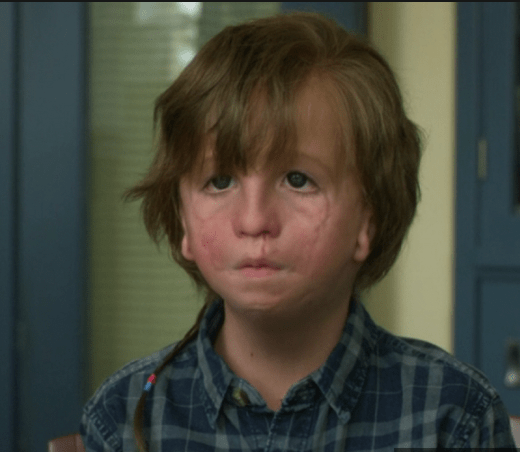
This is the main character (Auggie Pullman) from the movie/book Wonder. He was born with Treacher Collins syndrome. It is described as a “rare craniofacial disorder that causes major malformations of the face.
I remember reading Wonder when I was in about 4th grade. When it first came out, I fell in love with the writing. I admired the new perspectives the book offered on disability that wasn’t usually addressed in school and kid/preteen literature at the time. For those who haven’t read it, Wonder focuses on the life of a disabled young boy named Auggie. It depicts the trials and tribulations he experiences going to public middle school for the first time and how it affects him and the people around him. A few years later, they made a movie. I watched it and loved it. Well, when I was younger.
I later watched it again around the age of 17. I can still say I enjoyed it but I did have my critiques, as did others. I felt like it stayed true to the book, and captured the complexity of relationships. However, in my opinion, I do feel they do not authentically represent the severity of Auggie’s disability in the movie regarding the makeup and script, making it more comfortable for people who weren’t disabled. This is a critique many others share, explaining why the movie got much lower ratings and lots of criticism, especially from other people in the disabled community. I think these critiques propose an important question, “At what point do decisions make about the presentation of disabilities within society reflect an ableist viewpoint?”
This is a question that is explored by many people and has a different answer from person to person. One article I think that gives a very important viewpoint on this topic is Critics Question the Representation of Disability in ‘Wonder’ written by Lauren Barack. She focuses on the perspective of Mike Moody. A 21-year-old female who was born with Crouzon syndrome, a disability very similar to that of Auggies’. With that shared experience, he expresses his discontent with the representation of disability within the movie. She discusses how she disliked how directors had “Tremblay appear disfigured, instead of hiring an actor who is.” She goes on to further criticize the film by saying “The film just seems to hop on the bandwagon of disability. It’s ‘inspiration porn’, the same driven by films like The Theory of Everything—films that treat disability as a costume, that kind of attitude permeates through the films to the audience. Actors who portray disabled people are revered, and disabled people (especially actors) are ignored.”
Though it can be seen as “harsh” this critique Moody expresses is one that many people agree with, including myself. Seeing the drastic changes in Auggie’s disability in the book versus the movie does make me question the underlying ableism within the production. It also demonstrates the constant fucked up reality that people with disabilities constantly have to face: having to change and diminish themselves for the comfort of others.


Hey ItsBigDogYuh,
Just dove into your post “Underlying Ableism found in Creative work” and let me tell you, it’s more eye-opening than my first espresso shot this morning. Your take on ‘Wonder’ and its Hollywood makeover is as sharp as the edges on a LEGO brick (and we all know how much stepping on one of those hurts).
Reading your childhood love for ‘Wonder’ took me on a nostalgia trip, like finding a forgotten toy in the attic. But then, your critique of the movie adaptation? That was like realizing your favorite toy is actually a knock-off brand. The way you described the film’s handling of Auggie’s disability is like putting ketchup on a gourmet burger – it just doesn’t sit right.
Your point about the makeup and script making Auggie’s condition more palatable for non-disabled viewers hits the nail on the head. It’s like the film industry put on those rose-colored glasses and forgot to take them off. And the point about hiring an actor who doesn’t have the disability? That’s like casting me as an Olympic gymnast because I can touch my toes – it just doesn’t make sense.
Mike Moody’s perspective, as you shared, is the kind of unfiltered truth we need more of. Calling out ‘inspiration porn’ in movies is like calling out someone who brings a store-bought pie to a bake sale and claims they made it – we all know what’s really going on.
Your closing thoughts about the “fucked up reality” that people with disabilities face? Spot on. It’s like the world is trying to fit square pegs into round holes and wondering why it doesn’t work. We’re basically watching a play where the script was written by someone who skipped the rehearsal.
Keep up these razor-sharp critiques, ItsBigDogYuh. Your blog is turning into my go-to read for a dose of reality, served with a side of wit. And who knows, maybe one day we’ll see a movie adaptation that doesn’t need a Hollywood filter to be relatable.
Stay bold and keep those critiques coming,
Nicole