http://performativediscipline.tumblr.com/
This is a link to the tumblr I made for my research project, as Kate requested!

http://performativediscipline.tumblr.com/
This is a link to the tumblr I made for my research project, as Kate requested!
One of my closest friends is a fashion stylist. She chooses outfits, hair, makeup, and general looks or moods for photoshoots for natural makeup companies and independent designers. I have modelled for her in the past even though I am not a model and don’t look like a magazine model. I also model for my own Etsy store, selling vintage clothing. My friend has had eating disorders since puberty and I have not. I feel that her eating disorders are a sign of privilege and she feels that my “poverty genes” and post thyroid cancer synthetic metabolism are a sign of privilege. The arguments are frequent and comical.
I feel that it would be insulting to her profession and life’s path to say that her involvement with fashion feeds her disorder, so I often try to tell her eating disorders are a result of a sexist, competitive capitalism, a first world problem, and that if she stops aestheticizng the super young and super thin, wheat colored waify girls with vacant expressions, she won’t hold herself up for comparison to them. I tell her to keep her job but change her aesthetic, make it weirder, and I tell her she’s a misogynist. Then I go on like a hypocrite and smooth out my hair, put makeup on, and have my boyfriend shoot photos of me for Etsy, to make money. And I do make money. But recently, editing and cropping photos of myself, I feel like I look OOLLDD. So I call my friend and ask her for a disorder that will make me less old, less short, less frizzy, less dark, less tired. And there isn’t one. I’m really not sure what I’m aestheticising, but even though I’m perfectly happy with my weight I still feel the need to critically tear apart whatever I can about my own image, down to my assymetrical smile or uneven hair texture or slightly more almond shaped right eye than left one. Little little minute stupid details. All while knowing that I’m making this image public by my own free will, by my need to pay the bills and put gas in my car to get to school. Because those waify wheat colored girls are out there, and my tiny little capitalist enterprise is knowingly in competition with them, and growing up in the 80s and 90s, between Debbie Gibson and Kate Moss, I never felt that my features were pure or innocent, only exotic and “olive olive olive”, and now getting older.
Can a woman be this self-critical and also be a feminist?
At some point this semester I began screaming at my boyfriend, “I don’t have time for a body!” I was having a pulsating migraine, my skin was breaking out, I had had no sex drive for weeks, and had an endocrinologist appointment and blood test the next morning prior to three classes that day. I was having an anxiety attack at 1a.m.
Everyone says college is stressful. I have found that no longer having the body of a twenty year old makes it exhausting. Running around a hilly campus, trying to get to class on time, parking about a mile from any buildings. All of this physical activity is also time consuming, adding stress to days packed with classes, work, homework, making dinner, buying cat food, paying bills, keeping in touch with friends and family, attempting to relax, and trying even harder to sleep. I often find my inner dialogue about stress going something like: “It’s because I’m a woman” or “It’s because I’m not upper middle class.” I have many found my stress triggers to generally be gender or class oriented.
I found the following documentary on stress very interesting. The director, John Heminway posits stress as not only as detrimental to mental health, but as someting that can kill the body over time through exposure to dangerous levels of stress hormones. It also argues that stress levels are relational to class structure, with lower rung workers experiencing higher, and more deadly, levels of stress hormones. The documentary follows Stanford University Neurobiologist Robert Supalski in his studies of stress hormone levels of baboons in Kenya. He measured both adrenaline and glucocorticoids in these baboons and found differing levels according to the gender and social class of the baboons. The non-alpha males have higher stress hormones than the alpha males. When most of the alpha males died off due to tuberculosis infection, the stress levels of all the other baboons in the group went down. This documentary is very much worth watching, I believe all parts of it are on youtube and hope you can check it out.
As a child, people often asked me or my parents where we were from. Was I Iranian? Jewish? French? In eighth grade a boy told me I had “negroid” eyes, and for most of my adolescence I was mocked for having a “ghetto booty.” Last summer while in a thrift store near D.C. a complete stranger, a white middle aged man, approached me and asked in deliberately slow English if I was from Honduras. A former boyfriend once commented on the fact that I was not “pale” when naked in winter. I live in a mixed neighborhood with many Central American immigrants, and have been addressed in Spanish on a few occasions.
To most people, I assume that I appear white. I have brown hair, black/brown eyes, and an “olive” complexion. I consider myself to be on the pale side of this “olive”, paler than most of my father’s family at least.
I am of North African/Tunisian, Sicilian, and “Black” Irish decent. None of these categories have been deemed pure “white” by historically racist notions of U.S. “whiteness.” I am not a WASP. I have often wondered if I had blonde hair and blue eyes if people would ask where I’m from on a monthly basis. I gets worse in the summer as I do tan very quickly. But, if I was clearly white, of no curious or “exotic” background, would strangers feel as comfortable violating my personal space? It’s as if my height, skintone, and eye color are an accent – one to be met with “Where are you from?” My cousin, who like most of the women in my family, has very curly hair, was called a “mulatto” all through high school. We have all learned to laugh this off. We eat ravioli, my grandmother travels to Sicily frequently, we know where we are from. And yet, of all the assumptions strangers have made regarding my or my family’s ethnicity, Arab is never one of them. If we all wore headscarves perhaps our “origins” would be more apparent, more clearly marked. After 9/11 some of my friends would joke about my father getting pulled over due to racial profiling, and I would laugh with them.
So after years of being hailed as less white than my white friends I decided that I am not. I am not entirely white. A few years ago when the U.S. census came to my apartment, I had to check off my ethnicity. While “Other” seemed the best choice for me other than “White”, I noticed that there was no “Arab” choice. “African American/Black” was available, but many North Africans are not black. Most are Arab or Berber. Although Arabs constitute a large number of the world’s population, covering North africa and Western Asia, as a people or race they are simply invisible in the United states. So unwanted as to not be counted. I checked every single box and handed it back to the census worker.
Are high heels hetting higher? What do super-heels do to the bodies that wear them? What does the design of super heels say about expectations of feminity, and what role does height play in those expectations?
I am 5’0″, or 5’1″, depending on the time of day. Sick of being teased for my height, I started wearing high heels at the age of 13, packing them in bookbags until my mother was out of sight. The only time I felt comfortable not wearing heels as a teenager was when wearing soccer cleats, which did add an inch, but the soccer field was was of the only places where, as an offensive forward, my size allowed me to weave through and past other players, giving me an advantage. Seventeen years later, having spent my entire formative years running around in cleats and my entire twenties dancing in three inch heels until the wee hours, I have a pinched nerve between two metatarsals. The treatment involves cortisone shots followed by three days of limping. Not fun. This came as no surprise. I came to accept a life in flats, and that I would never “be taller when I grew up” by my late twenties. What has shocked me, in my relentless and foot-tiring search for comfortable shoes, is the marked increase in the height of high heels lately. While looking for sensible and “flattering” or “feminine” flats, all I have found is orthopaedic, hippie/nurse/grandma styles (yes this is honestly how I see comfort shoes), babydollish flats seemingly designed for twelve year olds with no cushioning anywhere, and HIGH heels – heels frequently over four inches high.
If shoes meant for formal, fun, or even some proffesional occasions, mean adapting to styles usually directed at erotic dancers, what does this say about the sexualization of women’s bodies? Is the added height considered sexy? Or is it the discomfort and vulnerability? I certainly would not want to walk down ANY street alone in four or five inch heels, or literally stumble out of bed the morning after wearing them. In my search for shoes, both in person and online, I have found some of the following styles:
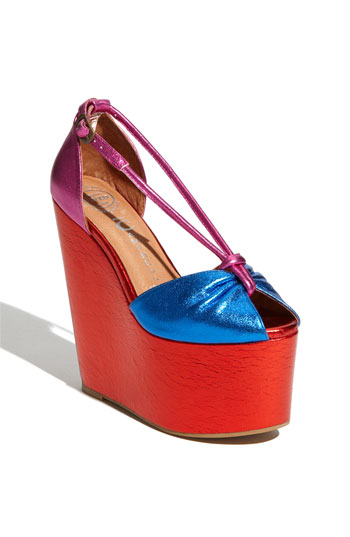 Jeffrey Campbell “Wedges”, for a mere $275 at Nordstrom. What a nice, colorful sculpture! I’m sure they’d be great for walking on cobblestones.
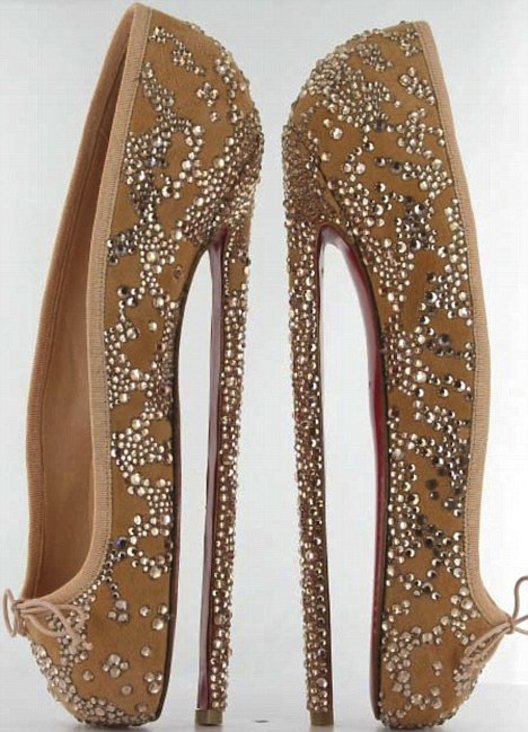
Christian Louboutin “Pointe” ballet stilettos, designed by a man, high fashion of course, but are they meant for a body?
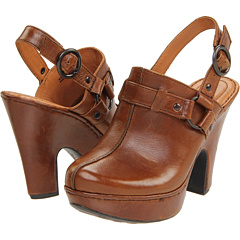 Born “Comfort” wedges, $145 on zappos.com. These claim excellent arch support but still have an overall height of four inches.
So ,what, exactly is wrong with being short? Would strangers ask my height or tell me how tiny I am (like I have no idea) if I was 5’4″ and in considerable pain? Would men, as women have for centuries, submit to any accessory or piece of clothing that tortured them? Tortured them but let them be fashionable, stylish, and “with it”?
I frequently see girls on campus wearing stiletto heels, in the daytime, trucking around from class to class, and this is what I see: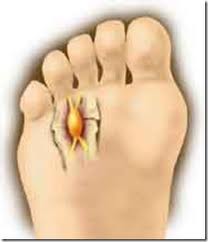 Morton’s Neuroma
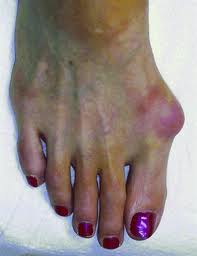 The Classic Bunion
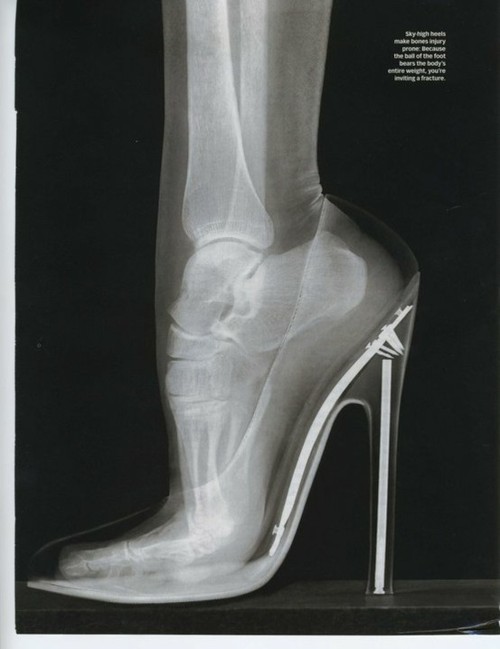
Sadly, in the year 2012, in the country where women supposedly have the most “freedom” in the world, some still choose a Foucauldian self-discipline (or torture) not far from that of Chinese footbinding. Heels are higher than they’ve ever been. I would love to know why.

