Sex With Limited Mobility

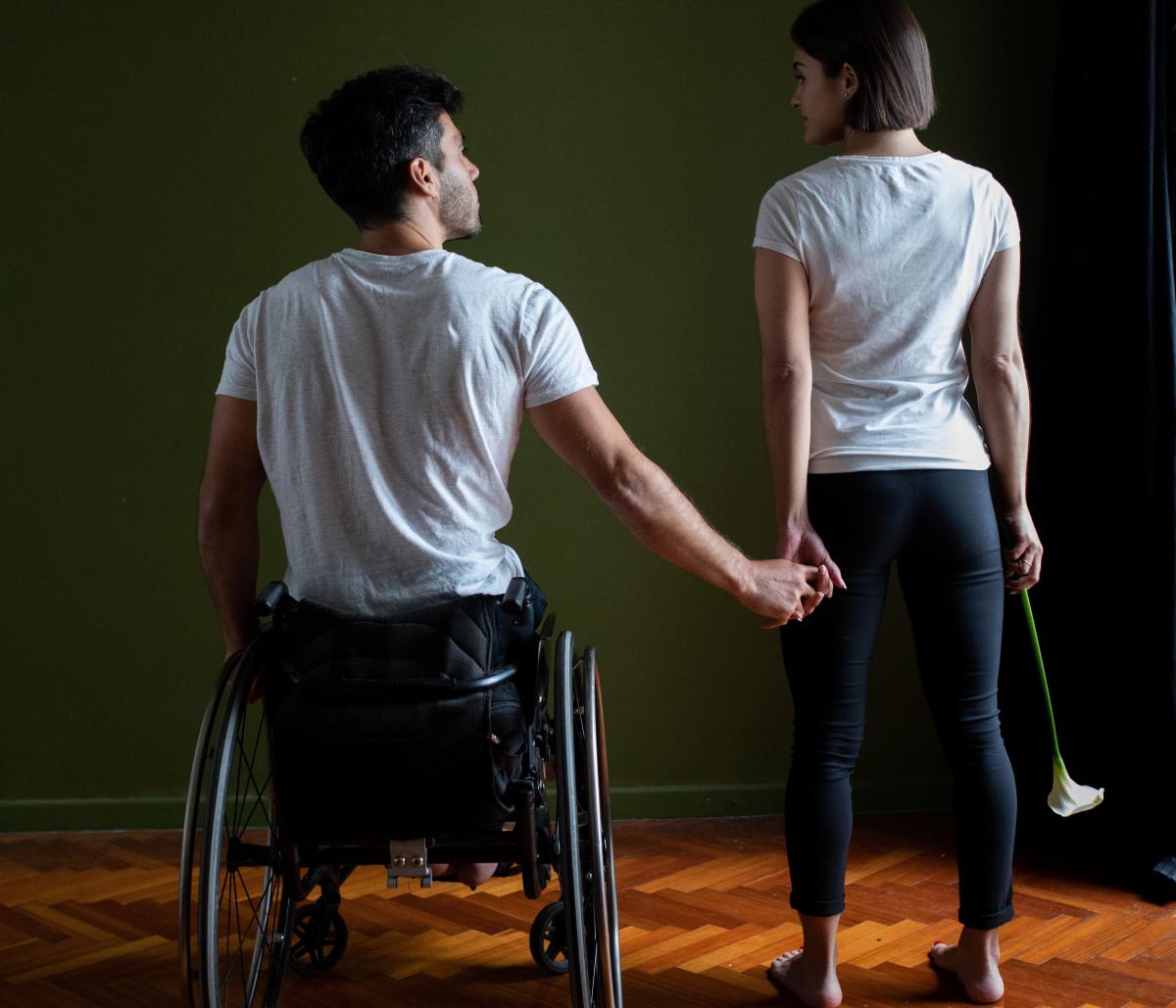
Growing up, we saw physically disabled people as the odd ones out. I could take responsibility for viewing disabled people that way, but that was how everybody around me viewed them. I had no chance of “knowing better,” at least in that environment and age. That was the case until I was introduced to this class and had a fair share of friends who were open-minded. These people changed my thinking in both positive and negative ways, but the point that they taught me that people are different; not everyone is going to look and act the same as everybody else, and that is okay. I know the previous statement can come out as a very “duhh” statement for most of yall; however, I didn’t use to think like that. It was more of “you are weird! something is wrong with you.” And of course, like most adolescents who are just discovering sex and how it works, I wondered what sex must have been like for people with spinal cord injuries and other disabilities like that. I asked myself, “Do they feel anything down there?” or questions like, “can women who are paralyzed from the waist down give birth?” Most of these questions came from mostly ignorance and a bit of curiosity. 

Sexuality and Disability: The Missing Discourse of Pleasure by Mitchell Tepper opened my eyes to this issue regarding disabled people and sex. An article like Tepper’s is exactly what people like me missed back in junior high. From reading the article, I learned that sex is more than just borrowing some friction from a partner, and there are more ways to derive sexual pleasure that does not involve the privates. I found it heartbreaking that some disabled individuals give up on their sex lives because they believe that there is no point in trying, “nothing will be the same.” And that is when Mitchell Tepper steps-up and encourages people with SCI that their “sexuality is their responsibility.” These people learned more about the spinal cord-injured bodies and embraced their disability. Evidently, disabled people in wheelchairs tend to have a more difficult time finding a sexual partner than abled individuals; most of this is due to the stigma around disability and sex and partially due to self rejecting before they can even try. Self rejection is a problem that we need to tackle. We (teachers and professors) need to teach about pleasure and sexuality in order to shine a light on this topic of sex and disability and hopefully reduce the stigma and misinformation around disability and sex.
How I came to learn about Autism

Growing up middle class in East Africa was itself an experience. I don’t remember learning about neurodivergence in class, however, that could be because I was in the lower classes and maybe the school system didn’t think that we needed to know about autism and such. I learned about many neurodivergent disorders much later in American high schools. In Tanzania, if a kid is acting strange or out of the norm, people would just say “oh that kid is crazy!” or sometimes they would say “he is not receiving proper care from his parents.” Never once have I heard someone say “oh maybe that kid has a disorder or neurodivergent.” Now that I’m looking back, a lot of those “crazy” kids in my childhood probably fell somewhere in the autism spectrum, they just never had someone to diagnose them.

I grew up in a very religious family, I attended a Christian boarding school for 4 years. I remember one time at school, a kid was talking to himself and he would display multiple personalities. When the students saw that, they reported him to the matron and as soon as she saw the student, her first reaction was to pray for him believing that he is possessed by some evil spirits. Again looking back, that kid should have probably been diagnosed with some neurodivergent disorder but instead, we just kept treating him like he was possessing demons. This blog is just to show that education in neurodivergence and autism is highly needed because people are out there getting sprayed with holy water instead of receiving medical care that is highly needed.

Learning about mental health and neurodivergence has opened my eyes because I now know why some people act the way they do. I am judging people less, and most of the time I don’t really care. We all have some form of mental issues; some people are just really good at suppressing them, and some people are terrible at it.

Reproductive bodies and Disabilities in Different Cultures

https://kerrythompsonblog.files.wordpress.com/2020/08/savingpng.png

According to many cultures around the world, It is a woman’s “duty” to reproduce. In fact, many people believe that our sole purpose here on earth is to pop out kids and try to populate this planet. This view doesn’t even consider if the woman – who has to carry and deliver the baby – even wants kids in the first place. And If a woman chooses not to be a mother, she is not doing her “duty.” Like duty by said who? God? Not everyone believes in an eternal being with infinite power. It’s even concerning how some people wholly ignore how much work goes into having a child; all the sacrifices and attention to detail that a woman needs to have in order to deliver a healthy baby. I remember having a friend from Dubai who told me that the culture there in Dubai is very patriarchal, and it is the men who do most of the decision-making in the family. The woman is just his “wife.” His job is to look after the woman and her kids, and her job is to do housework and take care of the kids. This kind of thinking is a very traditional way to view gender roles. It is how cavemen view gender roles, where the men are tasked with hunting, and the women are to pick berries and take care of children. However, we can all agree that this view is outdated and it views women as if they are physically disabled, thus an “almighty” man is needed in all families to guide them and fill in the gaps that woman is unable to fill.

Drawing some examples from Baynton’s Disability and the Justification of Inequality in American History and the film Aftershock, women have been viewed as being physically disabled, at least that’s how Baynton wants us to understand them. He argues that a patriarchal society – like the one we have in America – views women as weaker, emotional, irrational, and thus inferior to men. This reasoning can explain why women are paid less than men despite taking on similar positions. This belief that women are irrational is the reason why women in some areas of the middle east are not allowed to drive or in some cases pick their lovers. This is a social disability that needs intervention because it can be crippling to the advancement and well-being of a lot of women in patriarchal societies.

Acting like a female

https://seedandspark-static.s3.us-east-2.amazonaws.com/images/ProjectImage/000/034/263/large/ALW%20thumbnail%20FINAL%202.jpg?cb=34263

For as long as I can remember, men are not encouraged to be emotional simply because “you don’t want to be a bitch.” It is like an unspoken rule everywhere because it was the case in East Africa, Congo, Jamaica, and now in the United States. I remember back in my early childhood, whenever I fell and hurt myself playing outside, the people around would just whisper “shhh shh stop whining, be a MAN!” It was so engraved in me that every time I saw a boy crying, I would view him as weak, and incompetent; real men don’t cry. However, whenever I saw a girl crying, the first thing I would think of is “I wonder what is wrong with her? Does she need someone to talk to?” As I grew up and started experiencing more of life, I got that revealing moment like “Ok, I see why people cry now.” It’s not a secret that life gets hard. It will get hard for everyone no matter their background, and every once in a while, you will reach a point where you just have to let it all out. 

In my case, I found it difficult to cry, for instance, l will get really emotional but nothing will come out; no tears. So, I will end up forcing it out but to no avail. Next thing you know I’m on YouTube watching sad videos hoping they will pull a tear out of me like my situation isn’t terrible enough. An hour in after doing everything in my power, guess where I end up? On google just like every sensible person. There I typed, “why won’t tears come out when I cry.” The results were varying but I found it funny how one of the results was “you live in a dry climate; therefore, you don’t have a lot of water in the body.” I knew right away that this didn’t apply to me because it was a humid summer evening in Maryland and I sweat all the time. After a considerable amount of reflection and reading sources from mindbodygreen.com, I realized that the reason I won’t fully cry is that I won’t let myself get there, and that is because of all the cultural stigma that has been ingrained in me for years on end. Crying puts you in a vulnerable position and that can be hostile because we grew up seeing people get shamed and called names for simply expressing their emotions. It is very unfortunate that some people end up taking their own lives because they don’t feel comfortable or scared to express their emotions, so they end up burying them deep inside them until they can’t anymore. According to ourworldindata.org, men are twice more likely to commit suicide compared to women and the main reason is that most men would rather take their own lives than put themselves in a vulnerable position like sharing their deep feelings with the people around them. With proper education and awareness, we can eradicate stigmas like this and make it a safe place for everyone to share their feelings and have them be heard by someone. Just like the article by Iris Young Throwing like a girl, some actions and ideas just should have a gender attached to them because not only are they offensive, they can be hostile and take from one’s wellbeing.