

Talking about judgment

Child giving a judgmental side eye with two front teeth out. The side eyeing Chloe meme.

I live in my body every day. I experience the world through the eyes of my body. It is my vision that allows for interaction, and my choices of how to take action or respond that shape who I am as a person. My body should be in my control. So why do other people have so much say on how I live my life? I used to go to the gym twice a week at the break of dawn so no one was in the gym, but recently more people started going to the gym and it’s gotten more crowded. I tell myself I don’t go anymore because of the crowds, but I know it’s more so because my gym buddies won’t be there with me. Having other people with me helps me forget about other people and in turn increases my self-confidence. Very much so the safer in a group mentality. So even though it’s my body, and I know these people’s opinions won’t hurt me, and know I will survive any mean comments or judgmental stares, I’m still scared to go to the gym. It doesn’t help that I don’t look like any of the other people in the gym. How people interpret my body, the comments and staring, has affected how I move about the world. Other people also affect what I wear and how I sit or stand. If I try to have good posture I feel too tall (I’m not even tall standing.) and like I’m drawing attention to myself. If I wear something revealing I’m scared people will misinterpret what I might say or do. There is judgment everywhere, and society rewards the judgmental, social media, magazines, hot or not lists all promote the practice of judging someone’s body and assigning worth to a specific look. I believe one of the things that makes feeling judged worse is also being judgmental of others. If I’m judging other people, then that same energy from myself is reflected back sometimes even harsher than the original judgment. According to the article “Why Do We Judge Other People?” from Psychology Today, judging perpetuates a cycle of negativity and pushing other people down to make yourself feel better. So other than the gym equipment being unavailable, I have the ability to go, have fun and move my body. It’s a matter of mindset and not internalizing the judgment other people give.

The link to the Psychology Today Article: https://www.psychologytoday.com/us/blog/living-eating-disorders/202110/why-do-we-judge-other-people
Spice Girls Wannabe answered

“So tell me what you want, what you really, really want, I’ll tell you what I want, what I really, really want”

First lets define disability and impairment. Susan Wendell uses disability activist’s and United Nations definitions explaining:

Disability activists and scholars usually distinguish impairment from disability, treating impairment as the medically defined condition of a person’s body/mind, and disability as the socially constructed disadvantage based upon impairment.

Wendell, S. (2001). Unhealthy Disabled: Treating Chronic Illnesses as Disabilities. Hypatia, 16(4), 17–33

For some people the limitations they face in day to day life isn’t based at all on impairment, but rather how society disables them. And even for people who are looking for treatments to make life more livable, society is still a huge disabling presence. Some examples of how society can disable include, uneven sidewalks, broken or lack of elevators or in general poorly made and maintained spaces. Those are some of the more obvious physical barriers. There is a larger social barrier that people with disabilities face and that’s prejudice. Especially for those with invisible disabilities the strain of people assuming they are fine, that they are “faking” and don’t really need the help they are asking for, causes such an intense mental and sometimes physical strain.

From personal experience people don’t trust that you know what’s going on with your body and with what you are able to do. When covid was really bad I got sick, but not in such a way that I needed to go to the doctor. During this time going to a doctor if it wasn’t necessary was not just looked down upon but also dangerous. When I told my professor I couldn’t come to class I was asked to get a doctor’s note, which I was unable to produce and ended up getting points marked off in the course. Another time I was hospitalized and the doctors told me they contacted my professors. Either the professors didn’t care or they weren’t told because when I came back most of the professors said I couldn’t make up the work and should just drop the class and take it next semester. Instead of preparing and trying to figure out a way for me to make up the work. Not only did I lose thousands of dollars in tuition, I ended up going under the credits needed to be full time and I was kicked out of my housing. This whole time disability services didn’t do anything because they said “We can’t do anything retroactively”.

Recently someone asked me if I could change anything about my university to make it more disability friendly what would it be? There’s the obvious: fix the sidewalks, routine maintenance on elevators and doors and changing certain stairs into ramps, but there’s also making professors have recorded lectures or accessible online materials. I’ve had multiple professors that use pre-lecture videos to prepare students for class discussion, and while going to class is important, in times of extremes like hospitalization these pre-lectures are wonderful supplementary materials. I’d also like to see disability talked about more and normalized not just in the university setting but in the work place too. So hopefully that answers the statement: “tell me what you want what you really really want.”

My experience with weight loss

Trigger warning: Eating disorders

When I was 10 my doctor at the time yelled at me and made me cry for not losing weight. That’s when I remember starting to look at health as being skinny and losing weight as a need. 

The next doctor I went to also said I needed to lose weight. So, when I was old enough 12 or 13 my doctor recommended I do Weight Watchers with my mom. The idea being I just needed to become more aware of what I was eating and that would help with my weight. We had x amount of points and every food was associated with a point value. My mom was so into it, we would get the cookbooks and the special low point foods, keep track of our weight at home and attend every meeting. 

From the outside it would seem like a good idea, not a diet just looking closely at what you ate and making sure to balance it, and the meeting should be there to hold you accountable. But there was a more insidious side, tracking led to bargaining: “I’ll skip on this so I can indulge later.” And the meetings became commiserating about being overweight and pushing the idea of how much better life is being skinny or how much better it would get if we lost weight. 

From a young age I found my self image turning into self hate and a need to be skinny. By high school I quit WW not because I realized the negative effects, but because it was too hard to maintain. But the ideas stuck with me that my life would be better if I was skinnier (I wasn’t even that overweight), that it didn’t matter when I ate just how much in a day, and that health was just based on the body. I wanted to be like my stickbug friends and classmates. One of the saddest memories I have from high school is how I slowly and secretly started to develop negative eating habits. I would bring just oranges to school for lunch because in the WW version I did they were 0 points so in my mind I could eat as many as I wanted without gaining weight.

I wouldn’t eat breakfast and I would bring 8 of the small oranges or cuties to school and just eat that for lunch, then when I got home I would have an entire TV dinner and for dinner I would eat as much as I possibly could, often going past fullness. All my friends saw were the oranges and they commented “wow you’re so healthy” and those comments made me go further, only eating oranges some days. I was so depressed, I never lost weight and I always felt weak. I was involved in sports and some days I felt like I was going to faint because I wasn’t eating. But I hid all this from my parents. They only ever saw what I ate for dinner so I would lie and say I already ate or that I hadn’t eaten if I ate a concerning amount at once. I wasn’t losing or gaining weight, so no one ever saw how much I was suffering. It began to feel normal: if I don’t eat all day then it doesn’t matter what I have when I do eat. I’m still not fully over it, having a meal plan in college helped because I wanted to get a meal every meal period. It wasn’t until listening to the Weight Watchers episode of the podcast Maintenance Phase that I remembered just how bad Weight Watchers had been for me and I started to remember all of those aspects that hurt me and shaped my young mind. There is no happy ending. I still find myself starving through the day and binge eating at night, but at least I’m aware that it’s something I need to work on.

F-A-S-H-I-O-N What Spells Gender Neutral Fashion?

First it has to be acknowledged that there is no one “look” and everyone perceives labels to mean different things. How one styles their clothing is going to reflect what they think looks good on them and expresses themselves accurately. Everyone has a unique perspective that has been shaped by their experiences. Just because I perceive these things as gender neutral does not mean everyone does and it should also not be assumed that wearing any style associated with gender neutral or gender non-conforming makes someone gender-non-conforming. To that end, wearing or dressing in a way that might convey a gender (such as wearing more masculine or feminine clothing) does not mean that someone identifies as how you are perceiving them. As tik toker kissmychaase put it “Even when I’m fem I’m still a them.” meaning even if this person dresses feminine they still go by they/them pronouns and that should be respected.

The clothes, shoes and accessories we put on our bodies says a lot about who we are and deeply influences how others interact with us. In “not just the reflexive reflex” by Mary Kosut and Lisa Jean Moore clothing and accessories are described as part of an identity-kit. When this identity-kit is stripped away it takes a chunk of someone’s individualism and uniqueness. Clothing is important, it allows self expression and can create comfort.

Fashion is outfits (clothing and accessories) and make up that project one’s belonging to a certain group. There are many types of Fashion. All of it is subjective and while some outfits are easier to deem as part of a subculture, others are harder to identify or explain. Some examples of fashion subcultures are Goth, Lolita, Hipster and so many more.

Gender neutral fashion is one of the most extensive groups of fashion. Mostly because it encapsulates so many other subcultures and can drastically change with each one. Each subculture, country and group of people are going to have another perception of gender and normal, and with that the idea of gender non-conforming changes.

America and many other parts of the world live in a gender binary, the perpetuation that there are only two genders male and female and someone is either part of one or the other. In Western society things like skirts, frills, lighter colors and dresses are considered feminine and associated with women. While simpler colors, pants, collared shirts, and suits are considered masculine and associated with men.

Gender neutral fashion usually aims to make it unclear what someone’s gender is, this can include techniques such as baggy or more rectangular clothes to hide body shapes, underwear like boxer briefs which can work for anyone, and culottes which can be described as pants that are flowy enough to also look like a skirt.

Here is an article with some brands and examples of gender neutral fashion :

https://www.bustle.com/articles/100668-7-gender-non-conformist-gender-neutral-clothing-brands-to-support-right-now

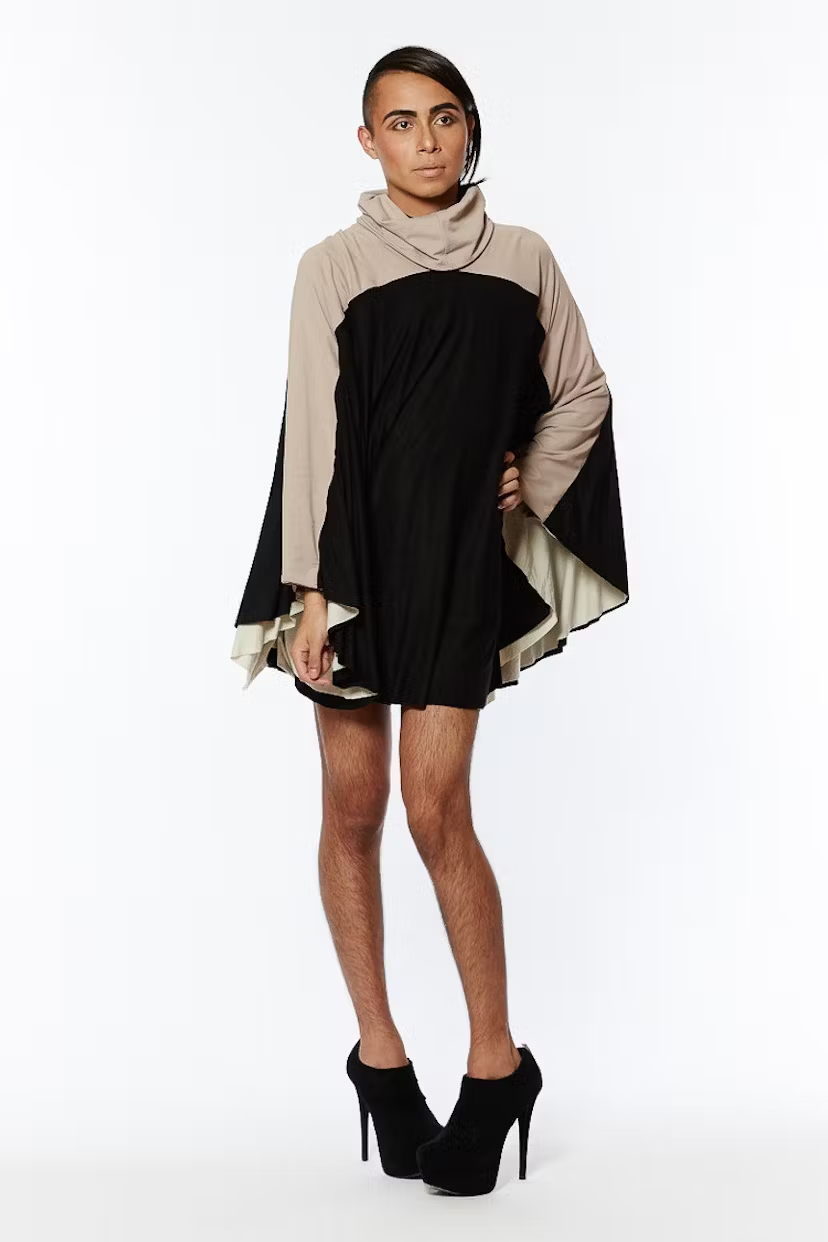
and here is one of the pictures that stood out to me

Person with Nude make up
unshaved legs 
wearing a black poncho with cowl turtle neck and arms are sewn in to make sleeves that are part of the poncho, the arms, shoulders and turtle neck are all a light beige making a single light beige stripe at the top of the garment
black boot heels 
white backdrop

Also worth noting gender and pronouns are not the same thing, gender neutral, genderqueer, genderfluid are all labels and can only be applied if the individual chooses to apply them themselves. No one gets to say “oh you use [some set of pronouns] you must be [this gender]” and vice versa. No one has to have a label and you can also have multiple labels. They are just sets of words to help unify groups of people.

And make looking for clothes easier (mostly joking).