
F-A-S-H-I-O-N What Spells Gender Neutral Fashion?

First it has to be acknowledged that there is no one “look” and everyone perceives labels to mean different things. How one styles their clothing is going to reflect what they think looks good on them and expresses themselves accurately. Everyone has a unique perspective that has been shaped by their experiences. Just because I perceive these things as gender neutral does not mean everyone does and it should also not be assumed that wearing any style associated with gender neutral or gender non-conforming makes someone gender-non-conforming. To that end, wearing or dressing in a way that might convey a gender (such as wearing more masculine or feminine clothing) does not mean that someone identifies as how you are perceiving them. As tik toker kissmychaase put it “Even when I’m fem I’m still a them.” meaning even if this person dresses feminine they still go by they/them pronouns and that should be respected.

The clothes, shoes and accessories we put on our bodies says a lot about who we are and deeply influences how others interact with us. In “not just the reflexive reflex” by Mary Kosut and Lisa Jean Moore clothing and accessories are described as part of an identity-kit. When this identity-kit is stripped away it takes a chunk of someone’s individualism and uniqueness. Clothing is important, it allows self expression and can create comfort.

Fashion is outfits (clothing and accessories) and make up that project one’s belonging to a certain group. There are many types of Fashion. All of it is subjective and while some outfits are easier to deem as part of a subculture, others are harder to identify or explain. Some examples of fashion subcultures are Goth, Lolita, Hipster and so many more.

Gender neutral fashion is one of the most extensive groups of fashion. Mostly because it encapsulates so many other subcultures and can drastically change with each one. Each subculture, country and group of people are going to have another perception of gender and normal, and with that the idea of gender non-conforming changes.

America and many other parts of the world live in a gender binary, the perpetuation that there are only two genders male and female and someone is either part of one or the other. In Western society things like skirts, frills, lighter colors and dresses are considered feminine and associated with women. While simpler colors, pants, collared shirts, and suits are considered masculine and associated with men.

Gender neutral fashion usually aims to make it unclear what someone’s gender is, this can include techniques such as baggy or more rectangular clothes to hide body shapes, underwear like boxer briefs which can work for anyone, and culottes which can be described as pants that are flowy enough to also look like a skirt.

Here is an article with some brands and examples of gender neutral fashion :

https://www.bustle.com/articles/100668-7-gender-non-conformist-gender-neutral-clothing-brands-to-support-right-now

and here is one of the pictures that stood out to me
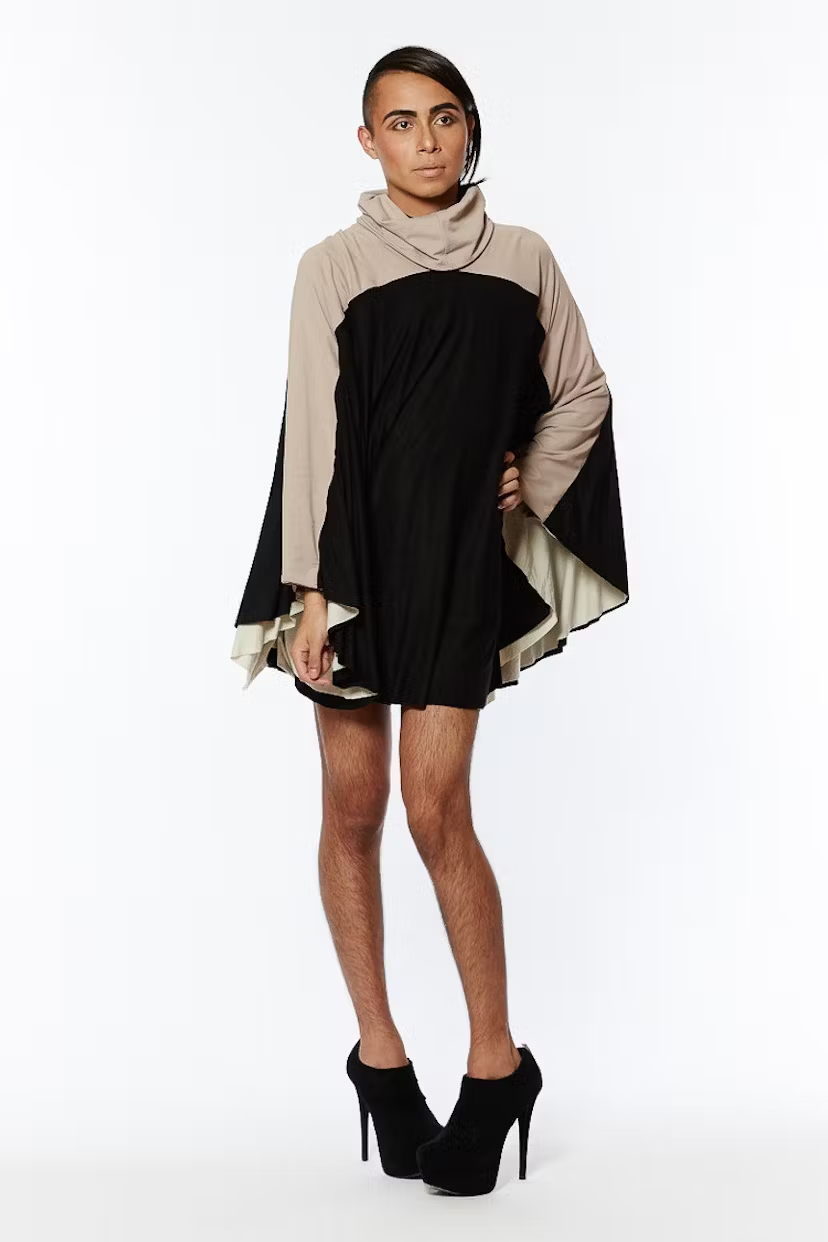
Person with Nude make up
unshaved legs 
wearing a black poncho with cowl turtle neck and arms are sewn in to make sleeves that are part of the poncho, the arms, shoulders and turtle neck are all a light beige making a single light beige stripe at the top of the garment
black boot heels 
white backdrop

Also worth noting gender and pronouns are not the same thing, gender neutral, genderqueer, genderfluid are all labels and can only be applied if the individual chooses to apply them themselves. No one gets to say “oh you use [some set of pronouns] you must be [this gender]” and vice versa. No one has to have a label and you can also have multiple labels. They are just sets of words to help unify groups of people.

And make looking for clothes easier (mostly joking).
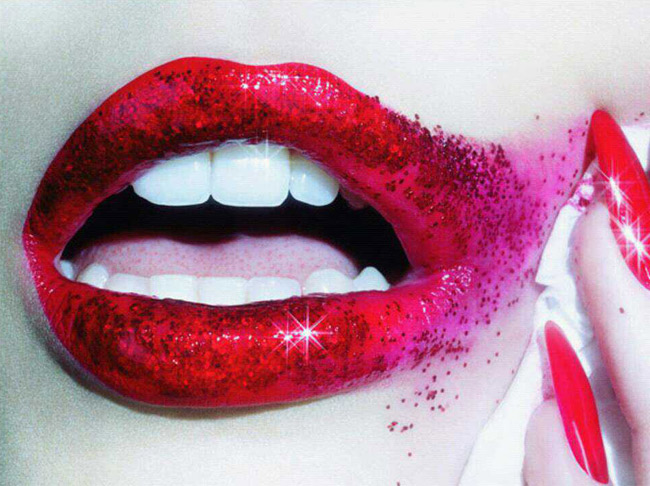
Can I be a feminist and still wear lipstick?

Have any women out there felt a conflict or contradiction between their feminist identity and desire to adorn their bodies? That is, can I shave my legs and simultaneously protest patriarchy? I know of many women (including myself) who have struggled with this and similar questions. In a culture so rampant with images of plucked, primped and worked-out women and men, it’s sometimes hard for me to decide if I want to display my feminist protest on my body or wear pretty clothes, shoes and jewelry.

When I read Gala Darling’s post “Am I A Hypocrite For Professing Radical Self Love While Wearing 5 Inch Heels?” or “Can you call yourself a feminist and still wear lipstick?” I was thrilled to read her take on these very questions. As a woman who blogs about fashion and style and who also boasts a “Radical Self-Love Bootcamp” program, Gala Darling’s work may seem to contradict itself. So she asks the million-dollar question about lipstick and feminism, and raises very good points about bodies, body adornment  and our selves.

Gala points out that when we (women and men alike) display our bodies the way society wants us to, we are rewarded for this behavior. This could be by wearing makeup, stylish clothing, shaving, etc. Gala calls this “beauty” privilege.”  Beauty privilege can be as simple as a smile from the person ringing up your groceries! In a lot of ways it’s easy and comfortable to conform to beauty standards when you can in order to access beauty privilege. Of course, not all bodies have equal access to this privilege. It is overwhelmingly easier for able bodies, thin bodies and white bodies to access beauty privilege. Access to money helps beauty privilege too!

Further on the subject of beauty and feminism Gala explains, “I’ve spent some time recently thinking about “beauty” & trying to reconcile that with truthful feelings about myself. A major & difficult piece of the puzzle is that none of us grew up totally free from societal influence, & so it is almost impossible to separate what we really want from what we think we want…. The place I keep coming back to is that even when I recognise that my ideas of beauty have been passed down to me from society, it doesn’t feel good to me when I choose to deny myself something which provides me with genuine enjoyment….

Gala argues that body adornment is akin to art. People are attracted to aesthetically pleasing objects, whether natural or manufactured, and enjoy being surrounded by them. Of course there is variety in peoples’ tastes, but I think it’s fair to say that most of us like having pretty things around us!

She further notes that “wanting to feel beautiful does not make you a bad feminist or a bad woman. It does not mean that you are being oppressed or that you lack the ability to think for yourself. Wanting to adorn ourselves is natural & normal — very few of us live in houses that are all function & no form, & while we COULD all drive boxy Volvos, the truth is that most of us are attracted to beauty — however we choose to define it.”

Lastly, I found this point quite persuasive: “Some women say that if we wear lipstick, we’re only doing it because society has told us to. I would argue that the woman who tries to buck society by NOT wearing lipstick is just as influenced! No one exists in a vacuum, & almost all of our decisions are effected by external sources.”

I find Gala Darling’s discussion of beauty, bodies and feminism quite persuasive. I like wearing clothes that flatter my shape. I like having smooth legs and putting glittery eyeshadow around my eyes. I love earrings and bracelets. This doesn’t make me less of a feminist, right? What are your thoughts?

Androgyny

Often, we talk about “beauty standards” as a single set of rules, as though they can be internalized and followed the way one might follow the rules of grammar or mathematics.  Beauty standards have very real consequences for those who break them and also those who don’t, and they are so pervasive as to seem universal.  But they aren’t universal.

Take, for example, the context of the fashion industry.  Granted, there are plenty of harmful aspects of consumerism and misogyny in fashion in general.  Still, fashion is, purportedly, an art that pushes boundaries, even if it has inherited the unfortunate boundaries of the society of which it is a part.  This is an essay in itself.  What is interesting for the purposes of this post is how the beauty standards for fashion models differ from those for the average person in a given culture.  The purpose of fashion is to push boundaries, and so it continually shapes the beauty standards and trends for average people and then changes them.

Similarly, models are not held to the same set of standards.  Successful models have a certain set of common characteristics (tall, thin), as well as something that makes them “stand out”: a sharp nose, strong brow, angular jaw line.    At the same time, the desire for models who are tall and thin has necessarily led to an increase in models with androgynous bodies.  Perhaps the most popular androgynous model at the moment is Andrej Pejic, who in one season walked five men’s shows and four women’s shows.

His body seems to be proof that even biology is not dichotomous.  One would expect this to be more threatening, yet Andrej reports a happy, carefree childhood.  His mother is doting, his brother is supportive, and the hardest part of his teenage years, he says, was figuring out who he was.  The freedom that he seems to have felt from pressure to look or act a certain way, the ability to decide for himself who he wanted to be, is remarkable.  The following interview shows him to be level-headed and surprisingly unaffected by his sudden success as a model.

In the context of fashion, androgyny seems more acceptable, relatively speaking.  What do you think makes this the case?  Is this a positive move, or does it just reflect a fetishization of “unusual” bodies?