Deceased “Etiquette”

The media heavily covered the death of legendary singer Whitney Houston.  There was much speculation about the circumstances surrounding her death all of which were reported on in the media.  The latest story about the singer’s death is the National Enquirer publishing a photo of the late singer in her casket.  There is an article on Celebritology on the Washington Post which reports on this latest media frenzy.  Where do we draw the line when it comes to respect of the deceased?  Is showing their body in a casket appropriate, especially when her family did not authorize such a photograph to be published let alone taken? 

The singer’s entire life was in front of paparazzi as is any other celeb’s.  But is this same extreme invasion of privacy acceptable after death when the star is no longer her to be a voice for herself?  The media feeling the need to publish such a picture is extremely indicative of  how we view bodies.  Whitney was famous mostly for her voice, however the voice went with the face and body.  At one point in time she was a model, however her notoriety came from her vocal skills and stylings.  So following death people do not separate the two?  The deceased corpse is no longer able to produce the angelic sounds that it once did, however there is such a focus on the body. 

In my opinion it is extremely disrespectful of not only the celebrity but her family as well to post pictures of her body in a casket.  Why does the media feel such a need to be so intrusive into the lives of people?  There should be more of a line drawn between reporting on what needs to be known or what is of interest and respect of the privacy of those being reported on.

http://www.washingtonpost.com/blogs/celebritology/post/national-enquirer-publishes-photo-it-alleges-shows-whitney-houston-in-casket-has-a-line-been-crossed/2012/02/22/gIQAjrrnTR_blog.html

Making “Private Parts” Public

Over the summer I was an intern in the gardens at an intentional community called Heathcote. Intentional communities are essentially communes but the members do not have a shared income or business, so the members have outside jobs.  I instantly felt at home with the members, a group of older radicals and hairy second-wave feminists. One Saturday evening  the community was hosting a hot tub party in their handmade cob hot tub that sits over a fire. Although I was not interested in getting in, considering it was the middle of the summer and extremely hot, I was interested in attending the party to enjoy some conversation and vegan marshmallows. The party was taking place about a 10 minute walk through the woods from where my room was. As I approached I started to notice something was odd, everyone in the hot tub was naked.         I was stunned. These people I had gotten to know so well through everyday interactions were now baring it all in front of me. Going into this internship I was not expecting to see my boss, the intern coordinator, naked. My own reaction to the nudity of the community members was surprising to me. I needed to analyze why I felt so uncomfortable about this.
My first thought was that I felt uncomfortable because no one has warned me in advance that clothing was optional, and perhaps they should have. But, what was the real reason for my discomfort? The human body itself is simply raw material, however it is also packed with meaning given by society. The body is sexualized; society has created a framework in which certain body parts are not to be shown to the public. Even in more enclosed and safe environments, like the one I was in, to many is thought to be eccentric. Sexualized body parts are labeled with words like “private” and are expected to stay that way unless that are being used for arousal.
Something many young people rarely see is a naked average-sized body, imperfections, cellulite, and all. When “plus-sized” women are shown in the media, like in the Dove Campaign for Real Beauty,  the images of the body are distorted with airbrushing, thus creating a false idea of what a “real” body looks like. Because of my instilled sexualized associations and my lack of experience in seeing what real naked bodies look like, my experience at the hot tub party was an awkward one.

Pin-up boys?

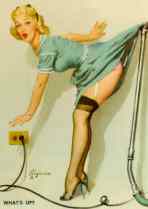
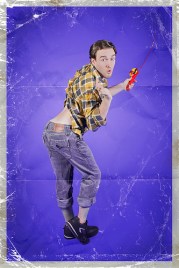
A friend sent me this series of men photographed in traditional “pin-up” girl poses. They sure capture the pin-up girl vibe: Look at those arched backs, pursed lips, and inviting gazes!

Yet the difference is obvious: these “pin-up boys” wear jeans and camo and are depicted with traditionally masculine props such as dumbbells and a wrench. What do these recognizable poses on different bodies do for us viewers?

I love these pictures because they subvert the pin-up girl image. Seeing male bodies in pin-up poses takes apart what we’re used to seeing, and for me expose the silliness of pin-up girls while questioning their supposed sexiness. These guys do look silly! We’re used to seeing women with their backs arched and chests thrust out, even in the midst of their regular activities (like vacuuming, apparently). Seeing men in the sam poses while doing their regular activities (fishing? Skateboarding? Talk about the sexual division of labor!) exposes its artificiality; exposes the pin-up girl as the fantasy she is.

Do these men look sexy to you? I think they look funny, which reminds me that “sexy” means different things on different bodies. In U.S. culture, one kind of sexy = slender white women doing chores with their underwear exposed. Does it work in reverse? Do these men look sexy, or goofy and posed?