I used to be a Glee fan in high school, though not to the same extent as most Glee fans were or are. I can’t even remember what the first two seasons were about, except that I cringed much less frequently than I do at the show now. My memories are very hazy, but when I think of Becky Jackson, the cheerleader with Down’s Syndrome, I remember liking her character. I remember thinking she was funny, intelligent, but a little bit neglected by the writers. The Becky I see in episodes now is such a drastic change from the character I remember. I try to pretend that it’s because Becky gained some confidence in her few years in high school and that’s why she’s so self-assured, but something about her character now really rubs me the wrong way.
disability
QUEERIES: My Love for Eli Clare’s Exile and Pride and Why You Should Go Ahead and Read It, Okay?
I haven’t connected to any other class’s readings as I have connected with Eli Clare’s Exile & Pride. I’m trying to figure out why, and I still don’t rightly know, but I needed to share.
It seems obvious to say, “Well, I like the subject matter,” but really. I do. And it is all very different but so intrinsically connected, that I feel bad that I ever doubted the meshing of these worlds into one book. The environment, queerness, and disability (to narrow it down to a main triad) are all sides of the same coin. The environment–the one he have created and the one that has always been–often dictates disability.
Disability provokes a queer understanding of identity. Being queer in different environments–rural and urban–is like being a polar bear or a house cat, a bird or a lost lizard in a sewer. The criticism that Clare invokes when talking about these topics is also critical of race and ethnicity and of privilege and gender. Who was the first to claim land as an inexhaustible resource? Who dictates the gender and sexual norms? Who creates the urban space that perpetuates disability? Clare touches on all of these linked together identities and sites, and it feels so right. I learned so much from Clare’s writing, but I also picked up his sense of criticism; that calm, assertive, compassionate voice that questions why and kicks out with fervor. Clare’s criticism is beatifically formed and so god damn smart, but it’s not the only thing that keeps me in the book.
Limping
Six weeks after meniscus repair surgery, I am currently re-learning how to walk. Actually, I can already walk, but with a limp – I’m re-learning how to walk “properly.” That is, like a princess, like Audrey Hepburn in Roman Holiday. Several times a week, in front of a floor-to-ceiling mirror either at my physical therapists’ office or at home, I slowly take steps, deliberately bending and straightening my legs in a precise, exaggerated motion. According to my doctor and physical therapists, I have to re-learn how to hold my leg perfectly, 180 degrees-straight within a few weeks or else I’ll be stuck with an essentially permanent limp. Truth be told, the prospect of a lifelong limp is frightening enough to scare me into doing my draining physical therapy exercises, which I had otherwise been avoiding. Suddenly, I feel strong motivation to get fully invested in my exercises and “get better.”
Hardest Two Days of My Life
In my 21 years of living I have never struggled so much as I have recently. My mother is all about helping family and although I’m neither for or against her decisions this was one that made my life difficult and irritated. Continue reading
Youth Filled with Disabilities
What child would ever want to grow up with many physical disabilities? Certainly not me!!
Retarded.
My sister is mentally retarded. I’m not sure what the ‘politically correct’ term would be for this these days. I’m pretty sure it’s “mentally handicap”. Retard literally means to slow down. At the end of the day that’s a pretty accurate description of my sister. She is 24 years old and has the mentality of a twelve year old. She isn’t stupid by any means. She just got slowed down. My 6-year-old son and she are such good friends. I fear the day he intellectually passes her.
Let me explain a little more about her condition.
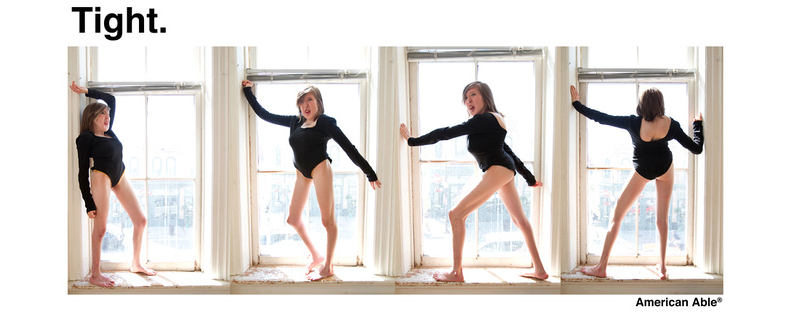
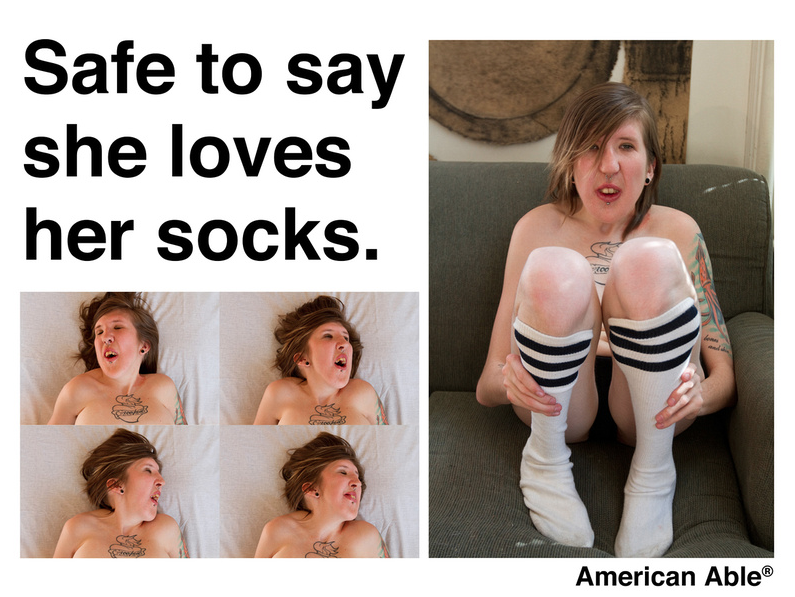
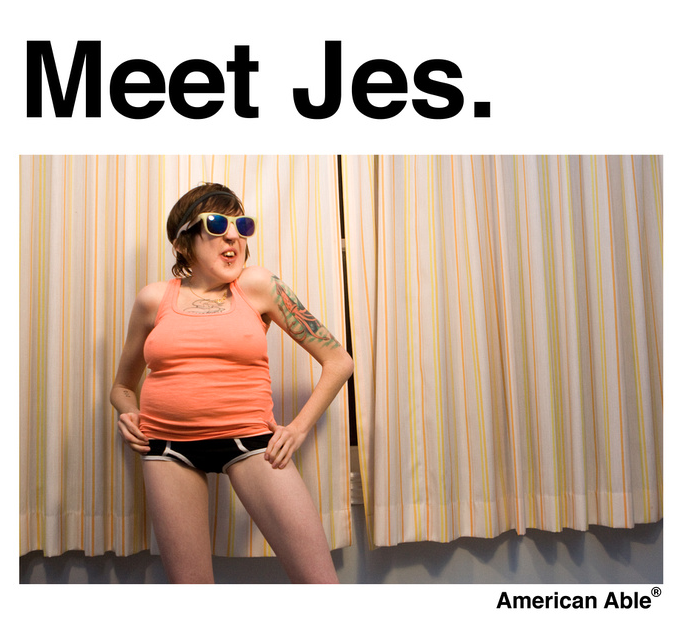
“American Able” – Challenging Media Representations of Disability
Here’s a description of the project from the the artist Holly Norris’ website:
“American Able” intends to, through spoof, reveal the ways in which women with disabilities are made invisible in advertising and mass media. I chose American Apparel not just for their notable style, but also for their claims that many of their models are just ‘every day’ women who are employees, friends and fans of the company. However, these women fit particular body types. Their campaigns are highly sexualized and feature women who are generally thin, and who appear to be able-bodied. Women with disabilities go unrepresented, not only in American Apparel advertising, but also in most of popular culture. Rarely, if ever, are women with disabilities portrayed in anything other than an asexual manner, for ‘disabled’ bodies are largely perceived as ‘undesirable.’ In a society where sexuality is created and performed over and over within popular culture, the invisibility of women with disabilities in many ways denies their sexuality, particularly within a public context.
Too often, the pervasive influence of imagery in mass media goes unexamined, consumed en masse by the public. However, this imagery has real, oppressive effects on people who are continuously ‘othered’ by society. The model, Jes Sachse, and I intend to reveal these stories by placing her in a position where women with disabilities are typically excluded.
I think this project is extremely fascinating in its critiques of advertising and mass media, specifically American Apparel, and the projects counter-depictions of disability.
How is Norris’ explanation of the invisibility of disabled bodies in mass media, including the de-sexualization and undesirability often seen intrinsic to disability, parallel to Garland-Thomson’s “Integrating Disability, Transforming Feminist Theory”? Do you believe that the depictions of disability in American Able are revolutionary? Can these counter-depictions of disabled bodies truly change advertising and mass media and the ways in which we view disability in our society?
Some of the following images by be not safe for work (NSFW).
Bald Barbies
Disclaimer: While I have never experienced baldness personally, drawing from the literature on disability and class discussions I felt an affinity with the topic. If I indirectly offend anyone I offer an apology in advance.
Recently I’ve noticed a lot of rabble on facebook about a topic I never thought would pop up in my newsfeed: Bald Barbie.
There’s a facebook group dedicated to pressuring Mattel to create the Bald Barbie for children who suffer from hair loss due to cancer as well as Alopecia, and Trichotillomania. Mattel has finally released a statement saying they will create Bald Barbie but it, “will be a friend of Barbie, which will include wigs, hats, scarves and other fashion accessories to provide girls with a traditional fashion play experience.”
Hm. So, the new doll cannot be labeled a “Barbie” and she still has to have fashion accessories which, in my interpretation, (and perhaps this is my raging feminist coming out) means people who have hair loss still have to cover up their scalp since baldness cannot be accepted as normal.
Not only will Mattel’s new doll not be a “Barbie”, she will also only be distributed to children’s hospital for reasons of “directly reaching girls who are most affected by hair loss”. But what about the children who are not in hospitals who have experienced hair loss? And how does a hospital reinforcing to the children that they’re still beautiful actually combat the main message that Mattel sends out to the general public on a day-to-day basis, i.e. beauty has a certain standard, and if you don’t have the hair and body for it, you will never be beautiful.
Could placing the doll on the shelves of a toy store create too much of a sense of normalcy towards hair loss?
From the past course discussions on disability, and the invisibility and inaccessibility that many disabled people have expressed they have experienced; I don’t think that Bald Barbie does much to enhance the lives of children who have experienced baldness.
By only distributing these dolls to hospitals Mattel is stating that baldness is still a disability and is associated only with illness. Mattel could release Bald Barbie in mainstream stores and allow Bald Barbie to be viewed right next to a Barbie with hair but then what message would Mattel be sending to the children that experience baldness? Beauty standards can actually deviate from what Mattel portrays them to be?
If Bald Barbie were to be considered equal and sold in the mainstream market right next to a Barbie with hair I think children who experience hair loss could actually feel acceptance and beauty towards their baldness, especially when Barbie is such an icon for female children for femininity and glamour.
I think Mattel’s creation and distribution of Bald Barbie is just another way to emphasize disability rather than accept it.