
“Are you autistic?” A peer asked me recently with a genuine look on their face. They quickly added that they were on the autism spectrum, and were just trying to see if we shared that in common. I shook my head and politely said “No, I am not autistic specifically, but I have other neurodivergences.”
I’ve probably had this conversation, if in different words, over a hundred different times. I know I share a lot of traits and experiences with people on the spectrum, and a lot of people in my life from family, friends, and acquaintances, to near strangers, have seen that and mentioned it to me. I know that I do not always pass as neurotypical, and that is bound to raise questions and assumptions. I don’t mind explaining myself, I am used to it.
A lot of people seem to think that ‘neurodivergent’ just means autistic, and that’s not true. Neurodivergency encompasses all kinds of neurological differences (see graphic below for examples), a lot of which happen to have overlapping traits. For example, sensory issues, stimming, hyperfixations, lack of social awareness, and meltdowns are all traits associated with autism that all also occur in other neurodivergences. I have been tested for autism on three separate occasions in my life, and despite having all of the aforementioned traits I have always been told that my autistic traits are better described by other neurodivergences.
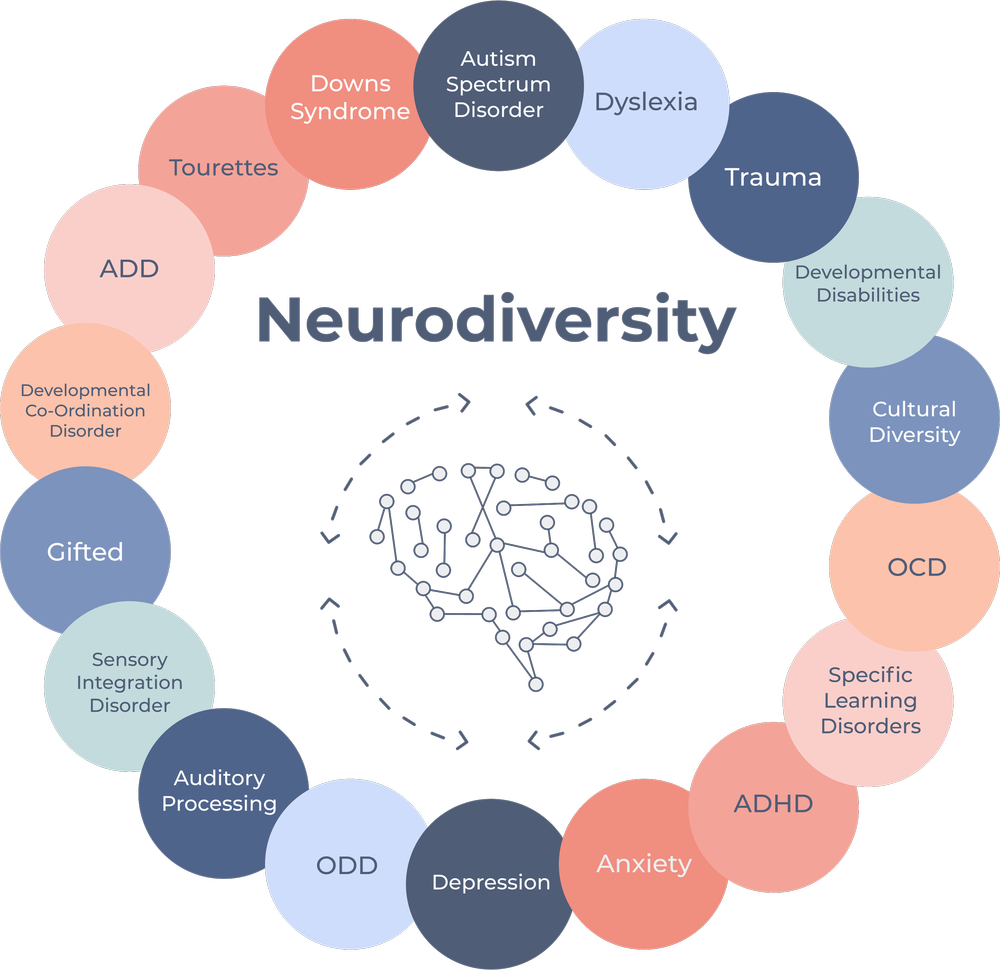
Like I said, I don’t mind people assuming or asking if I am autistic. What I do find annoying is when I explain that I am not autistic and I am not believed. People who barely know me have listened to me explain the previous paragraph and responded with things like “it’s ok to self diagnosis as autistic though, you don’t need a diagnosis” and a recent example “Oh, don’t worry I know lots of people who have only realized they are autistic once they get to college.” I know people mean well when they say things like that, but it just feels like I am being contradicted about my own identity, or that the people telling me those things think they somehow know my experiences better than me and my psychologists.


The idea that neurodiversity just means autism is one that has been so ingrained in the general psyche. Having only one example of something means that all other subsets of neurodiversity are either ignored or resorted into other categories that don’t fit as well. How do you feel about being asked questions surrounding your neurodiversity? I understand the curiosity and desire to learn more about others and the way their lives are impacted by various aspects. My thought though is that unless the person asking is part of disability services or another program where their job requires knowing about neurodiversity, then it is none of their business.
The equation of all neurodivergence with Autism seems to be a common misconception that many in society hold. Perpetuating this misconception can be really harmful because it stereotypes Austim as well, not understanding that ASD can feel and work differently for different people, and that other neurodivergence can as well. Especially since the traits associated with many neurodivergence are most commonly studied in mainly white people and men. Such limited research can deter others from getting proper diagnoses and overall perpetuates distrust in the individual. It must also be extremely frustrating to be consistently told that you are less knowledgeable about yourself and your mind/body than those around you. Your feelings are so valid, and it’s important that you continue to do what’s best for you when these circumstances arise.