
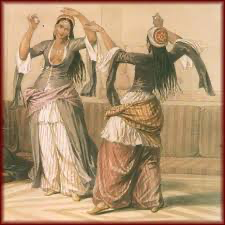
When people think of belly dancing, they often picture a woman in an ornate bra and low-waisted skirt, moving sensually in a way that seems designed to cater to the male gaze. But this image is a relatively modern phenomenon. Traditionally, belly dancing was about cultural celebration—a communal experience where people came together to mark joyous occasions, like weddings, or simply to enjoy the act of moving and connecting. It wasn’t about performing for an audience, let alone for men, but about expressing joy, vitality, and a deep connection to life through movement.
This view resonates with Kimerer LaMothe’s ideas in As the Earth Dances: A Philosophy of Bodily Becoming. LaMothe sees the body as an active, creative force that helps us connect with ourselves, with others, and with the rhythms of the world around us. In its original form, belly dancing captures this beautifully; it’s a form of movement that isn’t about external validation or objectification but about celebrating the body’s ability to tell stories, build community, and honor life’s cycles. Like the dances LaMothe describes, belly dancing is rooted in creativity, joy, and shared connection, reminding us that movement is as much about what we feel as it is about what others see.


Thank you so much for illuminating the art of bellydancing and its connection to the body as active. I truly admire bellydancers and the art through movement that they create. I remember watching bellydancers at events with my mom (she is a henna artist) and always being in awe of how it seemed as if there was no one else there for them, just the connection between their body, themselves, and the ground they were dancing on. It is an utterly misunderstood artform that deserves to be appreciated for not only its beauty, but for its ability to celebrate the body as an agent for movement and community.
This reminds me of the origin of twerking and whining. In Africa women would make the same movements as a way of culture. It had nothing to do with hypersexuality or performing for men but when Europeans came they twisted it. It was a way of telling a story and very spiritual. All females did it, depending on the tribe and region it’d be young girls and women and some places it’d just be women. But now when we see a black girl do that she’s an thot and doing too much and unholy. And it’s just like wow this used to be the norm. Like just another walk in the park not some deviant oh she’s ratchet and sexy thing.