
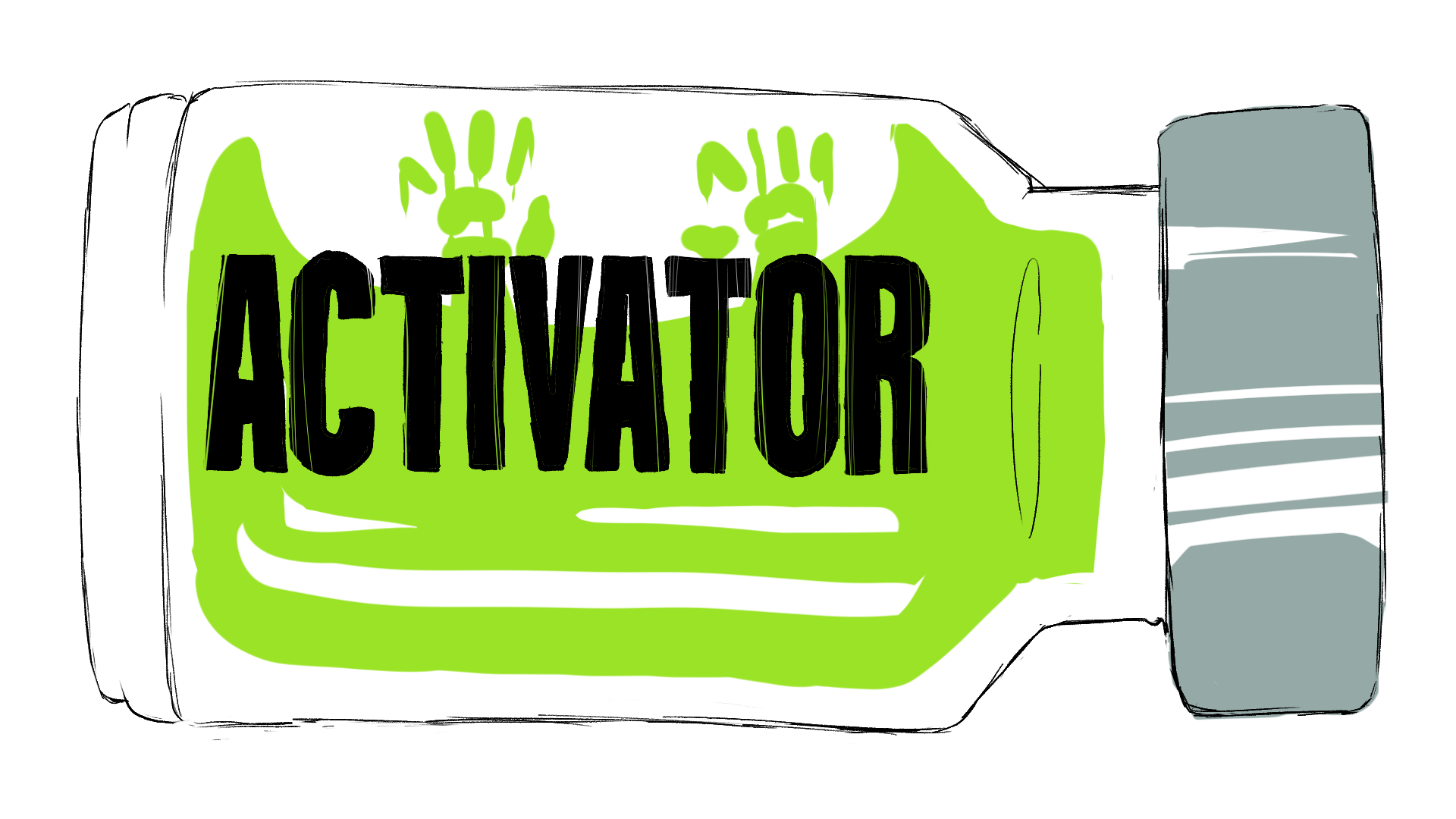
Illustration by me of a vial of “Activator” from the film The Substance with small green hand prints.
The Substance is easily my favorite horror film to come out this year, and probably my favorite film regardless of genre to come out of 2024. It executes common horror tropes beautifully while offering a combination of fresh new ideas that haven’t felt explored in the specific way Coralie Fargeat, the director, addresses them. The film’s plot and general message are also incredibly relevant to politics of Desire and how physical attractiveness is measured among different groups of people.
Elizabeth Sparkle is a character who had access to Desire Capital for the majority of her life, and then upon her 50th birthday suffers the consequences of being “Ugly” for the first time in being fired from her job as a TV show host due to her age (it was not lost on me that the actor who plays her boss, Dennis Quaid, is 8 years older than the actress who plays Elizabeth, Demi Moore). This single consequence of being Ugly socially then causes her to take The Substance, a drug that creates a new, younger, “more beautiful” version of herself named Sue, but not without dire consequences that cause her life to quickly spiral out of control.
In Da’Shaun L. Harrison’s theory in “Pretty Ugly: The Politics of Desire,” he states, “Privilege insinuates that there is a possibility that you can opt out, and that if you don’t feel pretty, then you can’t possibly benefit from Prettiness or suffer the violence of Ugliness. Desire/ability politics and Desire Capital, however, suggest that one does not need to feel pretty to be Pretty…How one benefits or suffers from the subjugation of particular people is not determined by their feelings; it is determined by the identities they embody.” Elizabeth as a female celebrity is someone who has her appearance judged by society in an exponentially harsher lens than those not in a Hollywood sphere (or whatever the equivalent to Hollywood is in this movie) — in fact, in most cases, you simply aren’t allowed to exist in celebrity culture unless you embody certain Desirable characteristics, something Elizabeth realizes when she loses her job (and therefore social spotlight) as a direct result of the space she occupies as an aging — and therefore Ugly — woman.
This film’s big obvious blind spot is its incredible whiteness and overall lack of intersectionality, choosing to approach the topic of desire politics from a cisgender, heterosexual, skinny, able-bodied white female lens. The only Black character in the entire movie plays Sue’s set assistant and has a whopping 2 lines of dialogue in 1 scene, and she is also the only character of color with a speaking role in this film. Elizabeth, played by Demi Moore — an already very conventionally attractive actress — has no outward “flaws” or marginalized aspects to her appearance outside of her age and status as a cis woman. There are no displays of queerness (specifically expressions of gender variance) whatsoever in this film, either. Therefore, the film only addresses politics of desire from two facets (misogyny and ageism) when it has the potential to explore even more axes of “Ugliness” — I could envision a possible horror TV series around this movie where we follow different people’s experiences with The Substance and how the drug plays into their insecurities fostered by societal norms.


Pingback: The Substance: A Commentary on the Ozempic Epidemic – BCM Screen Media