
*Spoilers for the halfway point of the play John Proctor Is The Villain*
Last year I had the pleasure of reading John Proctor Is The Villain for the first time. A new play written by Kimberly Belflower about girlhood, friendship, and what it means to believe women.
My whole life I have been told that I am too much, too loud, and most of all, “too dramatic.” and I’m not alone. Women are taught that their bodies should be smaller and unseen. Women don’t get to take up space; that’s for the boys. Belfower sees and explores this thought through her cast of high school-aged girls discussing the Crucible in their drama lit class.
Now, in case you don’t remember anything from reading The Crucible in high school, I’ll catch you back up.
Arthur Miller created a famous example of a “tragic hero.” A man who gave up his life to protect his good name. He chose not to lie and be killed rather than say that he was a part of the witchcraft.
And then there’s Abigail, she is 16 and works for John Proctor and his wife. Abigail likes to go out into the woods with her friends and dance. When some men caught onto this they accused the girls of witchcraft. Abigail is quick on her feet and rapidly throws the blame onto someone else when the witch trials first begin.
When John Proctor is questioned about her use of witchcraft, he originally lies for her because of the affair/ feelings he has for Abigail.
Usually, Abigail’s story is perceived as one of a manipulative and conniving girl who sets out to destroy John Proctor’s reputation…Does this sound familiar?
Belflower sets her piece in a one-stoplight town in Georgia in the heart of the MeToo movement(2017).
Let me give you a run down of the characters from the scene I will be looking at:
Shelby: Quick thinking 16 year old. Her mouth often moves quicker than her thoughts. She’d been out of school for a month or two and no one knows why. She just returned earlier this week.
Carter Smith: Fun-loving English teacher. Cares about his job; the students love him.
(The other students are important to the plot but are less so important to the text I am showing you. )


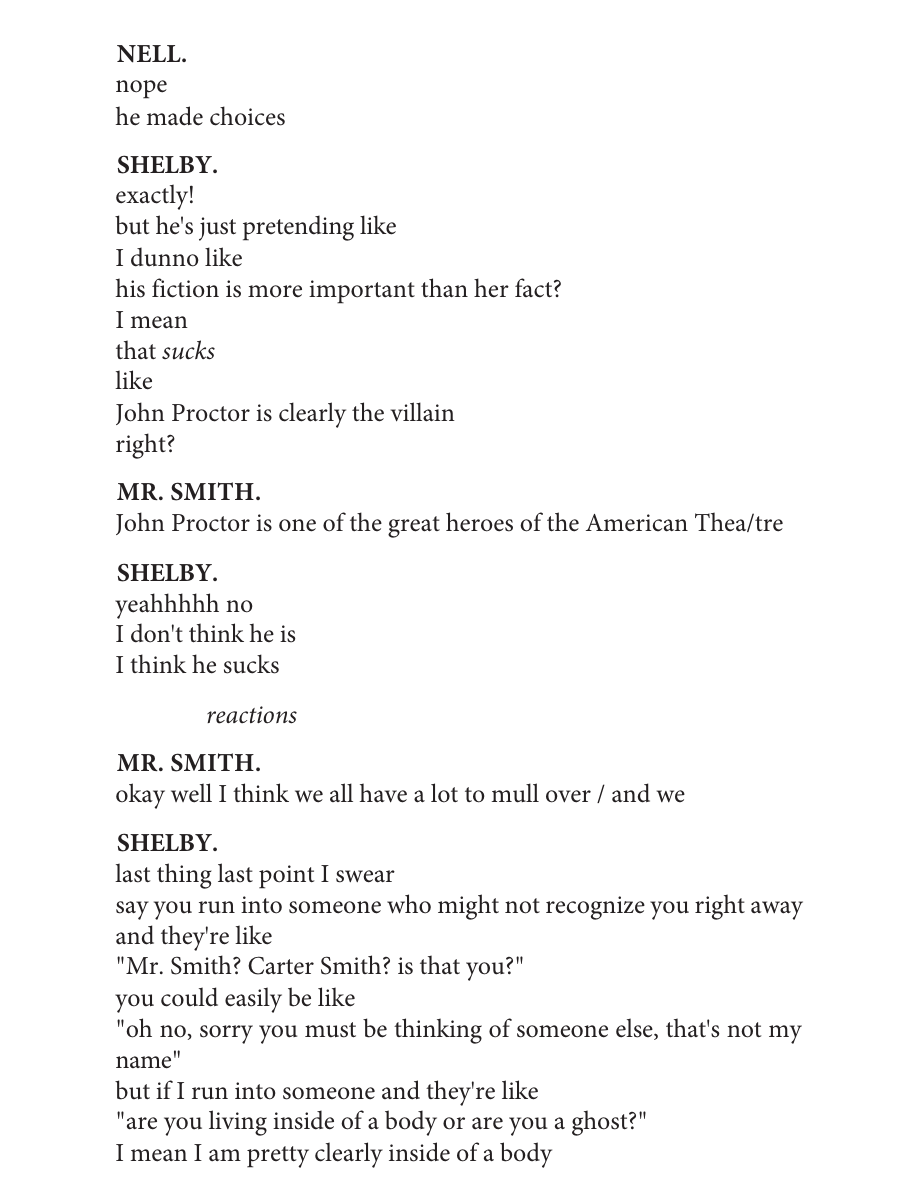

Our bodies and the space we take up is fact. They stay with us for eternity. From a young age we are told not to take up space and that we can’t because we’d be stealing it from men. Oppressors want our space and are terrified of what will happen if we take it back. This is the same concept that Iris Young states in Throwing Like A Girl. The feminine space is supposed to be enclosed and confining. But it doesn’t have to be.
We’re told that a man’s reputation and his “future” are more important than our facts. We shrink ourselves and our experiences so that way the people who hurt us can go on and be happy. His name and reputation means nothing in reality. He can move and change his name and no one will know what happened.
However, our bodies can’t do that. Our bodies remember.
In this play, Carter took Shelby’s space and girlhood away from her, and we get to watch her fight in taking it back.
If you are interested in reading the whole play, here is a link to a PDF:


I saw this play performed by the UMBC theatre department in April and it was just an absolutely incredible experience. My roommates and I all walked out of the concert hall with tears streaming down our faces. We picked it apart and discussed scenes that were very impactful to us on the walk back to our dorm. Seeing John Proctor is the Villain was very impactful to me. Thankyou for the connection to what we learned in class about minimizing women’s bodies and experiences.