In Defense Of Juliet

Juliet, from the titular play Romeo and Juliet, has long been seen as a woman stripped of agency. She is seen as a woman who couldn’t stand to live without her beloved Romeo, so she protested the only way she knew how and ended her own life. This is what the new broadway hit &Juliet says as the show follows Shakespeares wife, Anne Hathaway, as she rewrites her story, now starting with Romeo’s death.
For many reasons, I am not a fan of this musical’s take on Juliet’s life. For right now I will stick with this one point. Anne Hathaway ends up making every choice for Juliet. Anne takes Juliet away from her family and political ties and instead takes her on a girls’ trip to go clubbing around Verona. Without realizing it, by having Anne control every new aspect of Juliet’s life they have once again stripped her of her agency.

I do not believe Juliet is stripped of her agency in Shakespeare’s original piece. I actually believe she is the smartest character in the whole play.

Let’s get one thing straight, Juliet always wanted Romeo and her to be married. In fact this diva demanded that Romeo bend the knee when she said “If that they bent of love is honorable, thy purpose marriage” 2.2 150. She knew what she wanted and communicated it clearly to Romeo.


She also knew how fast things were moving, “It is too rash, too unadvised, too sudden” 2.2 125. She wasn’t dumb and in love, she knew that Romeo was moving quickly. The only reason she decided to speed everything up was that her marriage to Paris was to happen any day now.
And finally, with her monologue in act 3 scene 2, she describes how she is desperately awaiting for Romeo. She repeatedly says, “Come, night. Come, Romeo.” 3.2 17. Now, not to get too rounchy, but Juliet is not just waiting around to just sit in the presence of Romeo, she’s waiting to have sex with him once more.
In modern times, this seems more normal to us, but back in Shakespeare’s day, a high-class woman having sex with a man out of marriage was a big deal. So why do it? Because she knows that if she were to get pregnant with Romeo’s child, her parents would have no choice but to ensure Romeo and her got married.

Now let’s talk about the final scene. She wakes up from her sleep to find Romeo and Paris dead. At this point in history, Juliet would’ve had a hard time moving on now that she is a widow and the feud between the two families would’ve only gotten worse. If Juliet hadn’t used her body and life to protest in the face of both the Montagues and Capulets, how many others would’ve died? The feud would’ve continued and Juliet would’ve been outcast from her family. Yes, she missed Romeo, and yes, she partly took her life to be with him. But to say his love was the only reason is to discount all the other factors Juliet was also dealing with.

So no, &Juliet, Juliet isn’t just a love-sick girl who let a man take control over her life. But instead, a smart and witty girl who acted with wisdom.

Protesting In Antici….pation

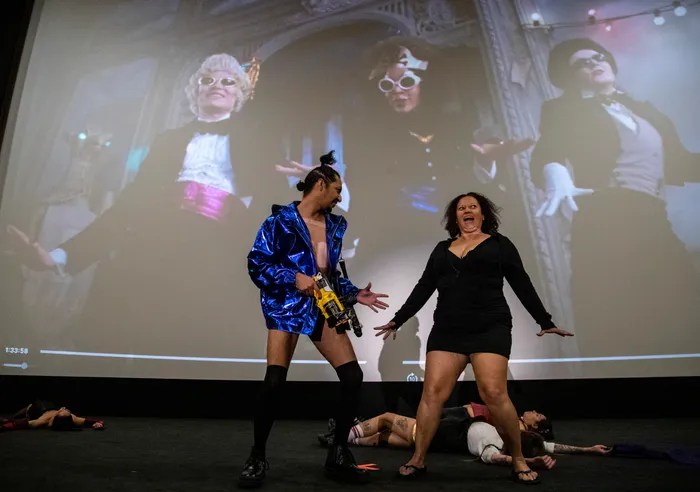
Keely Sherpinskas as Dr. Frank N. Furter performs with Riff Raff and Magenta at the showing of The Rocky Horror Picture Show at Lakewood Theater in Dallas, TX on October 25, 2013. (Alexandra Olivia/ Special Contributor)

After watching Crip Camp there was a scene with a preformer with cerebral palsy preforming in what looked to be a shadow cast of rocky horror (although they could’ve just been singing the one song) it made me start to think about theatre casting version shadow cast casting. 

When you see a theatrical show often the actors are beautiful able bodied people. Who is allowed to play what role is highly gate kept and usually based off of the physical appearance of the performer. 

However shadow casts aren’t kept to that same standard. For those who don’t know a shadow cast is a performance in which a movie is being projected in the back and actors mouth along and do the movements of their parts in front, usually adding in their own gags or jokes. In a shadow cast, anyone can play any role. Regardless of weight, race, disabilities, or even sometimes gender expression. 

This practice started with the rocky horror picture show in the 80s but nowadays plenty of cult classic films have shadow casts such as Refer Madness or The Room. 

Rocky Horror is a gem of it’s time. The plot line follows a cast of queer and gender nonconforming characters through one strange night. Throughout the years of shadow casts it became known as a safe place for anyone who lived outside of the norms. It became a meeting place for those who didn’t have or didn’t feel safe going to gay bars in their area. Because the bar for entry was so low, a lot of people were able to find and explore themselves here. 

There are a lot of reasons why Rocky was so successful but the biggest one was that it was the community that it built. A big part of these shows became shouting things out at the screen (Statler and Waldorf style) to make each other laugh at different things each week. 

They might not have realized it but a laugh is a powerful thing. They connect us. 

A laugh can help us feel less alone and more willing to fight for each other. 

Over the years I have been to many Rocky Horror Shadow casts and let me tell you there’s nothing like it. Some of them are better than others so stay safe if you do choose to go, but no matter what you will laugh, you will feel weird, and you’ll have some fun memories. 

Feminine Envy

In thinking about an oral history of my perspectives and what I can tell, one theme kept with me. It was this idea of Feminine envy and how I wish I could do the things they get to do without a second thought. 

Boys don’t have to think about their surroundings or body. The world wasn’t made to hurt them. 

They can get gas in the middle of the night and not park as close as they can to the machine so there is only space for your car door and the pump. They aren’t looking over their shoulder. 

It’s not that I am mad at boys, it’s that im envious of what they can do. 

They’re allowed to open up their dresser and wear the first thing that they see. Then they have the audacity to say “women spend to much time getting ready” when in reality it is a decision of how we are going to be perceived that day. 

If I wear something too tight, will people think I’m a slut? 

If I wear something baggy, will people think I’m lazy? 

If I wear a really well curated outfit, will people think I’m trying to hard? Or that I wear impractical clothing? 

This all seems trivial but they have an affect on how people treat us. 

Over the span of my life I have made multiple trips to my local giant. The level of which I am dressed will always affect how people treat me. 

If I decide to dress nicely then people stare at me. However, If I need to ask for help employees are far more likely to help me and will sometimes even go out of their way to help me (which could be attributed to that I am a pretty little white woman and the privilege that I hold in that) 

On the opposite side if I decide to dress in sweat pants, a baggy shirt, and no makeup no one will stare at me however I am greeted with side eyes. Maybe a store employee will watch me to make sure I’m not stealing anything. 

When I was a kid everything I was allowed to do changed once my breasts started to develop. Suddenly I couldn’t run, I couldn’t wear my spaghetti  strapped tops, and I had to wear an extra hot layer underneath my shirt. All my friends who were guys now started to act differently towards me, and all my family members couldn’t stop bringing up that I was “a woman now” 

Boys never had an experience like this. Boys didn’t get their childhood taken from them because of their bodies betraying them. 

I have come to love my breasts; they are a wonderful part of me now. However I wish I could’ve come in to my body on my own without the world’s judgmental eyes. 

Comedian Jo Sunday has a bit about when people say “Get home safe” In relation to the way she dresses. She states “Well it’s polite… but it’s really not up to me is it?” https://www.instagram.com/reel/DPe7jwXD6BC/?igsh=bzZ6Ymk4eDRxYzBp

I’d highly recommend everyone to check it out:)

Her Body Versus His Name 


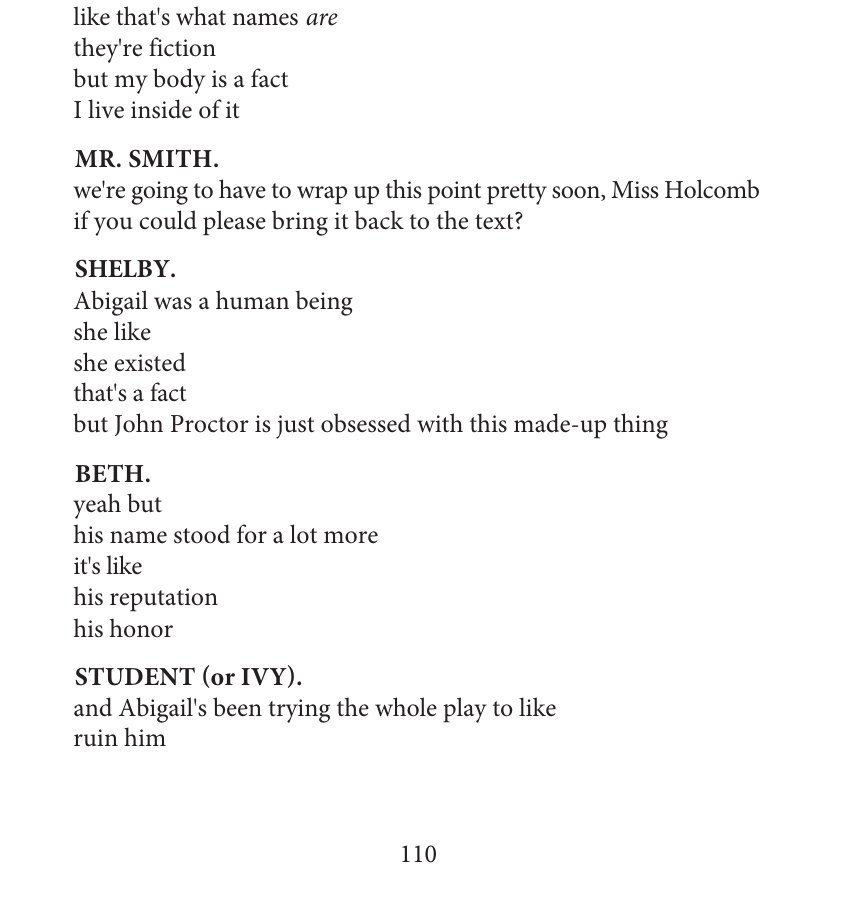
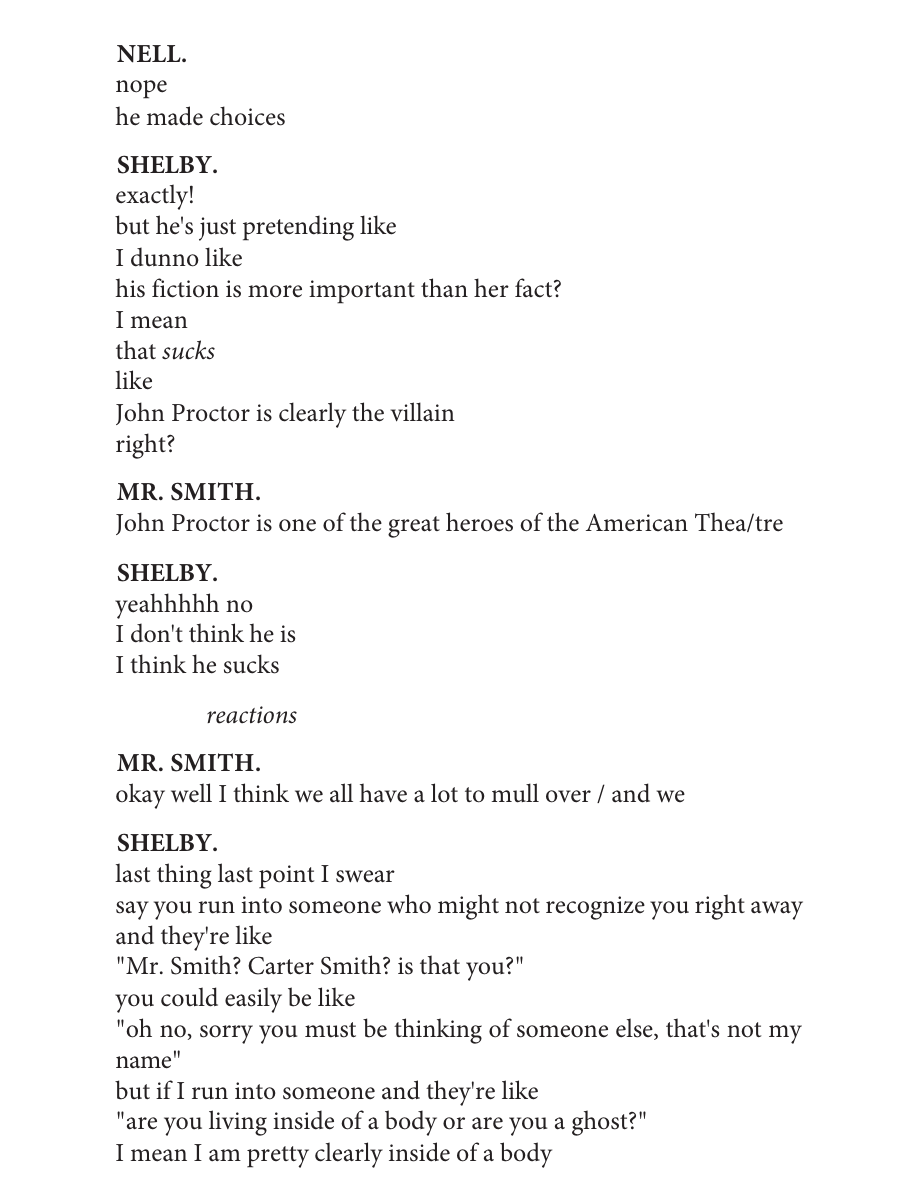
*Spoilers for the halfway point of the play John Proctor Is The Villain* 

Last year I had the pleasure of reading John Proctor Is The Villain for the first time. A new play written by Kimberly Belflower about girlhood, friendship, and what it means to believe women.

My whole life I have been told that I am too much, too loud, and most of all, “too dramatic.” and I’m not alone. Women are taught that their bodies should be smaller and unseen. Women don’t get to take up space; that’s for the boys. Belfower sees and explores this thought through her cast of high school-aged girls discussing the Crucible in their drama lit class. 

Now, in case you don’t remember anything from reading The Crucible in high school, I’ll catch you back up.
Arthur Miller created a famous example of a “tragic hero.” A man who gave up his life to protect his good name. He chose not to lie and be killed rather than say that he was a part of the witchcraft. 

And then there’s Abigail, she is 16 and works for John Proctor and his wife. Abigail likes to go out into the woods with her friends and dance. When some men caught onto this they accused the girls of witchcraft. Abigail is quick on her feet and rapidly throws the blame onto someone else when the witch trials first begin.

When John Proctor is questioned about her use of witchcraft, he originally lies for her because of the affair/ feelings he has for Abigail. 

Usually, Abigail’s story is perceived as one of a manipulative and conniving girl who sets out to destroy John Proctor’s reputation…Does this sound familiar?

Belflower sets her piece in a one-stoplight town in Georgia in the heart of the MeToo movement(2017).

Let me give you a run down of the characters from the scene I will be looking at:

Shelby: Quick thinking 16 year old. Her mouth often moves quicker than her thoughts. She’d been out of school for a month or two and no one knows why. She just returned earlier this week.

Carter Smith: Fun-loving English teacher. Cares about his job; the students love him.

(The other students are important to the plot but are less so important to the text I am showing you. )

Our bodies and the space we take up is fact. They stay with us for eternity. From a young age we are told not to take up space and that we can’t because we’d be stealing it from men. Oppressors want our space and are terrified of what will happen if we take it back. This is the same concept that Iris Young states in Throwing Like A Girl. The feminine space is supposed to be enclosed and confining. But it doesn’t have to be.

We’re told that a man’s reputation and his “future” are more important than our facts. We shrink ourselves and our experiences so that way the people who hurt us can go on and be happy. His name and reputation means nothing in reality. He can move and change his name and no one will know what happened.

However, our bodies can’t do that. Our bodies remember.

In this play, Carter took Shelby’s space and girlhood away from her, and we get to watch her fight in taking it back.

If you are interested in reading the whole play, here is a link to a PDF:

https://www.cliffsnotes.com/study-notes/24356801 🙂