
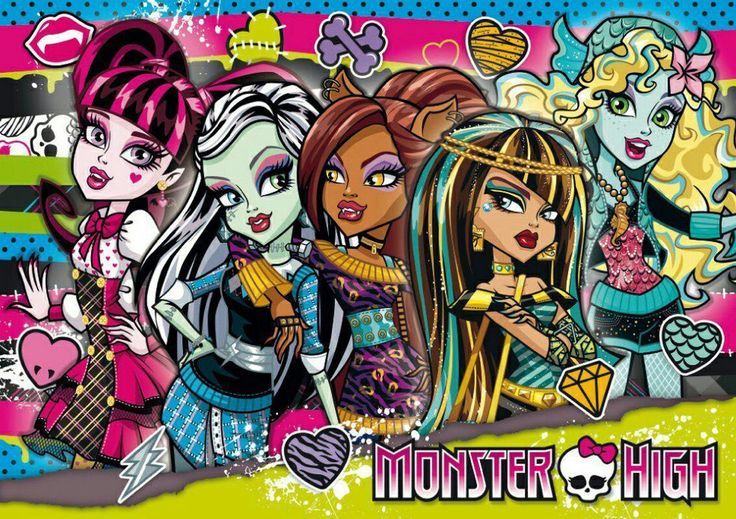
I was completely infatuated with the Monster High franchise growing up. Bed sheets, pajamas, shoes—whatever it was, I probably had it. My parents never quite understood the whys or hows, and neither did I until I reached young adulthood and still found myself rewatching the movies for comfort.
I think part of me has always been drawn to the idea of something different, such as monsters themselves. There was something surprisingly comforting about characters that were so incredibly different from each other. Whether they had fangs, stitches, or scales, they still were able to exist wholly as themselves without those differences diminishing their existence. They had friends, lovers, and full lives. They could exist without having to conform to someone else’s expectations. Looking back now, I realize my attachment to Monster High was more than just the fashion and interesting stories. I saw something in these characters I desperately wanted for myself: to accept and embrace every bit of myself, monster and all.
Reading both Stryker’s “My Words to Victor Frankenstein” and Gay’s “My Body is a cage of my own making”, it immediately reminded me of conversations I’ve had with my friends and our own feelings as monsters. Being the fat Black girl in predominantly white schools all my life was nothing even close to easy. When you later add my sexuality to the mix, it was downright impossible to not feel like a monster.
There is something so isolating about feeling like you’re different from the people around you, especially when you’re still learning who you are as a child. It becomes difficult to separate the way people perceive you from the way you perceive yourself, leading me to believe that I was a monster. I internalized the ideas forced onto me, thinking everything that made me me was something that needed to be corrected and hidden for even the slim chance at being what I thought normal was.
Stryker made me think how often we associate monstrosity with something unnatural or undesirable. Although my experiences are different than those described in the text, I found myself thinking about what it really means to be a monster. Why are certain bodies and identities demanded to be changed? If they don’t conform, why are they monstrous? Gay’s text pushed me to consider how society’s judgements can become internalized, shaping the way we inhabit and understand our bodies. Even when no one is around to judge us, even when we’re already seen as monsters, we still carry those expectations and intertwine them with our own perceptions of ourselves. I began to think about how much my own discomfort shifted from other people’s words to my own words. I was telling myself that I was too different. Even now, I still find these words circle my mind. When I sit in class and feel the arms press tightly against my thighs and not my peers, I feel like a monster. When I see people’s reactions after explaining that my sexuality is unlabeled and that I’m not confused, I feel like a monster. When I enter the room and am the darkest one there, I feel like a monster.
I am a monster. But not in the way I was taught to believe. I think back to the franchise I grew up loving and their monstrous identities—both literally and figuratively. I’ve begun to realize that I was desperately searching for permission to just exist within this show. Yes, I still have those moments when I look at myself through others’ eyes. But I don’t think being a monster was ever the problem. The problem was believing that I needed to become something different from myself to prove I deserved acceptance. If I am a monster, then I want to learn to love myself fully as the monster I am. Just as the motto of the Monster High franchise says:
“Be Yourself. Be Unique. Be a Monster.“


I loved Monster High as a kid, but I never actually connected its messages to our class before. Now that I can see it, it seems like such an obvious connection to make. I wonder what Stryker and Victor Frankenstein would think about Frankie.
You’re so right about body issues starting at a young age. Most of the time kids could care less about how they look however they are always put into a society where they have to conform to a certain mold to be considered alright to even exist. I think that a lot of adults want to teach their children young because they don’t want them to go through the same humiliation they did or they truly believe this is how girls and women should be. It feeds into an endless cycle of control where they can never truly be how they want to be. So when I see things like Monster High that try to break that cycle, it makes me really happy!
I love how you showed that even though a lot of people will get labeled as a monster because of their differences, reclaiming that label of ‘monster’ and embracing your differences. its very ironic how Monster High was demonized when it first came out, despite the fact that being able to accept what makes you unique is a very important thing to learn during childhood.