
my best friend

TW: Eating disorder, weight

Eating Disorder has always been my best friend. I was 12 when I met her, 15 when I dropped her, 17 when I met a new version of her, 18 when we become basically one person, 20 when I grew distant, and 22 when she came back into my life as the worst version of a person I could ever meet. Almost 23 and we’ve had so much history together it’s hard to get rid of her completely. She’s blessed me but also ruined me and I hate her but I love her at the same time. I never experienced “fat” until I was 18 but I was always different. Growing up everyone hated me so I internalized it and became my biggest hater. I couldn’t change my eye shape, or the ethnic food my mom packed for lunch, or the fact that I was “awkward” in a bad way, but I could change how much I weighed.

I’ve been many weights in my life and the social interactions I’ve had at each one would be enough to send a very mentally unstable person over. 110- I look like I’m dying. I need to eat more. I’m doing it for attention. No one is going to be sexually attracted to me. I’m a child. 135- I look so healthy. I’m too skinny. I have no ass. My body is perfect. 150- I’m fat-skinny. All men want to fuck me. I’m a threat to other women. I hate how I look. I’m too skinny. 170- I look hispanic. I’m greedy. I’m fat. I’m ugly. I need to lose weight. I have a fat ass. 190- I am obese.

My boss used to tell me that he preferred when I “had more weight”. My ex boyfriend told me he would leave me if I ever weight more than 140 pounds. All the women on the internet want a fat butt and a small waist. My doctor tells me that 150 pounds is overweight. I was pregnant and hated my baby because I gained 10 pounds in the first couple weeks. Why is it so okay for society to tell me how much weight I should be.

A decade later and my best friend is still around. She haunts me but comforts me when I need her. When I hate myself I run to her crying to change me. When I love myself she’s in my ear saying I need to change. When I say to other people the words she tells me they have a different opinion. I’m skinny. I need to lose weight. I love myself but I shouldn’t. Back and forth back and forth I know what my best friend wants me to look like and I know what society wants me to be but I’m the one that has to live with this fuck ass best friend forever because she will never leave.
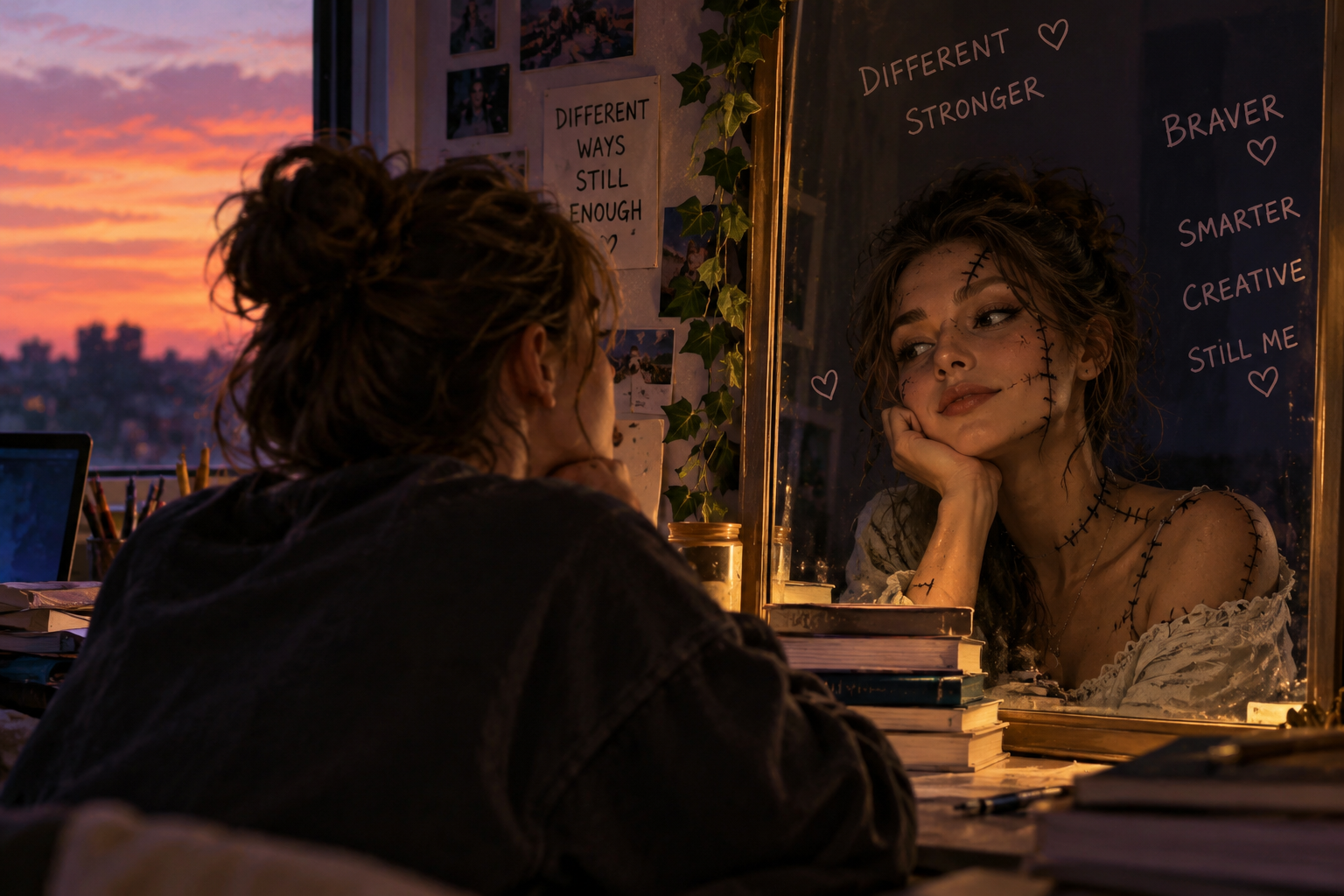
Who Decided What “Normal” Is?

When I first read Susan Stryker’s “My Words to Victor Frankenstein,” I honestly wasn’t really sure what to expect. I thought it was going to be mostly about Frankenstein and being seen as a “monster,” but it ended up being more about how people are treated when they don’t fit into what society sees as normal. I thought it was interesting how Stryker took the idea of being a monster and basically made it into something empowering instead of something negative. That part actually made me think about my own experiences with learning. I have had to find different ways to learn and get things done because of my learning disabilities, and technology has helped me a lot with that. Sometimes I used to feel like needing a different way of doing something meant I wasn’t as capable as other people, but I’ve realized that everyone just learns and does things differently.

Another thing I liked about the reading was how Stryker didn’t seem interested in changing herself just to make other people more comfortable. She took the things that made her different and made them part of who she was. I think that is something a lot of people can relate to, even if their experiences are completely different. In college, I’ve definitely realized that there isn’t really one “right” way to learn, think, or be successful. Everyone has their own stuff going on that you might not see just by looking at them. I didn’t understand every part of the reading right away, but I liked that it made me think about how quickly people judge things they don’t understand. It also made me think that being different doesn’t automatically mean something is wrong with you. Sometimes it just means you have to find your own way of doing things.

Choosing My Many Selves

“Ion know, but they say my attitude change every time I change my weave.” – City Girls.

That’s how I feel every time I look at myself in the mirror and I have my new hair in. I feel like a different version of me.

[Read More]

I have loose curls that make me feel more island and tropical, and I wear that when the weather’s nice, or I have my straight hair that I wear in the winter, and I just comb it with my fingers and you can’t tell me anything. Being East African as well, a lot of people can’t really pinpoint where you’re from, so I get lots of different assumptions as to what my ethnicity can be. It’s a mini version of what happened to Adichie with her roommate. My identity isn’t consistent. Every day when I wake up, I choose which layer of me to identify with most, depending on my mood and how I feel.

In “The Danger of a Single Story,” Adichie talks about how a single story is when people reduce someone to one narrative. Her roommate pitied her, was surprised by her English, and assumed she couldn’t use a stove. She also admits she held a single story herself about Fide’s family, who she only saw as poor, until she saw the basket his brother made. Her identity is multi-layered. I picture her as your African auntie one day, and your award-winning, very educated writer another day. It doesn’t mean she can’t be both.

I found hair to be a perfect example, because as a Black woman, changing your hair gives you a certain confidence, and it softens or toughens up your appearance. You could go for something bold and eye-catching, or something so people just don’t look at you. When you look in the mirror you can decide, “I want to wear this hair with this outfit, and I want to give off this vibe,” or I could do something else. The difference is that I’m choosing my many selves. At moments, Adichie and MJ had one self chosen for them, until they took the narrative back. But I can’t control how other people read me. Whether my hair is curly or straight, people still guess at my ethnicity, and Adichie’s point is that whoever has the power decides which story sticks.

In “Namesake,” MJ’s experience of people judging their identity shows how harmful it can be when others decide how you’re allowed to express yourself. For MJ, it wasn’t about being a tomboy and not being a girl or a guy. They were themselves. That is how they wanted to dress, that is how they wanted to carry themselves. It didn’t have to be about gender until people made it about that. MJ didn’t realize they were an “it” until other people defined them that way. MJ’s partner was the one who was pregnant, and MJ chose the name “baba” for their role. Just because they didn’t conform to gender norms doesn’t mean that they can’t be a parent as well. Is parenthood limited to a woman and a man?

I don’t mean to complicate hair, but I probably overcomplicated it on purpose. You could be whoever you want, as long as you’re the one choosing. Making identity a bigger deal than what it is might stress my hair stylist out, because I like to change my identity every day. So the next time I change my hair, I might be a little ruder. Watch out for that. How do you feel when other people decide who you are instead of you?