Growing up, I knew how to research. Researching stuff was my jam, and I built that skill through years of new hyperfixations and special interests. So, when I started to notice some psychiatric concerns and neurodevelopmental differences between me and my peers, I got to the bottom of it.
Even after a few trips to the child psychiatric ward during a few incidents in my teen years, I always ended up being blown away by how little the psych professionals seemed to know about diagnoses and treatment options. On top of that, because I had some background knowledge from my own research, it seemed to make psych professionals more dismissive of my concerns. Automatically, if you have done research that leads you to a diagnosis you think fits, you’re angling for a diagnosis just cause you want one and not cause you need the help. I have written a few of the particularly frustrating incidents below. Most incidents are from Johns Hopkins.
When my social anxiety and sensory issues were particularly debilitating, I brought up whether or not a psychiatric service dog would even be an option for me. To which the psych team looked at each other in confusion and then asked me, “What’s a service dog? You mean like a seeing eye dog for blind people?”
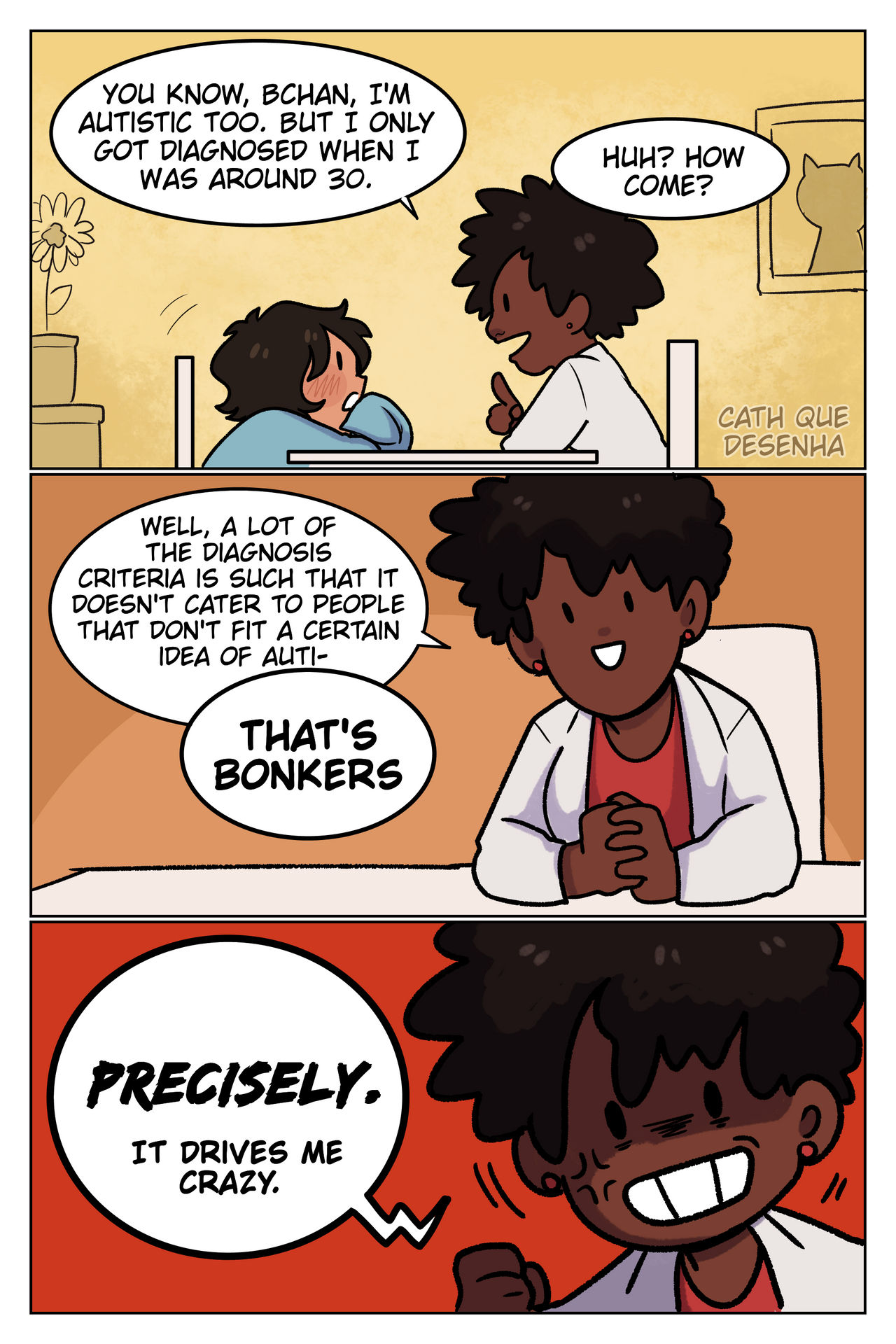
I brought up that I likely have Autism to the psychiatrist(?) assigned to me. She interviewed my parents and decided I didn’t fit the childhood criteria enough to fit the diagnosis, without interviewing me at all. Then, she tried to diagnose me with OCPD, and when I said I didn’t have those symptoms, she visibly deflated as if I had disappointed her
A different psychiatrist told me that even if I did have Autism, there wouldn’t be a point in him giving me a diagnosis because I’d be too high functioning for it to matter
I brought up to the therapist that I wanted to pursue a psych eval. She said, “What do you think they’ll find?” and I said, “depression”, then she actually laughed at me. I did get diagnosed with severe depression, obviously, so I’m not sure what her problem was
I’m not sure what the rules are for becoming a psych professional, but this track record is rough, and not nearly the worst I’ve seen. Please do better.
When talking about disability justice, we must reflect on the systems in our everyday lives. UMBC is a good place to start.
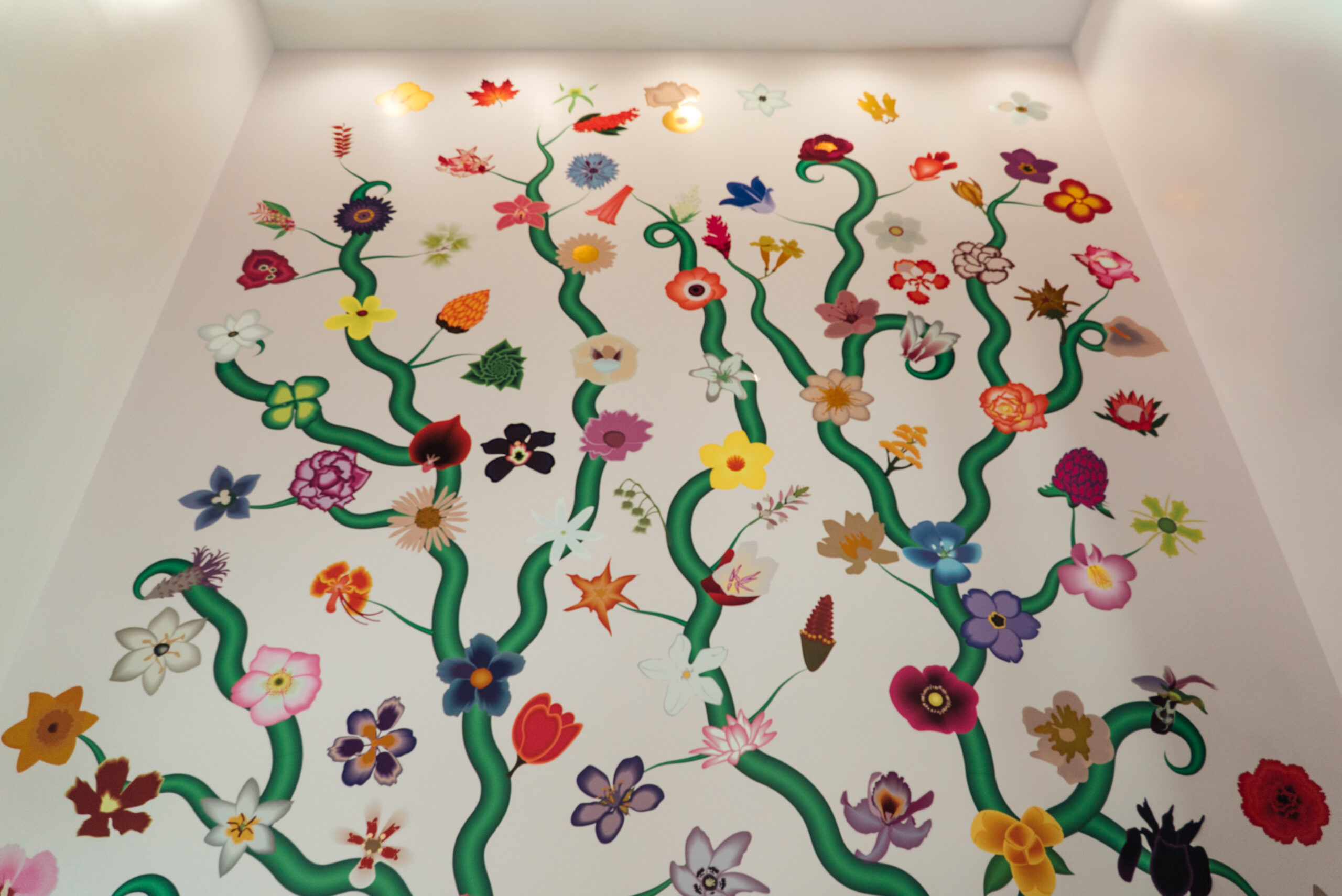
This is the “Inclusive Excellence” art from one of the entrances of the UMBC Commons
UMBC is a very diverse campus. A large portion of the student body is international students, and statistically speaking, a significant number of students at UMBC are disabled. When UMBC brags about its campus inclusivity, it makes me pause. UMBC misses the mark consistently when it comes to accessibility and inclusion of disabled people.
The accessible routes are long, often involve hills, and are mercy to whether or not a door opener has been fixed in time. There isn’t live captioning included in events, even though it would be an easy way to include Deaf and HoH people, people with auditory processing disorder, brain fog, sensory sensitivity, and those who English isn’t their first language. The campus activities include a consistent rotation of bingo and karaoke. Bingo would be very accessible for anyone to participate in if the event organizers clearly displayed the letter and numbers called on screen, but I have never seen any of the campus event organizers do so (correct me if you have). Karaoke at least has lyrics on screen most of the time, which fulfills a small portion of the live captioning need.
When it comes to simple, obvious things like these, I can’t help but feel angry. In most cases, I’ve found that what’s even more uncomfortable to nondisabled people than a disability advocate is an angry disabled advocate, so the anger doesn’t help. When I’m not angry, I’m tired, and either way, I am the one experiencing mental and emotional strain while the people in charge of whether or not all students should have access to events still do not care. It is 2025, do not bullshit me, you know you should have captions on screen. And it pisses me off to no end when an organizer says that the disabled person has to email the organizer in advance if they wanted that. Every student should have the opportunity to look on myUMBC and decide in the moment whether or not they want to spontaneously go to an event. No student should have to warn the event organizer that they’re coming just to participate. Disabled or not, UMBC takes the tuition payments all the same.
Special shoutout to the sunflower training program. It’s not that I think the training shouldn’t be there. It should, and I’m glad it is. But there are things that should obviously be made more accessible on campus that the office has not fixed, and getting accommodations from this office can be such a dehumanizing process. One of the people from this office proceeded to be ableist and all around awful while having this sticker in their email ending.
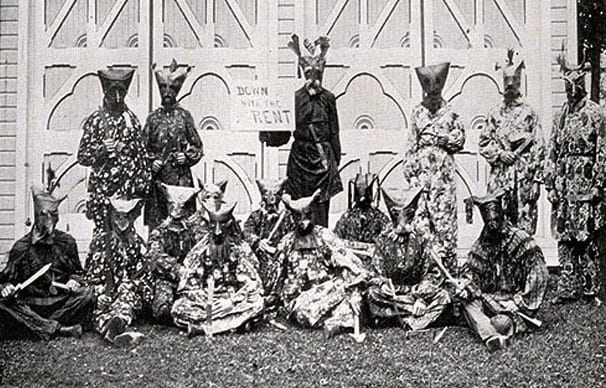
One of the Disability Visibility Project readings titled “Unmasking Mask Hate: The Racial-Criminal Pathologization of Dissent” by Leah Harris and Liat Ben-Moshe brought up the spread of anti-masking legislation and its impending arrival in Maryland. The right to mask at protests is not a new debate; the first U.S. anti-masking law can be traced back to 1845 in New York. That law made it illegal to be “disguised and armed,” though reports on the motivation behind the law can differ by source. According to Robert A. Kahn, a law professor at St. Thomas University of Law, the law was put into place to combat KKK terrorism. The Antebellum (pre-Civil War era) was from 1820-1861, so the timeline seems to check out (Kahn). The Anti-Defamation League also referred to the KKK as the reason for the first anti-masking law in New York (“#UnmaskhateNY Enough Is Enough”). But according to AskALibrarian on NYCourts.Gov, the anti-masking laws were in response to the 1845 anti-rent riots in which farmers were unable and unwilling to pay rising rent prices to their landlord, tension rose between the landlords and the struggling farmers, and what followed was a protest made up of young men and boys of the group dressed up as their interpretation of Native American people rioting against law enforcement (“What Was the New York Mask Law? – Ask a Law Librarian”). The law enforcement officers had come to the farmer bearing legal documents and the intention to sell their land, but the conflict escalated into a riot with multiple deaths (Rey). A detail that helps distinguish the law’s intent is that the Governor who signed it, Silas Wright, has been remembered for his harsh stance against the violent actions of the anti-rent riot movement.
Photo of Anti-Rent Protesters (Rey)
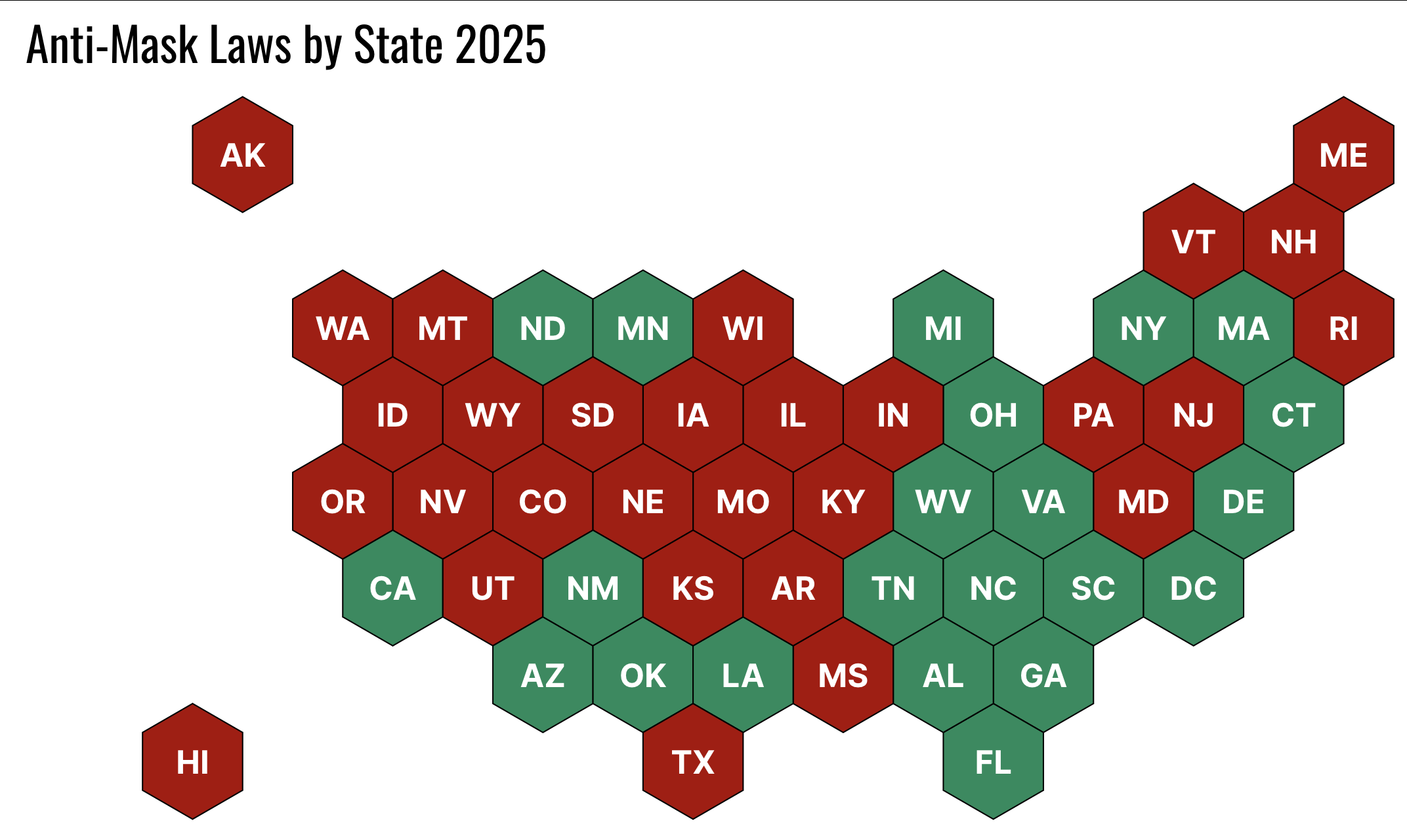
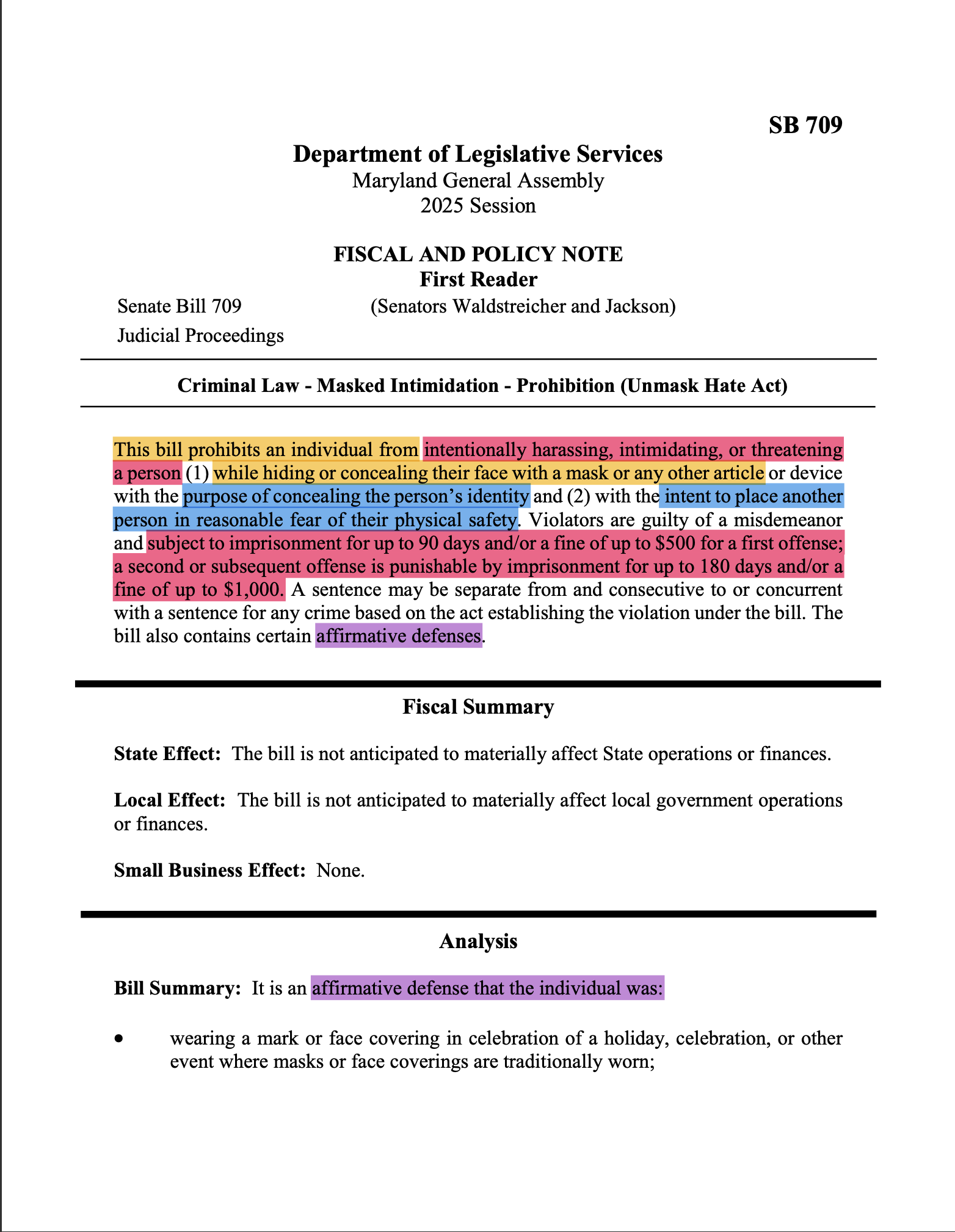
Currently, 22 states have anti-masking laws (“Anti Mask Laws by State 2024”). Most of these laws focus on the intent of the person using the mask, banning the use of a mask for the purpose of intimidating others, loitering, and hiding one’s identity during a crime. Maryland does not have an anti-mask law, but that may not be the case for long. The Masked Intimidation, aka the Unmask Hate Act, has gone through its first reading by the House as of February 2, 2025, and has 9 more steps to go through before landing on the Governor’s desk. Let’s review this law and consider its potential implications for peaceful protestors.
States in green have anti-masking laws in 2025 (“Anti Mask Laws by State 2024”)
Masked Intimidation AKA The Unmask Hate Act
SUMMARY OF THE LAW
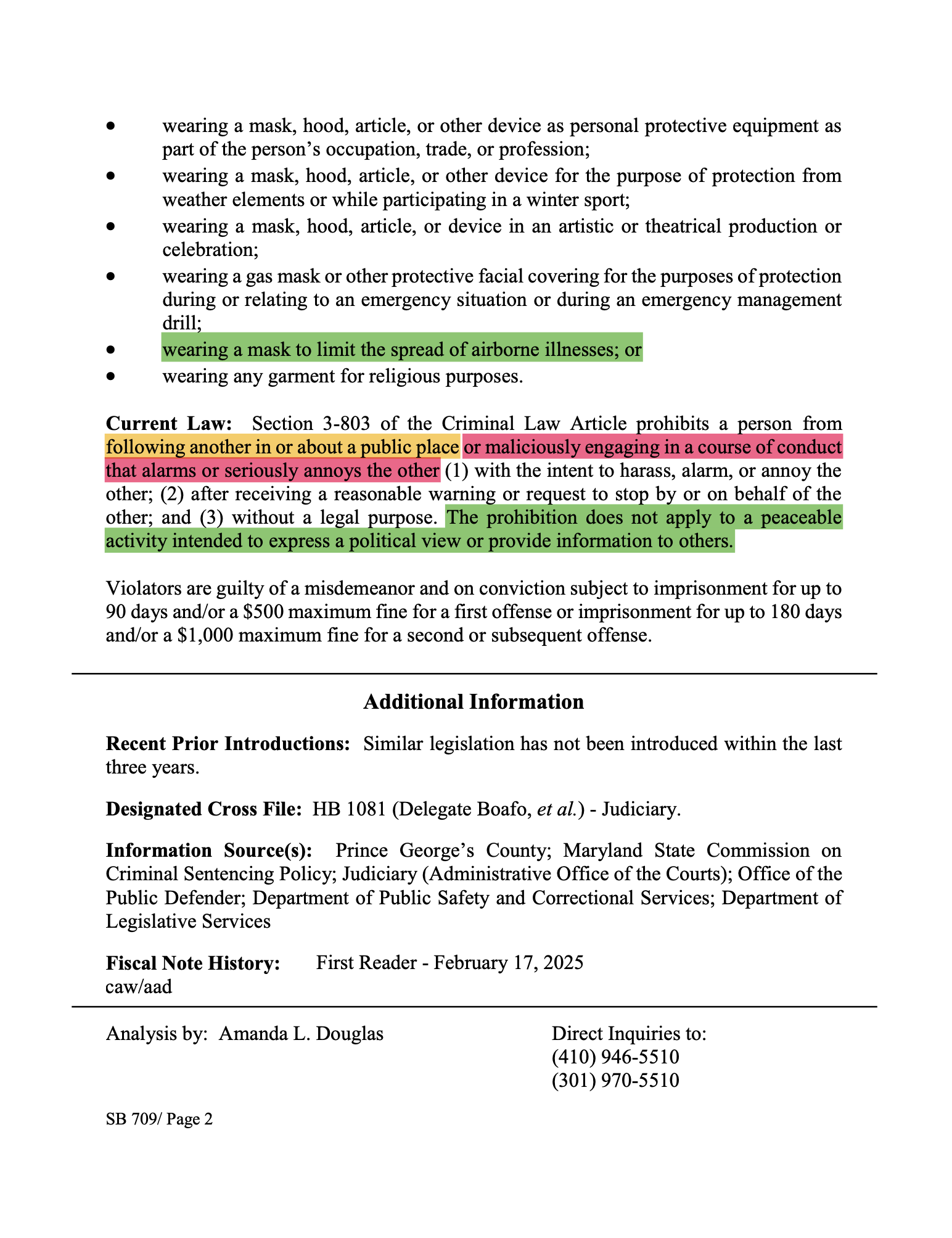
The anti-mask law prohibits people from intentionally intimidating, harassing, or threatening others when wearing a mask to obscure their identity. The law outlines excusable reasons a person may be wearing a mask: holiday celebrations, protective equipment for a trade, weathering elements, religious purposes, or to prevent the spread of an airborne illness (“Legislation – HB1081”). At first glance, this law seems like it could help with the issues of political violence, racial violence, and hate crimes, but how will this be used in the legal and judicial system? Does a peaceful protest count as intentional intimidation to some police officers and court officials? Are the potential 90 days of imprisonment or $500 upon first offense meant to deter dangerous extremists or silence activist action?
UH, WHO WROTE THIS?
To better understand legislation, I research the person behind it and their values. This law was proposed by Delegates Boafo, Simpson, Toles, and Vogel, all from the democratic party. Delegate Boafo has contributed to notable laws around protecting underserved minority communities. Most notably, the Maryland Values Act, which puts strict rules against ICE entering private areas of sensitive areas if they don’t have a judicial warrant (“Legislation – HB1222”), and the Eric’s ID Law, which gives disabled adults the option to add a butterfly to their Maryland ID as a way to communicate to cops that they have a hidden disability (“Legislation – HB0707”). Delegate Boafo’s work towards anti-discrimination legislation in Maryland suggests that this newly proposed law was intended to prevent antisemitic masked intimidation incidents, as outlined by the Anti-Defamation League about perpetrators in New York (“#UnmaskhateNY Enough Is Enough”). But, with a few cases of protestors being arrested at rallies, and the current president putting out social media statements including “MASKS WILL NOT BE ALLOWED to be worn at protests” and “What do these people have to hide, and why???”, who’s to say that this law won’t be interpreted differently than Delegate Boafo may have originally intended (Harris and Ben-Moshe).
…So, Do We Love It or Hate It?
This law is in its first of many steps before it reaches the governor. More information and official writing on how this could affect peaceful protestors is needed. What do you think about this law?
Rey, Oskar E. “Antimask Laws: Exploring the Outer Bounds of Protected Speech under the First Amendment—State v. Miller, 260 Ga. 669, 398 S.E.2d 547 (1990).” UW Law Digital Commons, 31 Dec. 2018, digitalcommons.law.uw.edu/wlr/vol66/iss4/10/. Accessed 8 Oct. 2025.
“What Was the New York Mask Law? – Ask a Law Librarian.” Nycourts.gov, 2020, askalawlibrarian.nycourts.gov/legalresearch/faq/410210.
The reading in Docile Bodies reminds me greatly of the disability acceptance movement and modern strides in autistic advocacy.
Docile Bodies describes how society seeks to control individuals by controlling how they move their bodies. The written work focuses mainly on people and general, and then the differences in how it may present for women and men. I will be focusing mainly on their comments on humans and general and how it may relate to autistic people.
“A body is docile that may be subjected, used, transformed, and improved” – Foucault, Docile Bodies, pg.136
Autistic people often have similar experiences of their stimming being shunned by members of authority, peers, family, and strangers. Receiving strange looks, biting comments, or disappointed speeches in response to moving their body in the way they felt fit. Though modern ABA therapy is stated to help clients learn to manage their stimming, and not eliminate stimming completely, it can be said that the way in which medical professionals have treated stimming is less than ideal. Stimming is seen as a disadvantage in social spaces, a way of making yourself stick out like a sore thumb, even sometimes interpreted by strangers as “performing disability”. Masking autistic traits is a way of fitting in as a docile body.
Many Autistic advocates and content creators have advocated for the freedom to stim and posted videos of stimming to help normalize the behavior to non-autistic viewers. It is important that if we ever feel inclined to judge or frown at someone moving their body, how they see fit, we reflect on whether that’s something we actually care about them doing, or if we’re reflecting the docile bodies message that was pushed onto us.