
Aren’t Gender Neutral Clothes… Just Clothes?

The dreaded boys section and girls section. The first thing you see when you walk into a store that sells clothes is that divide between blue and pink.

On one side is camouflage, trucks, dinosaurs, superheroes, and dark colors. The other is glitter, bows, cute animals, hearts, flowers, and bright colors. I didn’t specify which one was boys and which was girls but I didn’t have to, did I? Why has society spent so much time telling us these are the only two styles that exist, and they exist only for one of two genders?

My first experience shopping in the mens section was in middle school. I started with graphic t-shirts because I liked the fit better (women’s shirts: why do you insist on being so tight around the armpits?). I felt more comfortable with the looser fit. I then experimented with other types of shirts (I’ll be honest, it was flannels) and jeans. Mens jeans just have so much pocket space. Come on, women need pockets too. Where else would we keep our rocks? Experimenting with clothing came with questioning my gender. Suddenly I was stuffing my hair into my beanie to see what I would look like.

I can’t remember how, but I grew out of that and started shopping in the womens section again. Whether that came with the embarrassment I felt while wearing mens jeans around girls wearing skinny jeans and skirts, or just a change in my personal style, I couldn’t tell you.

That doesn’t really matter because I’m back in the mens section. And what I’ve noticed while exploring my nonbinary identity is that there are now more shops that sell gender neutral or unisex clothing. But what does that mean? Scrolling through different websites, it usually just means mens clothing that they also show female models in. Dark colors, boxy fit, usually street wear. I know there are websites and shops out there that actually sell good gender neutral clothing, so just pretend I’m not talking about them. Right now I’m talking about stores like PacSun. Most of what is in their gender neutral collection might as well be in the mens section. It’s almost like they think gender neutral means traditionally masculine. Why are designers so afraid of putting traditionally feminine clothes on male presenting people?
#LazinessIsOverParty

We’ve been talking a lot about how people with disabilities are called lazy for needing accommodations. But what does that even mean? I’d like to talk about it. Disclaimer: I’ve had three cups of coffee today and this post is all over the place.

If I asked you to define laziness right now, off the top of your head, what words would you use? Unproductive or unmotivated? Lacking energy/effort or unwilling to do work? Sluggish, inactive, sloth? Couch potato?

Procrastination is probably one of the first to come to your mind. Because we always attribute being productive to being successful and being unproductive to failing. (Capitalism, am I right?) You are not considered a valuable member of society unless you are giving 110%, 100% of the time. You have to be on all the time. You have to prioritize your job or your schoolwork above everything else in your life, including yourself. And for a lot of us, it is the fear that we could fail that keeps us from being “productive.” Or maybe it’s just that we aren’t putting our energy toward things that society approves of.

I used to want to be on Broadway. I wanted to apply to colleges as a musical theatre major. That’s where my energy was going when I was in high school; I was working on my acting and my voice. I can’t even count how many times I was told to pick something more realistic, more practical, because acting was never going to work out for me. So I said fine, whatever… I didn’t get into my first choice school anyway, so I guess I’ll just give up on theatre. I still wanted to do something I really cared about, though. So I chose GWST and was really excited about it. Again, people questioned me. Oh, that’s… interesting… and what do you want to do with that? What kind of job will that get you? How are you going to find a good job after college? Firstly, it’s none of your business. Secondly, why can’t I just get a degree in something that I enjoy and want to be more educated in? I didn’t even want to go to college in the first place, but everyone got in my head about getting a job when I’m older. Prospective jobs need to see that I payed well over $100,000 on a degree that cost me my mental health, and probably isn’t useful for the position anyway. Society rewards jobs that need a college degree over jobs that don’t, even though the jobs that don’t (food service, grocers, janitors, garbage collectors) are for services that we need and benefit from every day. Yet these same people will get mad that no one wants to make them a Big Mac for $9 an hour.

Where was I? Oh, right: laziness.

Instead of calling ourselves lazy, we should think about why we are using that term. Most of the time it’s because it is the easiest word to describe what we’re feeling and going through. If you are feeling unmotivated and unfocused, if you are fatigued, or if you can’t find pleasure in doing things that you usually love, you might blame it on laziness. Or, if you have a mental illness or other disability, you might think that being lazy is a symptom of that. But here’s the interesting thing: ‘laziness’ is not a psychological term.

No one is going to include “laziness” in the list of symptoms for depression. They might, however, list lack of motivation, lack of concentration, loss of interest, that “empty” mood, pessimism, fatigue, self-doubt, etc. All of these symptoms are things that would make someone procrastinate or seem lazy to an outsider. One blog I found on the myth of laziness says that “even if laziness did exist, it only describes a set of behaviors – the symptoms. It doesn’t describe or explain the cause of so-called laziness.”

So next time, instead of judging someone for being lazy, ask yourself what conditions around them have made them act the way they are. Instead of judging a disabled person for needing an accessible parking space or any other accommodation, ask yourself why society functions in a way that forces people with disabilities to even need accommodations… and then stigmatizes them for asking.

(One) problem with the fashion industry

I love shopping. I love clothes. I love looking at outfit inspiration on Pinterest, TikTok, and Instagram. Whenever a new trend comes out or a new aesthetic becomes popular I want to restock my wardrobe with as much of it as possible. There are really only two reasons why I can’t do that. One, obviously, being that I am an unemployed college student with no money. The second, the one that I will be discussing, is that Nothing. Fits. Me.

POV: You walk into your favorite clothing store looking for a new pair of jeans. The ones you are wearing are a size 14, in a boyfriend cut. If you shop in the mens department you’re probably thinking what the hell does a size 14 mean? I cannot answer that for you. I don’t even think the people who make and size the clothes could answer that. Because when you get to the jeans section, you are overwhelmed with choices: there are different washes, lengths, styles, and fits. Some are skinny, curvy skinny, boyfriend, mom jean, loose mom jean, straight, flared…. And I can guarantee you that if the store even carries a size 14, which is so rare, none of those pairs will fit you the same way.

Shouldn’t the size of pants be based on waist size and hip size? So why, when I have a size 14 that I bought from one store, do I have to buy a 16 at another store? One time even the 16 was too tight in the waist. But the problem is, the higher the size, the longer the pant legs are. So even if the store sold a 16 and it fit me, the legs would be too long!

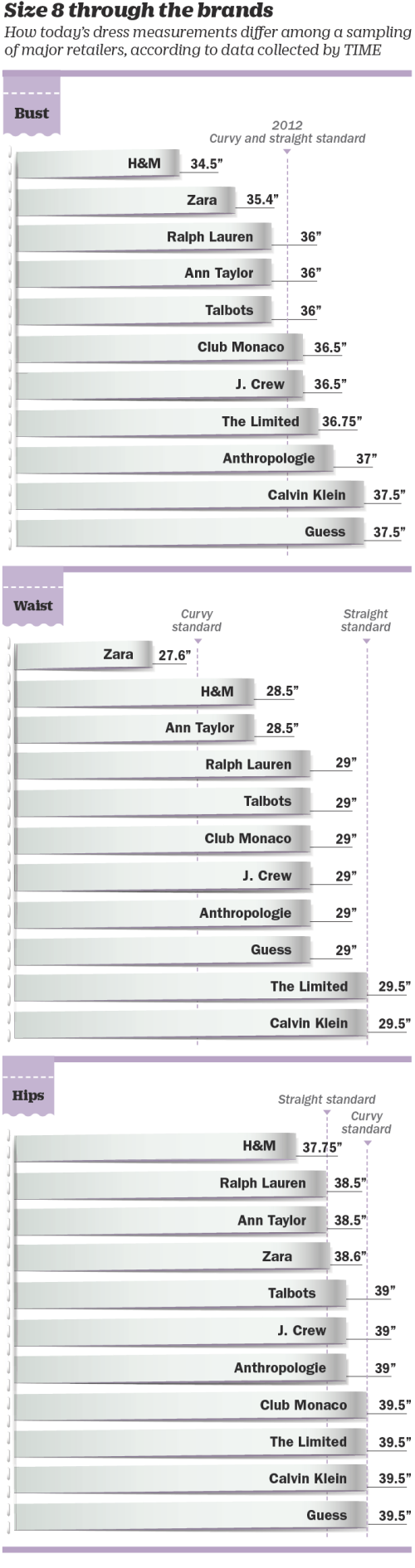
One quick google search on this topic brought me to a Time article from 2016 that says “brands have shifted their metrics to make shoppers feel skinnier—so much so that a women’s size 12 in 1958 is now a size 6.” Um, what?

I will never forget when my sister expressed to me that she was “getting fat” because she no longer fits in size 00 jeans and has to go up to a 0. I know we all know that the fashion industry is damaging our body image and self-esteem, but according to the article, when “shoppers prefer to buy clothing labeled with small sizes because it boosts our confidence,” it becomes even more jarring how deep the problem goes. This tactic, which I never heard of until I googled it, is referred to as “vanity sizing.” So that explains why different stores advertise clothes that fit different as the same size. Kind of.

I think it is unrealistic for the fashion industry to market clothes as “this size will fit all.” It just doesn’t make sense that we can size our clothes in a universal way because not all bodies look the same. We all have different proportions what make it impossible to have one pair of jeans fit a lot of people perfectly. I know this. I know that jeans are never sized correctly. So why do I still feel bad about myself when the jeans won’t go over my thighs?

Clothes are meant to fit us. We are not meant to fit in clothes.

Edit: I found this TikTok on this topic that I LOVED and I encourage you to watch it and maybe check out their other content!

Do I Deserve My Body?

TW: Disordered eating, mental illness, body image issues

Mental illness is one of the body’s worst enemies

I’ve never been good at taking care of my body. Which was fine, I guess, when I was a kid. I rarely ate anything because I was a picky eater, I hated brushing my teeth because it was boring, and I quit almost every sport I played because, well… I wasn’t good at them. The only kind of exercise I got was from my gym class and my dance classes. Even then, I told myself I was going to quit almost every year.

But, whatever, I was a kid. Kids do stupid things. They’ll grow out of it, right?

I never really did. All these things turned into habits and routines that are hard to break. And now I’m afraid to try new things. Is this because of the depression and anxiety that runs in my family? Or did I develop anxiety because I never try anything new? Probably a combination of both.

Continue reading