The Many Facets of Dance

Dancing is both an art form and a sport. It is one of the few places where the mind body connection is joined and exhibited in a such a way that it can be seen as tangible. There is beauty in watching a piece, its emotions and story, be fully embraced in this more visual way. There is also beauty in being able to commit to the act of dancing, training the body in a way where one can escape the mind and rely solely on the body to perform as it has been practiced. The experience of dancing can be further nuanced depending on the circumstances in which the action is taking place. In the case of dancing competitively, there is the need to have the physical body look and move a particular way and if the situation calls for it a reliance on the team and the desire to feel like a full accepted member for which the utmost requirement, in my experience, has often been felt to be the amount of skill one possesses.  
As someone who has been training in dance since the 1st grade, and allegedly dancing well before then, my experience with the art has been multifaceted. When my skill-level increased to the point of notice to others (around my last year of middle school) I was offered positions to teach a few classes weekly for my dance school. It was during this time that I finally felt the most included by my peers and their parents. Rather than commenting on the shortcomings of any rehearsal, parents would instead exchange niceties. I was able to exchange practice questions and answers with my peers as they began approaching me in a way they had not before. As the chubby, short girl, I was finally able to prove that I belonged in a space that revolved around bodies, despite mine not being of an “acceptable type”. Such dynamics can, in many cases including my own, a dual judgement first from the other players/teammates and their respective communities as well as judgement from the internal self about the internal self which can have long lasting impacts on self-esteem and the mental self.  

The point of team sports like this can and should be to have fun, create community and experience movement in a healthy way. However, in spaces where the emphasis is placed first most on the body and the specific ways in which it moves, it can be difficult for bodies that do not conform to social expectations to achieve the same community experience.
Bodily Insecurity as A Learned Thought Pattern

When is it that we, as beings, become aware of our physical forms? When does that awareness give way to insecurity and how is insecurity operationalized to control every aspect of our lives?  

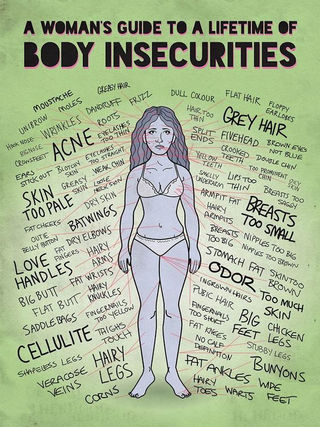
A Woman's Guide to a Lifetime of Body Insecurities

It seems as though, for as long as I can remember, my apperance was a defining factor in my life. It was the way others perceived my health, activity levels, “laziness,” essentially attempting to paint a full picture of my life, often without knowing me at all. Eventually, it became the way I valued myself, always hoping and striving to look different, to weigh less.  

As a member of the South Asian diaspora, it is culturally common to be blunt about one’s appearance. To comment on one’s weight and features as a “sign of care” and “worry”. Meaning that comments about my body were constantly fed to me. I was told consistently in parties, gatherings, pujas1 how I should feel about it and what I needed to do to change it.  

Third grade was the first time I could recall feeling insecure about my body, a feeling that lasted well into my early college years, and even now hums faintly in the background crevices of my mind. It was at this age when unsolicited weight loss advice began. Despite understanding that I existed in a physical body, I was not truly aware of MY body until this point. It was others’ comments about my body, my weight, my skin that flipped this switch in my mind. It was in daily, never-ending comments from family members, members of the community, even strangers at my grandfather’s funeral that I learned my thoughts and my actions would always be secondary in value to my physical self, which they did not deem worthy.  

Weight and more specifically weight loss became a constant on mind. As I took my first breath each morning and as my eyes closed in the nights, it was my first and last thought. It became an obsession where my weight seemed to be the only thing holding me back from realizing my life’s full potential. I developed an unhealthy relationship with external validation which spilled over into the fundamentals of other aspects of my life, namely my academics. It was not until the period of Covid-19 isolation, that these thoughts slowed down. It was at this time that I no longer felt compelled to compare myself to others. I had learned to tune out the majority of comments from family as well, and I realized that there was and is much more to a life and to one’s value and worth as a person. Though, this will continue to be a struggle for me as I grow, I hope that my negative self-image will only further diminish with time. I strive to do better for future generations of my family and generally as a member of this vibrant and diverse world.  

The Child Free Choice  

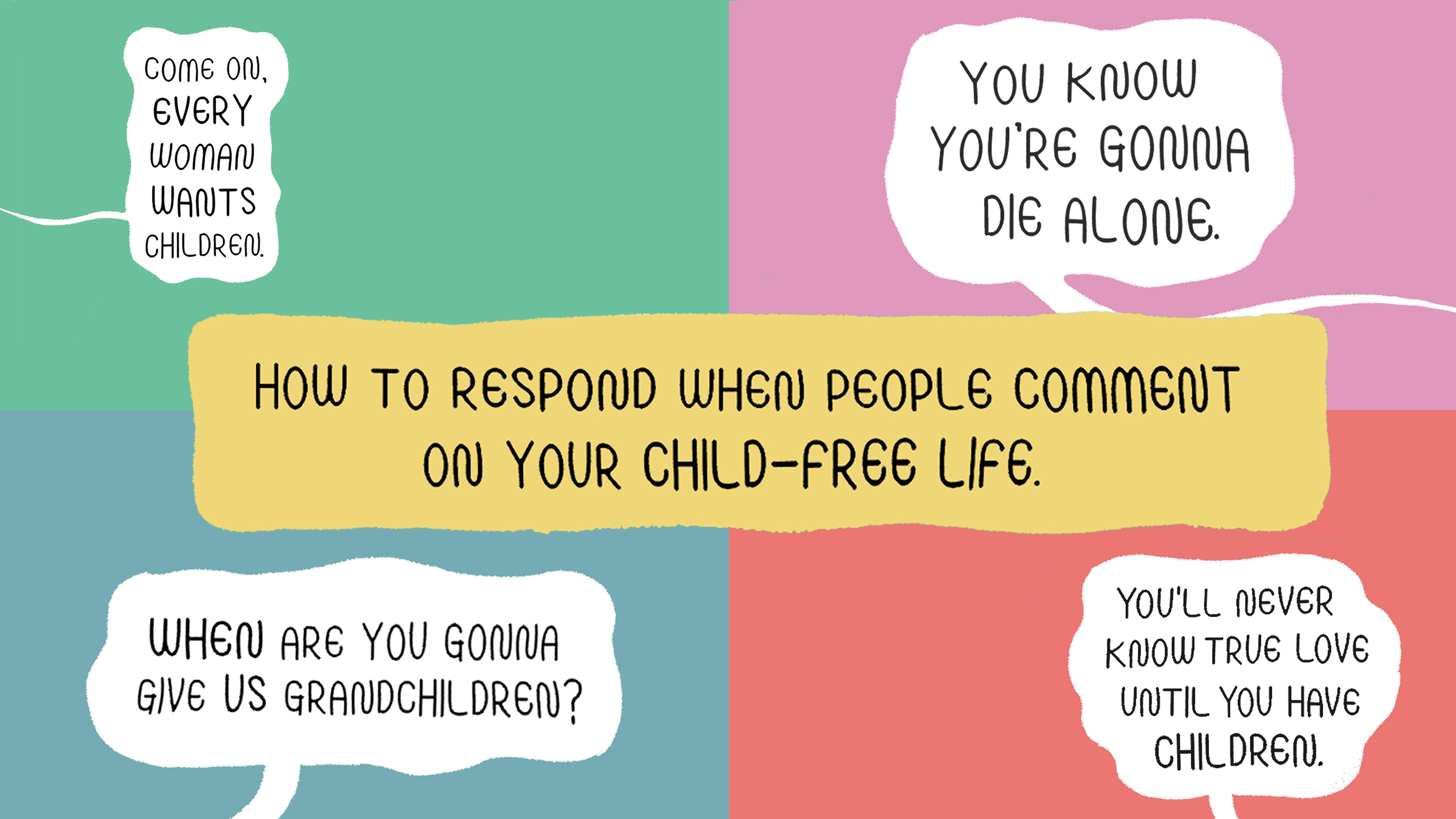
A graphic from NPR that says How to Respond When People Comment on Your Child-Free Life. It has four question bubbles which write "come on every woman wants children" "you know you're gonna die alone" "when are you gonna give us grandchildren" and "you'll never know true love until you have children"

The notion of child free women and the newly visible prevalence of them, often sparks intense debate amongst individuals in which women, their bodies, and their choices undergo intense scrutiny. Those who object to this notion often perpetuate the narrative that making a choice to not bear children makes one selfish and that the child free choice is one individuals will regret making once it is “too late”. Such arguments inherently equate the ability to reproduce with the responsibility to do so, which undermines the position of reproducing individuals in society and undercuts their access to personhood. This narrative continues to vilify women who choose not to have children and pins the phenomenon of a declining global birth rate on individuals who are making a choice that best suits their wants and needs.  

Thinking that having children is a certainty for any person who is physically capable of doing so, further solidifies the grossly incorrect idea that everyone should have kids. Though, having once been children themselves, many can attest to the fact that not everyone is fit to be a parent. There are those that often shirk their responsibilities in this role and grow resentful of their children.  

Additionally, even if reproduction were an obligatory part of the human condition this would logically require unwavering access to quality reproductive health care, which is not the case. Maternal mortality remains a prevalent issue globally that stems from insufficient and bias structures and often times a lack of access to quality care. In pressuring individuals with reproductive capabilities to reproduce and to do so within the confines of systems where they are actively harmed exposes that this issue has never been about safety or care for community. There is great irony in coercing women into having children and then not giving them a safe space to do so or enough time to heal, then further placing the burden of this choice on them by placing the responsibility of the family’s emotional labor as well as physical labor on them. Such considerations are often why women are hesitant to have children in the first place and this is only further exaggerated when their quality of life diminishes from the load of all they must do.  

The Body Neutrality Bubble

Is it possible to adopt a body neutral mindset in the face of external structural notions about what the body should be?

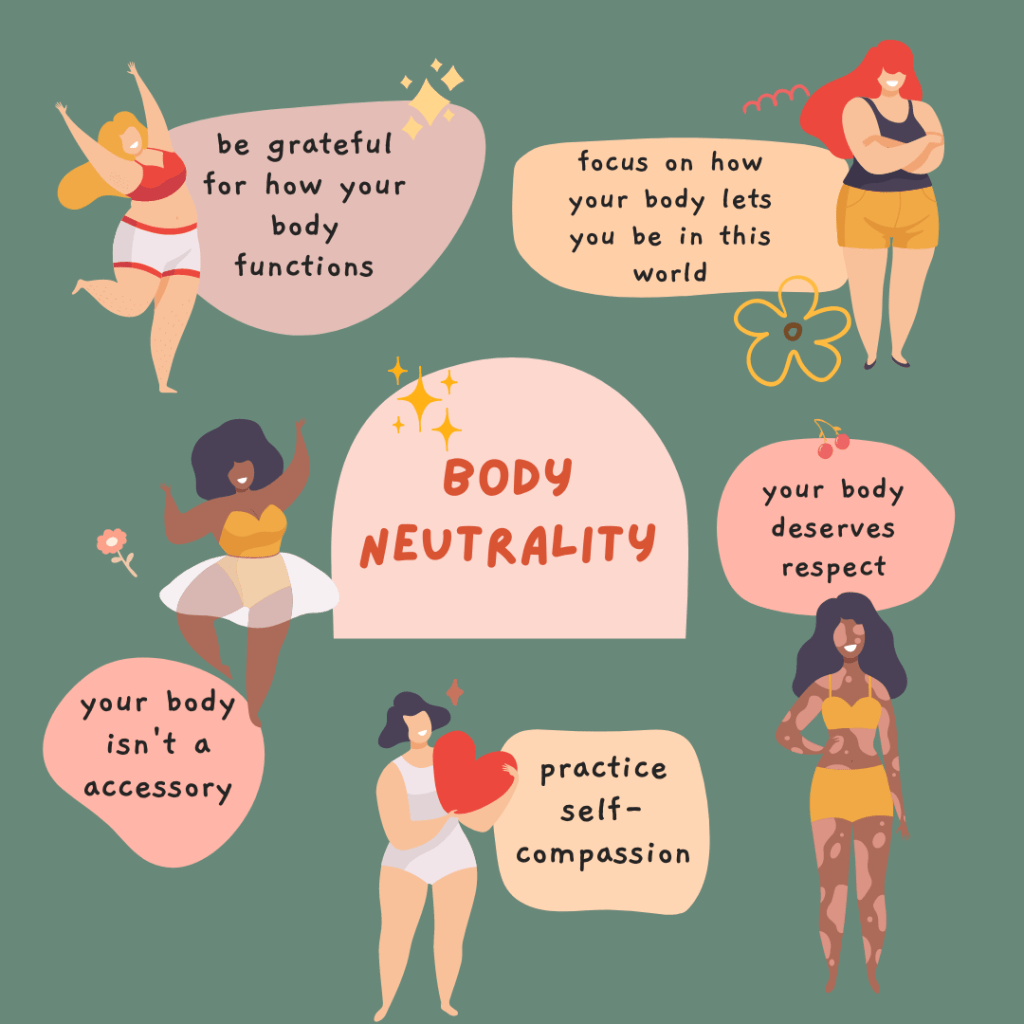
The image depicts a graphic from bewitching.net that has a green background and colorful splotches with text. The middle pink splotch says Body Neutrality. It is surrounded in a circle by 5 other splotches that say be grateful for how your body functions; focus on how your body lets you be in this world; your body deserves respect; practice self compassion; your body isn't an accessory. Each text has a different body next to it posing.

Image Description: The image depicts a graphic from bewitching.net that has a green background and colorful splotches with text. The middle pink splotch says Body Neutrality. It is surrounded in a circle by 5 other splotches that say be grateful for how your body functions; focus on how your body lets you be in this world; your body deserves respect; practice self compassion; your body isn’t an accessory. Each text has a different body next to it posing.

Body neutrality is a contemporary concept that describes the practice of adopting an objective, arguably more function-oriented mindset towards one’s physical self. Popularized in 2015 by Annie Poirier, body neutrality as a concept encourages individuals to view their bodies as physical vessels that allow them to experience and conduct through daily life. Some find it to be a stepping stone to body positivity, however in its fundamental ideology body neutrality is intended to promote a more peaceful relationship between the mind and body that does not focus on negative nor positive conceptualizations of the body, especially in those ways that can consume and strain the mind (i.e., significantly focusing on the size, shape, or color of the body). The concept of body neutrality is designed to operate in contrast to societal expectations that systemically operate to burden individuals to fit into physical and emotional molds in order to be legible as human beings and gain access to various spaces both physically and socially. It is critical to note that societal standards of physicality and being often disproportionately impact minority communities, who often may be denied access to other mechanisms of legibility such as personhood and femininity.

As the concept of body neutrality manifests as an individual effort—where one must rewire their thoughts to accept themselves in their current existence—it is critical to consider to what extent this mindset is sustainable. For sustainability seems unlikely in a world where one’s internal perspectives are competing with the perspectives ascribed to them by other social actors and the implications of structures more broadly (i.e., the spaces their physical and emotional selves may be accepted in or denied access to). It appears to be the case that the body neutral mindset can only exist in the individual bubble, as venturing out of those individual boundaries forces one to be confronted with realities of dominant thought about the superiority of thinness, smallness, whiteness, etc. that will inevitably, even momentarily, impact the way one views themselves and others. It can be said, then, that genuine bodily neutrality is an in-achievable pursuit in our current world where subjects are “locked in” their bodies unable to transcend to a space of being that allows them to shed their physical and spatial identities. While this perspective is less than optimistic, it does offer a more pragmatic contextualization of how societal influence is imperative in creating an environment where humans are categorized and then held to physical and emotional standards that are historically long-lasting and seemingly intrinsic, which hinder individual and population-specific liberation.