Excerpts from my investigation into disability on campus

The following is a series of excerpts for an article that I wrote for The Retriever that was published on Wednesday. (Below is from my original draft, some changes have been made in the final version for newspaper formatting.) If these tidbits interest you, you can find the whole article in print on campus now!

UMBC, I have a challenge for you.

Administration, Student Disability Services, and Facilities all tout the campus accessible routes map as the end-all, be-all solution for disabled students navigating campus. My challenge for you is this:

Make your way to the stadium lot, and then walk to the Fine Arts Building using only routes labeled as accessible. You are not allowed to use stairs, though you may use the short cuts available through buildings via elevators.  (The elevator short cuts are labeled on the map below.) For extra credit, start at the top of the hill near the Walker Apartments and go to the library.

I have marked the destinations for you below. The full map is available here: https://about.umbc.edu/files/2021/09/2021-UMBC-accessible-routes-map.pdf
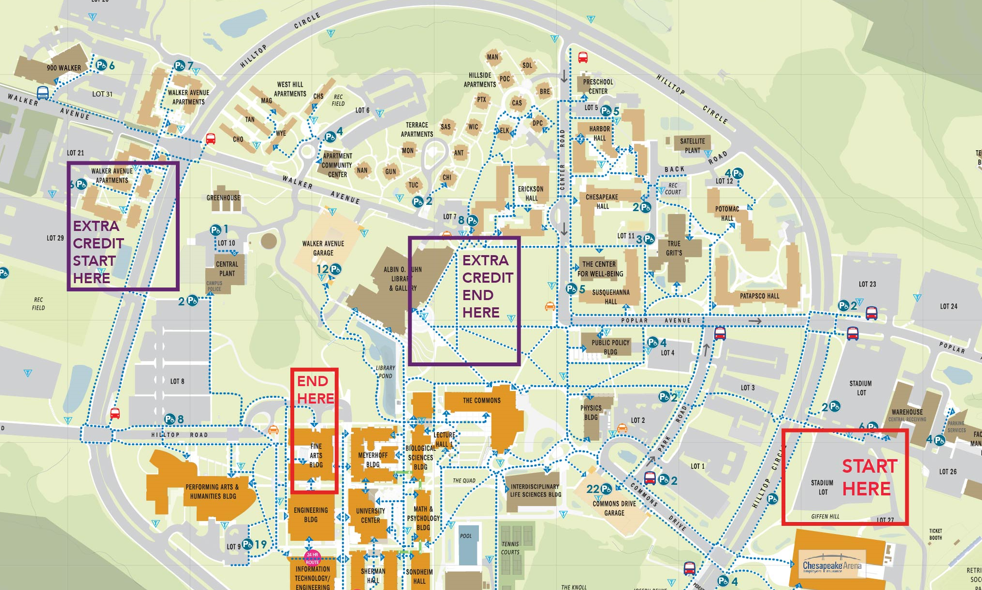
A map of the UMBC campus.  The original overlay is a set of dotted lines indicating accessible routes.  A second overlay has been added demarcating "start here" and "end here" routes of particular difficulty.

While you are walking, focus in on your body. Ask yourself: What would this walk be like if my calves were screaming in pain? What if I struggled with balance and were prone to tripping on uneven surfaces and could fall?  What if I were using a walker right now? What about a non-motorized wheelchair?

What about crutches, or a lower-limb cast? When you arrive at your destination, take a note of the time. How long did it take you compared to using the stairs? Did you have to use a new route compared to your ordinary routine?


It was disclosed to me by several students that after they met all of the (stringent and privilege-laden) requirements to receive an accommodation appointment with SDS, they are told they will be unable to get the accommodations they need. In addition, it has also been reported to me that these meetings are often negative in nature with the student seeking accommodations being met with derision and/or hostility for their accommodation requests. One student, who wishes to remain anonymous, reported being “refused note-taking assistance because they needed to ‘learn how to take notes themselves,’” as well as being refused alternative text formatting as that is up to the teacher and “they cannot do anything about it.” The student accurately pointed out that both of these accommodations are among the published list on the SDS website. Another anonymous student trying to receive accommodations was told, “I know migraines can hurt sometimes but that doesn’t mean you can miss class.”

Many of the interactions that were shared with me have a common thread that is heard all too often by the disabled community: “You’re just not trying hard enough” or “It can’t be that bad”. The implications that we are lazy, that we haven’t developed strategies to succeed in our classes, or that we are somehow exaggerating our health problems are not only outdated ways of thinking about disability but are also extremely harmful.  The reality of our lives is that it frequently is “that bad,” and that we wouldn’t be asking UMBC for help if we hadn’t already exhausted all of the resources available to us as individuals.  To hear these words from the people put in place to help us succeed is equivalent to lifting us up only to kick us back down. UMBC is not the only institution in Maryland struggling with this problem, as this article (https://www.jhunewsletter.com/article/2021/08/disability-isnt-taken-seriously- at-hopkins) written by a graduate student at Johns Hopkins details out. Laurel Maury was awarded accommodations by JHU but found that her professors refused to use them (even under threat of legal action) and some went as far as to bully her for having them. Maury’s struggle echoes many of the sentiments that have been expressed to me by current UMBC students.


To my fellow disabled students: You are not alone, you have a voice, and your voice deserves to be heard.
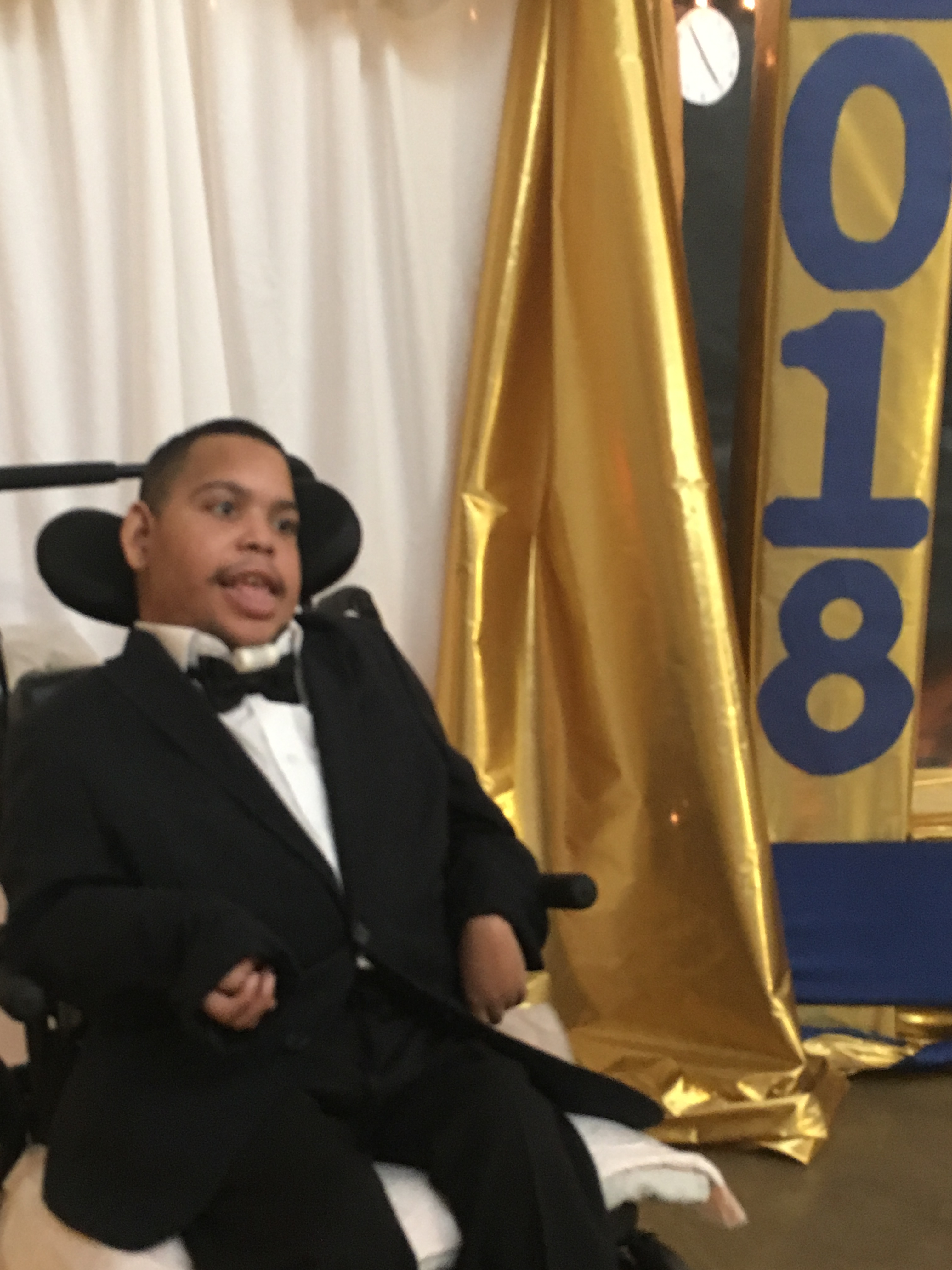
When Accommodation is the Bare Minimum, What Next?

@acaffeinateddesi

why is November is making me so emotional #deaf #deaftiktok

♬ original sound – Sita

First, let me just say that TikTok is a great platform for people to speak out on what seems like small moments in their lives but are ultimately extremely impactful: few other platforms expect you to produce 60-second vignettes of information with little further context, but TikTok allows and almost requires the person behind the camera to get to the point very quickly.

To summarize the video that does not have captions (not all creators in all countries have access to that feature yet): This person is deaf and was raised in a hearing community. They started a new job, and were surprised and overwhelmed when they walked in on their first day and everyone in the office was wearing clear, see-through masks, meaning they would be able to lip read. Their first reaction was to feel gratitude for what felt like a gesture of kindness and welcome, and that they feel seen as a person.

I want to take what this person almost said and bring it a step further. This creator felt gratitude, felt welcomed, and felt seen, and they felt these things because their workplace had done what could be argued they are legally required to do in order for them to be functional in their job. While clear masks may not be spelled out as an accommodation in the ADA, it definitely became necessary during COVID-19 for the deaf community in order for them to be safe, but also to participate in society. Providing clear masks to what is presumably an office would not be considered undue hardship as it would be only slightly more expensive than providing ordinary masks to the workforce. An office with a mask mandate is most likely providing their employees with masks, so an office with a mask mandate and a deaf employee would then be legally required to provide clear masks to their workforce.

I will reiterate: This person felt gratitude because their employer did what they were legally required to do to accommodate their disability and did it promptly so the accommodation was in place when they started their first day of work.

As a member of the disabled community this tells me that the bar is on the ground. It may even be buried, and we are then overwhelmingly grateful when someone unburies the bar and hands it to us. It may still be covered in dirt and we may have a new worm friend but it’s been so long since some of us have seen the bar that we accept it as-is.

Can we even conceptualize what it would look like if every disabled person was given their accommodations on their first day of work? What would it look like if in an interview we could just hand a list to our potential employer and it wasn’t a factor in the hiring decision but simply part of their resume? What if everyone was required to submit a list of accommodations and workplace preferences as a part of their application, and it was simply accepted as standard and a best practice in hiring? What if these were accepted as necessary and automatic requirements as long as they fell under ADA guidelines and did not cause undue hardship to the employer, and thus every employer automatically provided them?

Let’s take this thought experiment one step further. What comes next? What does disability acceptance look like in a world where each individual’s needs were met to the furthest extent possible?

This may take some creative thinking on our part, but I think it’s possible to imagine. I personally can imagine an office where wheelchairs were equally as common as chairs. I can imagine that one person may be at a treadmill desk (there’s always at least one fitness enthusiast in an office) and another desk may be empty most of the time, as its owner largely worked from home. I can imagine that transcription of recorded virtual meetings would be as automatic as meeting notes, and that it would be an expectation that the office would rotate through who took on that job just like we do note-takers. I can imagine that this office would throw out traditional concepts of what a work day would look like, and what work production would look like, and that each individual would be allowed to work and produce work in a way that best suited their personality, lifestyle, neurodivergences and sleep schedules.

These ideas, though, still linger within the realm of accommodation. Is it possible to get even more outlandish in our conceptualization of disability in the workplace?

I can imagine a workplace where a disabled person has been promoted several times. I can imagine a workplace where when someone schedules a happy hour, they take into consideration locations that would be functional and welcoming for every member of the team, which may mean having drinks at a quiet restaurant instead of a loud, difficult-to-navigate bar. I can imagine that at the desk of the person who works from home, there is a prank hidden in the drawer for that person to find from a coworker who is thinking of them whether they’re physically there or not, and doesn’t care how long it takes them to find it. (Who doesn’t enjoy the long game?) I can imagine a scenario where every team member is appreciated for their social contributions to the team, and that for some people that may mean not eating lunch in the cafeteria, but may look like them tracking everyone’s birthdays and sending out celebratory emails to everyone. I can imagine that people with disabilities are treated like people and are accepted in all contexts of the word and are welcomed not only on the surface of being able to do their work adequately, but are welcomed as a human being joining a collective enterprise.

When the bar for disability accommodation is buried underground, acceptance and equity for disability is buried along with it.

Is it worker exploitation, or just high expectations?

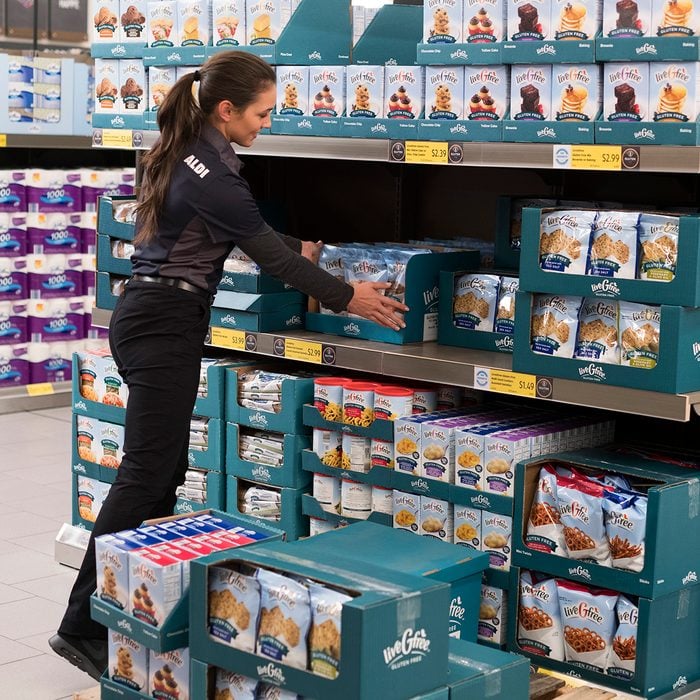
Stock photo of an Aldi worker placing boxes on the shelves with a smile.

I worked at Aldi for nearly two years before disability and injury forced me to quit, and take on several non-physical part-time jobs instead. Aldi runs on an extremely robust high-efficiency model that is designed to eke out every ounce of labor every worker has for every minute they are on the clock in order to keep their costs low and the customer’s costs low. In order for Aldi to be profitable, they must be exploitative.

Many Aldi employees will refute this statement because “Aldi pays more than minimum wage!” And yes, they pay just barely enough to be competitive in the local market they are located in – but only if you are comparing them to other grocery stores. The reality of the Aldi model is the job requirements are more in line with working at a warehouse, and warehouses on average pay quite a bit more than grocery stores as the understanding is that it is a difficult physical job.

Many customers also fail to understand how difficult the Aldi job is. The most common complaint we heard as employees was how lazy we were for getting to sit. This quote from querysprout best explains my feeling on that topic, “Letting cashiers sit down – it’s actually not a comfort thing (employees have described the work at Aldi as “backbreaking”), but rather, the company found employees could scan faster if they were seated.” We as customers praise and stand in awe of the Aldi model that allows us to get basic grocery goods for so cheap because they leave the goods in boxes, how revolutionary! In the next breath we complain that there’s never an employee around to ask questions to – the reason being Aldi staffs the bare minimum of employees at any given time to, again, maximize efficiency.

One of the most interesting facets in Aldi’s worker exploitation is how thoroughly prepared they are for worker injury. The job is intensely physical, the training for the physical tasks is minimal, and the expectation for worker speed and production is through the roof. It’s a breeding ground for serious injury, and the reality I knew working there was anyone who worked as a stocker was injured at least once in a year period. If they lasted more than a year, they typically were hurt at least once a year. I knew several people who had worked there for many years and all of them had received reparative surgery, or desperately needed it.

Aldi has a robust worker’s compensation insurance system, and it’s clear that they fork over a lot of cash for it. (I’ve had worker comp claims at other employers that were much less streamlined, in comparison.) Aldi will happily plan for you to be injured, pay for your recovery and for a short time out if needed, and then expects you to be back on the workhorse as soon as possible. Restrictions are heavily discouraged, though they do, of course, abide by them reluctantly when required to.

What happens if you just can’t come back to work right away? Scalia v. Aldi (2012) is an interesting case in which one employee was booted off of worker’s comp for taking too long to heal, and then promptly fired because she hadn’t worked in 12 months. The employee claimed that her firing was retaliatory for her injury on the job. (She didn’t win, which is hardly a surprise in the U.S.) The reasoning behind the decision came down to Aldi’s extensive policies around termination, worker’s comp, and time out, that enough logic loopholes existed in their policies that had existed before this termination to make it “not retaliatory,” though apparently only in a neutral sense.

What does that mean for you as a consumer, and for Aldi? Well, Aldi has absolutely abysmal employee turnover, akin to the rates of fast food industries. They are a ship with a mild leak that has been patched over and over with mixed success, and only time will tell if their model is truly successful in the long run. For you, I recommend asking yourself when you walk into an Aldi: Do the employees actually look happy, or do they look exhausted? Can you even find an employee?

A Shaky Start to the New Year

I don’t think my hands have stopped trembling since move-in day.  I’ve always had hand tremors, yet the neuroscientist my concerned mother urged me to visit assured me that it’s merely one of many cases she has seen of physiological tremors.  Surprisingly, it’s a phenomenon that is surprisingly very common and one that isn’t dangerous.  True, while this isn’t a condition that severely interferes with my life in the day-to-day, it’s often a channel through which emotions manifest in my body.  This is where my problem begins.  

Continue reading

Is It A Fit, Or Is She Just Skinny?

@brooklyndallen

this looks so bad on me mostly bc I don’t look right in baseball caps😭 it’s not /that/ bad #XfinityFanthem #fashion #pinterest #style #plussize

♬ Need to Know – Doja Cat

Fashion – and by extension, clothing – is created for skinny people.

Our world is built on the assumption that everyone is a certain size (that size being small) and that while some variety is allowable, the range of “acceptable” is even smaller than the jeans they expect us to fit into. Social media influencers flood their pages with images of them in a variety of outfits made by a variety of fashion sponsors, but the question posed here is simple: is the “Look” actually cute, or do we just view smaller bodies as more pleasing?

A recent TikTok trend involves users taking photos of fashion influencers and celebrities and styling themselves in similar outfits to try to answer this question. One note on this: While I have purposefully chosen a video of someone who is not skinny doing this challenge, I also found a lot of videos made by users who could be argued are skinny themselves, just not as skinny as an 18-year-old runway model.

The commonly-reached conclusion most creators have come to is two-fold. First, that the outfits themselves are often excruciatingly basic and boring. They lack color, interesting silhouettes and texture. The majority of these outfits are a pair of jeans or athletic pants and a t-shirt or sweatshirt – the sort of outfit that is typically classified as athleisure or “going to the grocery store.” The people wearing them look good, certainly, but they are not breaking new ground in the realm of fashion and won’t be found on the runways of New York fashion week. The commentary on these photos typically ignores the lack of originality, or even fails to notice it; the comments sections are flooded with people praising them for their beauty and their outfits.

Second, these outfits only look good because the person wearing them is skinny. When placed on a larger body they often look absurd. It’s worth noting that the absurdity is created largely because the challenger is not modifying the outfit or silhouette to more aesthetically suit their body type, as one would typically do when actually buying clothes or creating outfits for themselves; they are purposefully taking the outfit in its original form and simply scaling it up, precisely like modern-day jeans manufacturers. This conclusion only serves to enhance the first one: if the outfit itself is boring or even straight-up bad, why are we applauding anyone for wearing it?

The answer I, and many TikTok users, have come to is that skinny bodies are put on a pedestal of beauty. They are seen as the original, the default, and the gold-standard. They are afforded privilege that larger bodies are denied. They are given beauty labels that are unattainable for those around them, and in some cases like this, may also be completely inaccurate. Even worse, skinny bodies are also seen as the standard in medicine, which can leave massive gaps and inadequate care for those in larger bodies.

Beauty is in the eye of the beholder, of course, and I’m not here to reach any conclusions for you on whether or not you think these influencers and their outfits are pretty, but I would have you start to ask yourself this question every time you see yet another model wearing the same thing your dad wears to mow the lawn: Is it a fit, or are they just skinny?

The World Around Your Body May Not Be Made For Your Body

img_0849  Growing up within a world that was constructed through the naturalized standards of body movements, I noticed my brother’s body stood out. As he stayed wheelchair bound and I walked beside him as my mother lifted him upstairs I felt this desire to want the world to be more accessible to my brother. With small inconveniences becoming the reason my brother’s nurses refuse to take him out his room, I saw that my brother’s impairment in which he did not cause nor create was what caused the world to seem unfair to him.  Being diagnosed with something as debilitating as cerebral palsy and having infrastructure built off the assumption that you are an able bodied person creates   disability.  Tom Shakesphere, an English sociologist sees disability to be “the disadvantage or restriction of activity caused by a social organization which takes little to no account of people who have physical impairments and thus excludes them from participation in the mainstream of social activities.” This depiction of disability seems to be fairly accurate as places such as college campuses do the bare minimum to ensure that people’s impairments don’t stop from being productivity. For example, on my college campus they provide ramps on extremely steep hills reflecting a lack of thought of those who have to wheel themselves up and down these structures. With non-disabled people creating the structures and tools for those who are disabled it continues the cycle of ignorance. It is easy to understand why disabled people have created Continue reading

“The Body I Wear Is Not Perfect”

selective focus photography of skeleton
Photo by Chris Mitchell on Pexels.com

When thinking about the beauty standards of today it’s hard to ignore that bodies within magazines and television are rarely realistic goals for the general public. With bodies that range from what some may consider skinny to what others may consider thick, it’s important that we acknowledge all bodies contain a life within them. Looking at myself in the mirror can be difficult sometimes as I don’t believe my body is what society deems as attractive. Attractiveness is different for each gender as what is subscribed for males and females are different though this is changing it still holds today that men should be muscular and that women should be small and hairless. Focusing on the physical aspect of the

Continue reading

Bodybook™

If you spend time sifting through the hundreds of shitposting meme pages that have monopolized Facebook content, you may be able to find the occasional gem. Facebook groups have established online communities that often foster emotional support, validation, and advice from online strangers and internet friends. Many of these groups have “secret” security settings, meaning the group can only be accessed if one is personally invited, allowing for a sense of trust and community among its members. These groups exist in many different forms that fulfill a variety of purposes, one group being a place for members to share photos and stories that all pertain to their bodies. Continue reading

Bodies in Motion

Bodies in Motion

This is my last semester of college and I am now going to transition from being a body in academia to a body in the workforce. This is a terrifying new concept because I honestly never became comfortable in academia and now I get to go be uncomfortable in a whole new arena.  Continue reading

The Most Common Augmentation

While attempting to define what a cyborg is in class, I was struck with inspiration for a discussion topic on the blog. Fast forward two weeks and I had completely forgotten it, racking my brain for what I wanted to write on. I knew I wanted to write on cyborgs and how people don’t realize how common they are, but I couldn’t remember the specifi-It was memory!


http://www.putlearningfirst.com/br/grape/cyborg1.jpg 

Continue reading