I Miss Summer (Winter Is Coming)

“Oh shit,” I yell, “I need to make a blog post!” I grab a computer, sit down and open up a document.

I can’t think of one intelligent thing to say.

Yes, this is a post that is going up now. I have an idea of what I want to say now. Before, when I thought about it, I didn’t know what to put here. Me, disabled? There’s no way. I get out of bed on time every morning, I make breakfast, I go to school, I do things around the house, I work, take care of the animals… There’s no way I’d ever classify my constant state of movement as ever being disabled.

Continue reading

Faking Disabilities

I was reading the news the other day and came across an article that got me so angry. A man had been using the medical condition of epilepsy to get out of paying for his expensive meals. Luckily he got caught but his punishment is a very small punishment; a slap on the hand if you will.

The reason why this story got me so riled was because of the fact that my mother has been living with epilepsy for 26 years.She has to deal with the repercussions of her disability daily. For someone to mock and mimic an invisible disability is a despicable act. She has had to recently stop driving because her seizures have gotten so bad. Her seizures have taken a toll on her memory slightly so the small task of reminiscing becomes a difficult task of the realization that her disability is becoming more and more relevant each time we talk.

The man who decided it is acceptable to skip out on paying for a meal by faking a seizure makes me sick. It is disgusting and I wish he could understand epilepsy more in depth; this disability is no joking matter. Since he used the disability to his benefit, it makes me worried for my mother. If she has a seizure in the grocery store, restaurant, and any other public place, will people be less likely to help her if they think she is faking. I hope that if people see someone having a seizure they can recognize it and stay by that persons side until they come out of it. I hope that this mans acts did not make people want to turn a cold shoulder to a person actually having a seizure.

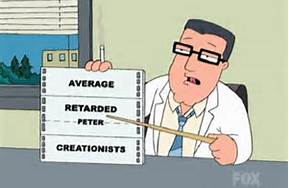
Retarded.

My sister is mentally retarded. I’m not sure what the ‘politically correct’ term would be for this these days. I’m pretty sure it’s “mentally handicap”. Retard literally means to slow down. At the end of the day that’s a pretty accurate description of my sister. She is 24 years old and has the mentality of a twelve year old. She isn’t stupid by any means. She just got slowed down. My 6-year-old son and she are such good friends. I fear the day he intellectually passes her.

petergriffiin

Let me explain a little more about her condition.

Continue reading

cry about it

Riding the bus and an older women sitting in front of me is wearing a shimmery gold jacket with “Golden Age Club” embroidered in white letters on the back. Her face smiles naturally. A stop or two later, another women around the same age, maybe older, sits beside the other and pulls out a small, worn book from her purse. It’s one of those tiny things filled with appropriate Bible passages for any situation. She opens it up to a previously bookmarked chapter. “Bible Passages For Confidence.” I feel my face heat up and my throat tighten and my eyes become heavy. I start crying.

Continue reading

Body learning: anxiety edition

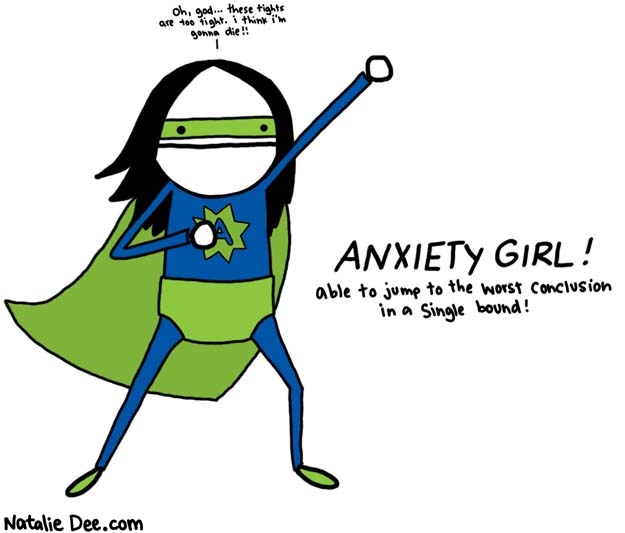
now-im-a-superheroIn my notes from one of the first days of class, I have written, “embodiment -> we know because of our body; ways of knowing that exceed rationality.” This simple concept – that our bodies are sources of knowledge – is something I’d never consciously thought about, but as this idea about embodied knowledge started to sink in, I realized that my head has been learning a lot from my body recently.

—–

I started the week with particularly active butterflies in my stomach, for no particular reason. I assumed that they would ebb and flow as usual. But they didn’t; they stayed.

The next couple of days, my body started experiencing anxiety in different ways. My heart would race. I wasn’t digesting my food. I would shake a bit. I cried more than usual. I always felt on edge, like I was just about to have a panic attack but without the relief that can come after one. Continue reading

Dysmorphic Friends

One of my closest friends is a fashion stylist. She chooses outfits, hair, makeup, and general looks or moods for photoshoots for natural makeup companies and independent designers. I have modelled for her in the past even though I am not a model and don’t look like a magazine model. I also model for my own Etsy store, selling vintage clothing. My friend has had eating disorders since puberty and I have not. I feel that her eating disorders are a sign of privilege and she feels that my “poverty genes” and post thyroid cancer synthetic metabolism are a sign of privilege. The arguments are frequent and comical.

I feel that it would be insulting to her profession and life’s path to say that her involvement with fashion feeds her disorder, so I often try to tell her eating disorders are a result of a sexist, competitive capitalism, a first world problem, and that if she stops aestheticizng the super young and super thin, wheat colored waify girls with vacant expressions, she won’t hold herself up for comparison to them. I tell her to keep her job but change her aesthetic, make it weirder, and I tell her she’s a misogynist. Then I go on like a hypocrite and smooth out my hair, put makeup on, and have my boyfriend shoot photos of me for Etsy, to make money. And I do make money. But recently, editing and cropping photos of myself, I feel like I look OOLLDD. So I call my friend and ask her for a disorder that will make me less old, less short, less frizzy, less dark, less tired. And there isn’t one. I’m really not sure what I’m aestheticising, but even though I’m perfectly happy with my weight I still feel the need to critically tear apart whatever I can about my own image, down to my assymetrical smile or uneven hair texture or slightly more almond shaped right eye than left one. Little little minute stupid details. All while knowing that I’m making this image public by my own free will, by my need to pay the bills and put gas in my car to get to school. Because those waify wheat colored girls are out there, and my tiny little capitalist enterprise is knowingly in competition with them, and growing up in the 80s and 90s, between Debbie Gibson and Kate Moss, I never felt that my features were pure or innocent, only exotic and “olive olive olive”, and now getting older.

Can a woman be this self-critical and also be a feminist?

Self-Diagnosis

According to a “recent study,” conducted by a company that maintains an online self-diagnostic tool and then misinterpreted by some website on the internet, “1 in 4 British women has misdiagnosed themselves on the Internet.”  Mind you, this wasn’t just posted on any old internet, it was posted on the Internet, so it’s totally legit, guys.  I believe it.  (By the way, Jezebel has some commentary that, while not problem-free, tickles the funny bone.)
This blog needs more color, so here's a rainbow.

Regardless, it raises some important questions about the role of diagnosis and self-diagnosis.  When overused or used irresponsibly, self-diagnosis on the internet can lead to a lot of unnecessary worry.  It’s an especially big problem in a culture that does not openly discuss bodies or illness, making it difficult to determine what is “normal” and “abnormal” for a body to do.  Female bodies, disabled bodies, older bodies, trans bodies, and non-white bodies, in particular, are susceptible to this kind of worry.  If your body was never “normal” to begin with, how can you possibly know if something is wrong?  If your body has always been strange or mysterious or untrustworthy, when does it cross the line from weird to dangerous, or sick?

I don’t have exact answers to these questions.  I do know, however, that since the majority of people cannot afford to see a doctor every time their body aches or something leaks, and since most female, aging, disabled, trans, and non-white bodies (to name a few) are not given serious consideration in the doctor’s office, the internet is an important diagnostic tool.  Several years ago, for reasons I can’t remember, I found a diagnosis for myself on the internet, and it was a major turning point.  As far as I knew, this was the way that I had always been, but at that time, I started to realize that it wasn’t the way that I would always have to be. It didn’t change my anxiety, but just having a name for it allowed me two conceptualize the phobia and my personality as two separate things.

These people stared at this x-ray for hours before realizing that it was blank.

When I later filled out an inventory or questionnaire, I hit every one of the symptoms.  But I never would have known that these were symptoms without coming across that page on the internet.  How could a doctor have possibly diagnosed me if I never expressed that anything was wrong?

Of course, my story might be unusual, and it might be somewhat unique due to my class privilege.  Still, I maintain that the internet should have a place in diagnosis, since no doctor can ever know a person’s body better than the person themself.  What do you think?  Does self-diagnosis cause more harm than good?  How can the internet be used or changed to improve diagnosis and available medical information?

Stress Kills, or “I don’t have time for a body”

At some point this semester I began screaming at my boyfriend, “I don’t have time for a body!” I was having a pulsating migraine, my skin was breaking out, I had had no sex drive for weeks, and had an endocrinologist appointment and blood test the next morning prior to three classes that day. I was having an anxiety attack at 1a.m.

Everyone says college is stressful. I have found that no longer having the body of a twenty year old makes it exhausting. Running around a hilly campus, trying to get to class on time, parking about a mile from any buildings. All of this physical activity is also time consuming, adding stress to days packed with classes, work, homework, making dinner, buying cat food, paying bills, keeping in touch with friends and family, attempting to relax, and trying even harder to sleep. I often find my inner dialogue about stress going something like: “It’s because I’m a woman” or “It’s because I’m not upper middle class.” I have many found my stress triggers to generally be gender or class oriented.

I found the following documentary on stress very interesting. The director, John Heminway posits stress as not only as detrimental to mental health, but as someting that can kill the body over time  through exposure to dangerous levels of stress hormones. It also argues that stress levels are relational to class structure, with lower rung workers experiencing higher, and more deadly, levels of stress hormones. The documentary follows Stanford University Neurobiologist Robert Supalski in his studies of stress hormone levels of baboons in Kenya. He measured both adrenaline and glucocorticoids in these baboons and found differing levels according to the gender and social class of the baboons. The non-alpha males have higher stress hormones than the alpha males. When most of the alpha males died off due to tuberculosis infection, the stress levels of all the other baboons in the group went down. This documentary is very much worth watching, I believe all parts of it are on youtube and hope you can check it out.