
There are so many selves we create in order to live our lives easily: as a child, as a sibling, as a student, as a friend, as an employee… When I was younger, I struggled with understanding who I am and what it meant to be me. Teenhood was complicated, as I know it is for almost everyone, but for me this was compounded by my introduction to the internet.
Continue readinginternet

Kanye West: Mental Illness is Real
We all know one of the current hot topic at the moment is Kanye West and his mental breakdown. It all started recently during Kanye’s concert for his tour, when he started ranting about different things like his support for Donald Trump, his anger towards Beyoncé’s performance at the VMA for her “formation” song which is based on the Black Panthers theme. He also mentioned Jay-Z and said “don’t send your people for me” referring to the whole illuminati thing, and also how people have been lied to by the media and the radio. A lot of videos have been circulating on twitter showing Kanye really strange and concerning behavior. And a lot of people have been reacting to this, and many people seem to be angry about this. Continue reading
Gifs, Emojis, and Avatars: Self-Expression on the Internet
The internet creates a strange liminal space where we must invoke our bodies in order to represent ourselves. In the absence of facial expression, body language, or verbal description, one can express emotion and identity with other methods, like pictures, gifs, and emojis.
This video talks about how people on the internet often represent themselves through pictures, gifs, and videos. They caption or tag it with the phrase “Me RN” meaning “Me right now”. Even though these gifs or pictures are taken from shows, movies, or places that don’t relate to the user, through their abstraction and decontextualization people can appropriate these images to create themselves in webspace. These images capture a feeling or mood that can be difficult to evoke on the internet because it would require long descriptions, finesse of diction, and/or visual depiction that’s not possible or desirable to pull off.
In a similar vein, emojis are abstracted images used to represent emotions and ideas in internet liminal space. However, emojis differ from things like reaction images in that they are designed by the owners of the webspace themselves. Whereas reaction images derive from a third-party source and can be easily manipulated to suit the user’s needs, emojis are dependent on its creators. We could assume that while reaction images derive from a bottom-up appropriation of culture, emojis represent a top-down system that is limited by the ideology and resources of website owners and creators.
However, I’d like to think it’s more complicated than that. We cannot characterize website owners and creators as from the “top” and users at the “bottom”, when many creators derive from lower or middle class backgrounds and found their work through their own funding or crowdfunding. Users can be creators and creators are also users. Thus, while some of the same privilege systems are recreated on the web, we cannot assume that this is always true.
That’s why I believe that the internet represents an amazing new space for people to represent themselves and perhaps create new identities away from everyday restrictions.
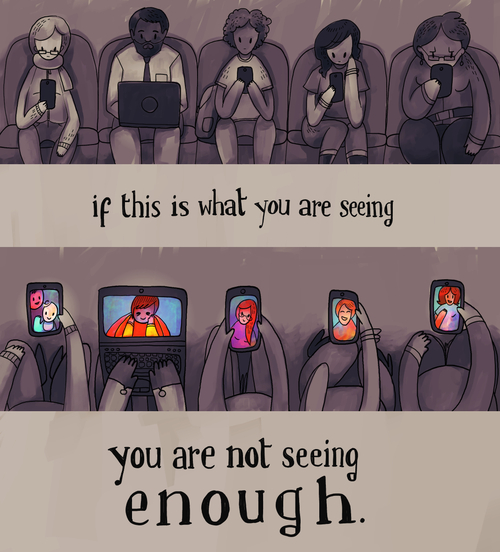
The internet allows for instant communication with people from all over the world. We can email, blog, instant message, “poke” on Facebook, Skype call — and, potentially, all without ever seeing the body behind the text or voice. The pessimist might assert that these communications are superficial, detached, and “not real”; we are ignoring “real” people in favor of glowing screens and lines of text.
Yet this point of view invalidates the incredible, long-lasting, very real relationships that people such as myself develop over the internet. There is the chance that we may never see in person, or even in photographs, the people we interact with this way. However, with things like Skype Video and Face Chat and “selfies,” it is easier than ever to match a face to the text. And anyway, even if I’m not talking with a person face to face, they are no less a person and our conversations are no less valid.
Self-Diagnosis
According to a “recent study,” conducted by a company that maintains an online self-diagnostic tool and then misinterpreted by some website on the internet, “1 in 4 British women has misdiagnosed themselves on the Internet.” Mind you, this wasn’t just posted on any old internet, it was posted on the Internet, so it’s totally legit, guys. I believe it. (By the way, Jezebel has some commentary that, while not problem-free, tickles the funny bone.)
This blog needs more color, so here's a rainbow.
Regardless, it raises some important questions about the role of diagnosis and self-diagnosis. When overused or used irresponsibly, self-diagnosis on the internet can lead to a lot of unnecessary worry. It’s an especially big problem in a culture that does not openly discuss bodies or illness, making it difficult to determine what is “normal” and “abnormal” for a body to do. Female bodies, disabled bodies, older bodies, trans bodies, and non-white bodies, in particular, are susceptible to this kind of worry. If your body was never “normal” to begin with, how can you possibly know if something is wrong? If your body has always been strange or mysterious or untrustworthy, when does it cross the line from weird to dangerous, or sick?
I don’t have exact answers to these questions. I do know, however, that since the majority of people cannot afford to see a doctor every time their body aches or something leaks, and since most female, aging, disabled, trans, and non-white bodies (to name a few) are not given serious consideration in the doctor’s office, the internet is an important diagnostic tool. Several years ago, for reasons I can’t remember, I found a diagnosis for myself on the internet, and it was a major turning point. As far as I knew, this was the way that I had always been, but at that time, I started to realize that it wasn’t the way that I would always have to be. It didn’t change my anxiety, but just having a name for it allowed me two conceptualize the phobia and my personality as two separate things.

These people stared at this x-ray for hours before realizing that it was blank.
When I later filled out an inventory or questionnaire, I hit every one of the symptoms. But I never would have known that these were symptoms without coming across that page on the internet. How could a doctor have possibly diagnosed me if I never expressed that anything was wrong?
Of course, my story might be unusual, and it might be somewhat unique due to my class privilege. Still, I maintain that the internet should have a place in diagnosis, since no doctor can ever know a person’s body better than the person themself. What do you think? Does self-diagnosis cause more harm than good? How can the internet be used or changed to improve diagnosis and available medical information?

