
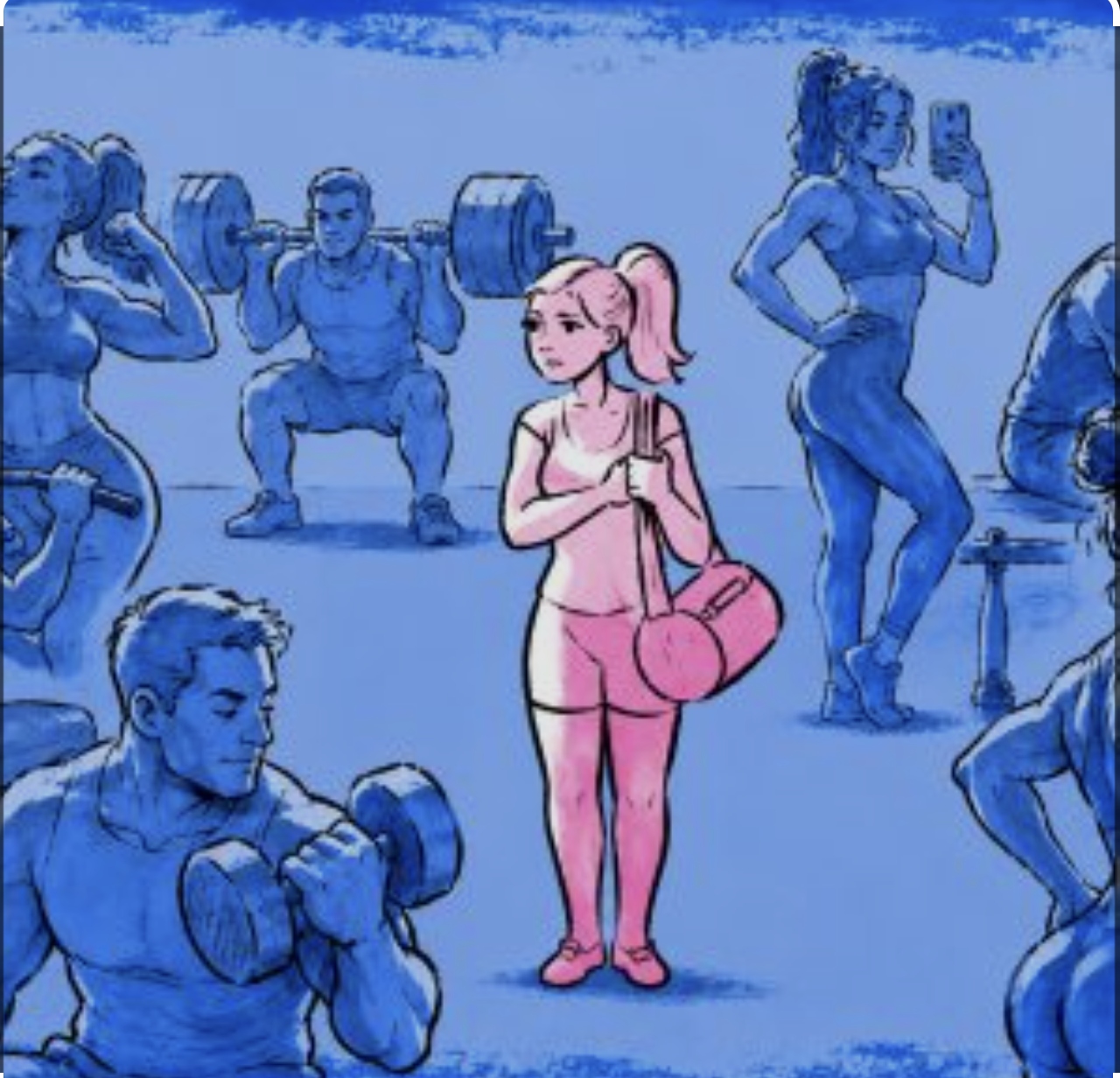
The Gym is an Award Show

When the fall semester started, I was determined to go to the gym consistently and start running around my neighborhood. I started doing all this research (Tiktok rabbit holes) on what type of exercising I should do to have my body look a certain way based on my height, weight, and schedule. I looked into Pilates classes, good running shoes, and certain meals to eat.

Read More: The Gym is an Award Show

Day 1 came in my 3 split weekly workout schedule, and I was ready. I had a list of exercises to do and a meal plan. However, that morning I started to have a bunch of anxiety. My outfit didn’t look like the cute gym clothes on social media, I had on an old family reunion T-shirt and too small leggings. I had this fear that what if I forgot how to do the exercises properly and someone looks at me and thought I was stupid or could tell that I was new to this. All these thoughts started rushing through my mind to the point where I ended up doing an at- home YouTube workout instead.

Looking back, I realize my anxiety was deeper than just exercising. It was more about how I thought other people would perceive not only my body but how I decided to move it. Social media has created an image of what someone who goes to the gym is supposed to look like, from the clothes they wear to their confidence level with using the equipment. I started comparing myself to that image before I even arrived at the gym.

This experience showed me how culture and societies expectations can shape how people view us and how we view our own bodies. My fear of being judged changed how I experienced my body and my comfortability level of exercising. The gym did not feel like a place to “better myself,” it felt like an award show where everyone was watching me. Fast forward to today, I still do have the fear and overthinking of going to the gym. But rather than not go at all I look on the app to see how busy it is before going. I’m not sure if that’s progress but at least I made it to being in the building.

Becoming Whole In a World of Fragments

Reading Sandy Stone’s “The Empire Strikes Back: A posttransexual manifesto” felt like stumbling upon a secret I didn’t know I needed. One quote stood out to me, almost as if it were waiting for me to see it:   “This paper…is about morality tales and origin myths, about telling the ‘truth’ of gender.”  Stone is talking about the stories society tells us,stories that claim to be the “truth” about who we are, even when those truths don’t fit us. For trans people, these stories are often used to deny their identities or paint them as something artificial. But the idea of being trapped in a story that isn’t your own? That resonated deeply with me.  I’ve lived my whole life caught in a story that I didn’t write. It’s the one that tells me I’m not enough. Not pretty enough, not confident enough, not “worthy” enough. I don’t even know when it started. Maybe it was growing up surrounded by images of perfection I could never reach, or hearing the subtle ways people praise others for what I always felt I lacked. Over time, I internalized it. It became my “truth.” Stone’s words reminded me that these stories aren’t real, they’re constructs, born from societal expectations, comparison, and insecurity. They’re myths, handed down to us as if they’re fact. And just like Stone argues for trans people to reclaim their narratives, I feel like I need to do the same for myself.   But that’s easier said than done. When I look at others, I see their beauty, their confidence, their ease. I convince myself they’re everything I’m not. I’ll scroll through social media, comparing myself to images of people who seem flawless, wondering why I can’t see myself that way. I’ve spent years trying to measure up to a standard I never set and every time I fall short, it reinforces the idea that I’m not enough.   What Stone helped me realize is that the only person who can rewrite my story is me. I don’t have to accept the idea that my worth depends on how closely I resemble someone else. My value doesn’t come from meeting some impossible standard, it comes from being me.  That’s not to say it’s easy. Some days, I catch a glimpse of my own reflection and think, “Maybe I’m not so bad after all.”  But other days, the old voices creep back in, whispering that I’ll never measure up. It’s a slow process, unlearning the lies I’ve believed for so long.   But Stone gives me hope. If it’s possible to challenge something as deeply rooted as society’s myths about gender, then it must also be possible to challenge the myths I’ve told myself about who I am. It’s not about becoming someone else, it’s about learning to see myself clearly, without the noise of comparison and doubt.  I’m not there yet, but I’m starting to believe I can get there. Little by little, I’m learning to let go of the story that says I’m not enough. And in its place, I’m beginning to write a new one: one where I see myself as whole, just as I am.  


Empowerment, Inspirering