
I was 12 years old when I first experienced aversion to my family’s concept of gender. It was fall 2019, and I was staying with family in New York City for a weekend. I have a clear memory of being in the shower when my older cousin walked into the bathroom to get something. I don’t remember what I said to her, but I must’ve expressed the extreme discomfort I felt at the time, because I remember her responding with something like “we have all the same parts. Why does it matter?” I just wanted to have some privacy during the 10 or so minutes I was in the bathroom, but apparently it was okay for my cousin to come because we were both girls, because “we have the same parts”. I didn’t know it at the time, but this was the start of my years-long critique of my family’s version of womanhood.
Continue readinggender performance
Gender’s got nothing on me.
In high school, I heard the rumors. I knew that I was not the epitome of femininity. It was not the first time I had to evaluate what being a woman meant to me.
It started in 3rd grade, with the best friend of my best friend, who asked why I had a mustache. I didn’t think I had one, but suddenly it was all I could see. Only boys had mustaches—but I was a girl. When I went home, I begged my mom for help. We spread pink Nair on my face and I locked myself in the bathroom where no one could see me washing away my insecurity.
But that wasn’t enough (spoiler: it never is), so in 4th grade, my crush told me my new haircut made me look like a boy—but I was a girl. The “teasing” didn’t stop until my hair had grown past my chin again. I still flinch when I pull my hair too far back and see the more masculine features of my face.
In high school, I’d had enough of hiding behind long hair and getting chemical burns underneath my nose. I decided I would try to stop caring—or at least appear to stop caring. I shrugged off the barbed comments about my face from classmates, refusing to give a reaction, even if it made me think no one could ever love a face like mine. Even if it shook my femininity to the core, even if I began to think my own face was ugly, I refused to cave.
In college, I tried to leave it all behind me; I was grown now. I could shake it. But some people never grow up, and they would match with me on dating apps just to ask me if I knew I had a mustache. An ex of mine told me I should shave my eyebrows and my lip (I should have left him right then).
Then the pandemic hit, and I had more time on my hands than before. I had a coworker who identified as nonbinary, and I started to wonder what that would mean. I shrugged off “woman,” which had caused me problems for so long, and I tried on something different.
But gender is weird. I found myself somewhere in between the two, sometimes feeling like nothing but a person inhabiting a body, and at other times like I was more of a woman than I’d ever been (occasionally, I even reveled in my masculinity). But the more scrutiny I put my identity under, the more it seemed to move. Like my gender, my identity is fluid.
When I shook off the weight of performing femininity, my biggest insecurity became nearly null. If I don’t have to identify as a woman, then it’s not an insult for someone to point out the ways in which I don’t perform as a woman. Rather, it can signal to others that my identity is not what they assume it to be. Most importantly, it is a (much needed) reminder to myself that I decide what I want my body to look like—not others.
♥ ♥ ♥
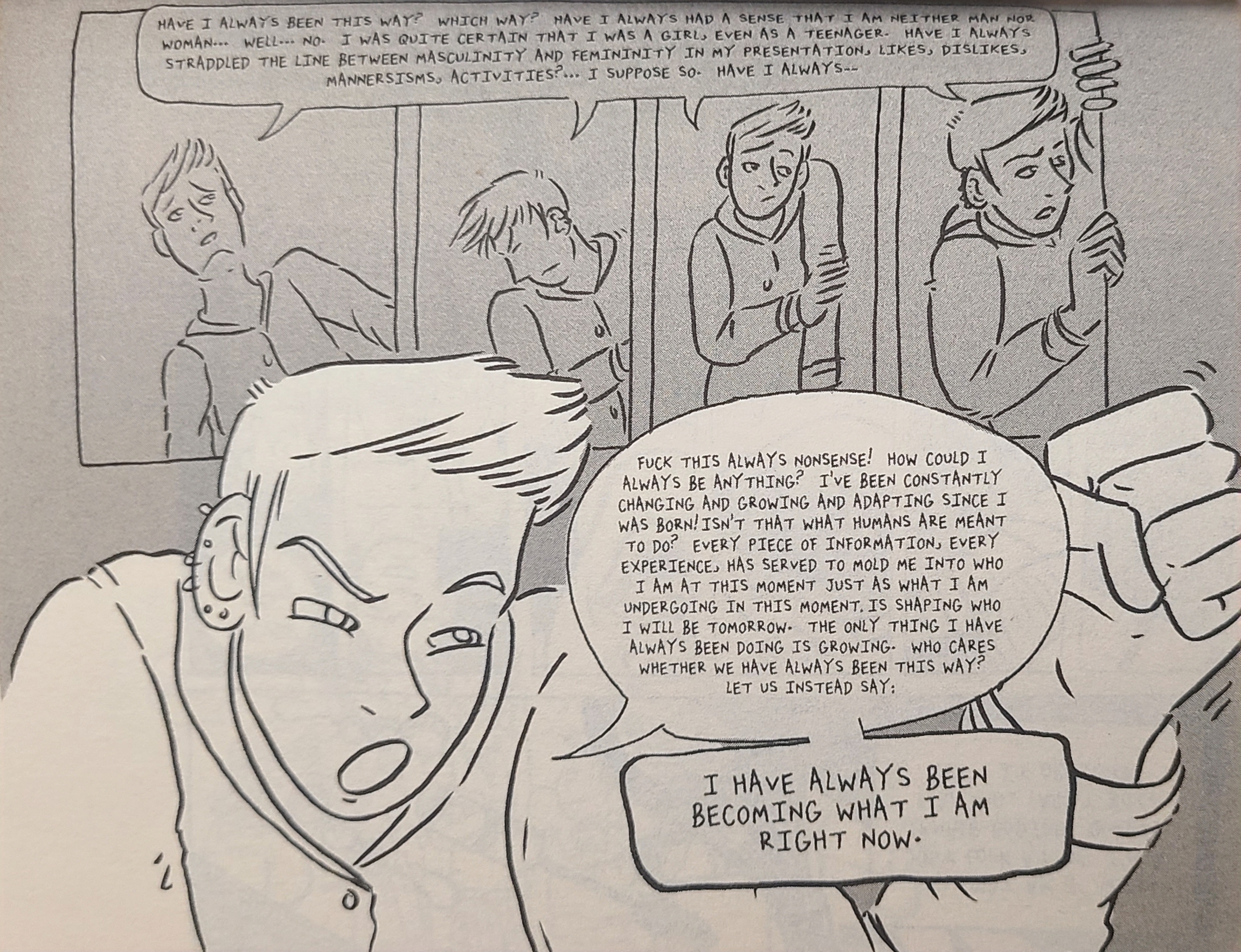
ALT TEXT: An image excerpt from “Gender Outlaws: The Next Generation” page 177. In background: Grayed out images representing an insecure internal monologue. They are saying: “Have I always been this way? Which way? Have I always had a sense that I am neither man nor woman… well… no. I was quite certain that I was a girl, even as a teenager. Have I always straddled the line between masculinity and femininity in my presentation, likes, dislikes, mannerisms, activities? …I suppose so. Have I always…”
The internal monologue is cut off by the person in the forefront, saying, “Fuck this ALWAYS nonsense! How could I always be anything? I’ve been constantly changing and growing and adapting since I was born! Isn’t that what humans are meant to do? Every piece of information, every experience, has served to mold me into who I am at this moment just as what I am undergoing in this moment is shaping who I will be tomorrow. The only thing I have always been doing is growing. Who cares whether we have always been this way? Let us instead say: I have always been becoming what I am right now.”
Embracing Suppression: Gender Stereotypes & My Experience as a Trans Person
There’s a struggle at the very heart of my experience as a trans person. The struggle of trying to navigate a society that heavily reinforces the gender binary in ways that most cis people don’t even think about, while also trying to do away with this outdated notion. A prevailing notion on how one does gender is through their performance. Our appearance & the way we use our body signify to others what gender we are. There is nothing in one’s very nature that makes her a girl, it is how she’s been taught a girl looks & behaves that determines her performance as such. I’ve discussed gender in the abstract, but how does it apply to me? How do I experience gender? Well, I am a demigirl, an identity within the non-binary umbrella where I am a girl, but also partially outside the gender binary. Despite this, in circumstances where I have to interact with mostly cishet people, I desire, but do not achieve, to present as femme as possible, to only be seen as a girl, as I don’t trust the general society to grasp that nuance. If someone even for a fraction of a second thinks that I’m a guy, it’ll create gender dysphoria. So if I’m basically trying to present as a girl, this in a way could be perpetuating the gender binary, by erasing the non-binary aspect of my identity in my presentation. But then how does one present as non-binary? There is a misconception that non-binary inherently means androgynous, because you are neither a boy nor a girl, you must not lean towards looking like either. This just creates a gender trinary, which I feel like is only an improvement from the gender binary in superficial ways. It allows for the expansion of gender in so far as it doesn’t mess with the existing structure too much. In other words, as long as it doesn’t challenge the patriarchy. But then, how do I do my part in transforming society such that the general notions of gender match how diverse it actually is? The only satisfactory answer I’ve been able to come up with is for others to be educated about the nuances of gender. After all, I don’t feel that same pressure in queer, especially trans, spaces. In those circumstances I know I’m around people who have the same or similar enough experience & knowledge of gender that I don’t feel obligated to live up to gendered pressures that are thrust upon me. When I’d go visit my ex-boyfriend, or my ex-girlfriend before that, who are both trans, I knew it wouldn’t matter if I didn’t feel up to looking as femme as I could manage, as they’d still see me as the gender I am. So through my experience with other trans people I know it is possible to live in a society that doesn’t require strict adherence to gendered stereotypes. But I can’t really give a presentation on gender to every passerby on the street, so all I can really do is wait, & until then, hope I’m seen as a girl.
Continue reading
