Gender’s got nothing on me.

In high school, I heard the rumors. I knew that I was not the epitome of femininity. It was not the first time I had to evaluate what being a woman meant to me.

It started in 3rd grade, with the best friend of my best friend, who asked why I had a mustache. I didn’t think I had one, but suddenly it was all I could see. Only boys had mustaches—but I was a girl. When I went home, I begged my mom for help. We spread pink Nair on my face and I locked myself in the bathroom where no one could see me washing away my insecurity.

But that wasn’t enough (spoiler: it never is), so in 4th grade, my crush told me my new haircut made me look like a boy—but I was a girl. The “teasing” didn’t stop until my hair had grown past my chin again. I still flinch when I pull my hair too far back and see the more masculine features of my face.

In high school, I’d had enough of hiding behind long hair and getting chemical burns underneath my nose. I decided I would try to stop caring—or at least appear to stop caring. I shrugged off the barbed comments about my face from classmates, refusing to give a reaction, even if it made me think no one could ever love a face like mine. Even if it shook my femininity to the core, even if I began to think my own face was ugly, I refused to cave.

In college, I tried to leave it all behind me; I was grown now. I could shake it. But some people never grow up, and they would match with me on dating apps just to ask me if I knew I had a mustache. An ex of mine told me I should shave my eyebrows and my lip (I should have left him right then).

Then the pandemic hit, and I had more time on my hands than before. I had a coworker who identified as nonbinary, and I started to wonder what that would mean. I shrugged off “woman,” which had caused me problems for so long, and I tried on something different.

But gender is weird. I found myself somewhere in between the two, sometimes feeling like nothing but a person inhabiting a body, and at other times like I was more of a woman than I’d ever been (occasionally, I even reveled in my masculinity). But the more scrutiny I put my identity under, the more it seemed to move. Like my gender, my identity is fluid.
When I shook off the weight of performing femininity, my biggest insecurity became nearly null. If I don’t have to identify as a woman, then it’s not an insult for someone to point out the ways in which I don’t perform as a woman. Rather, it can signal to others that my identity is not what they assume it to be. Most importantly, it is a (much needed) reminder to myself that I decide what I want my body to look like—not others.

♥ ♥ ♥

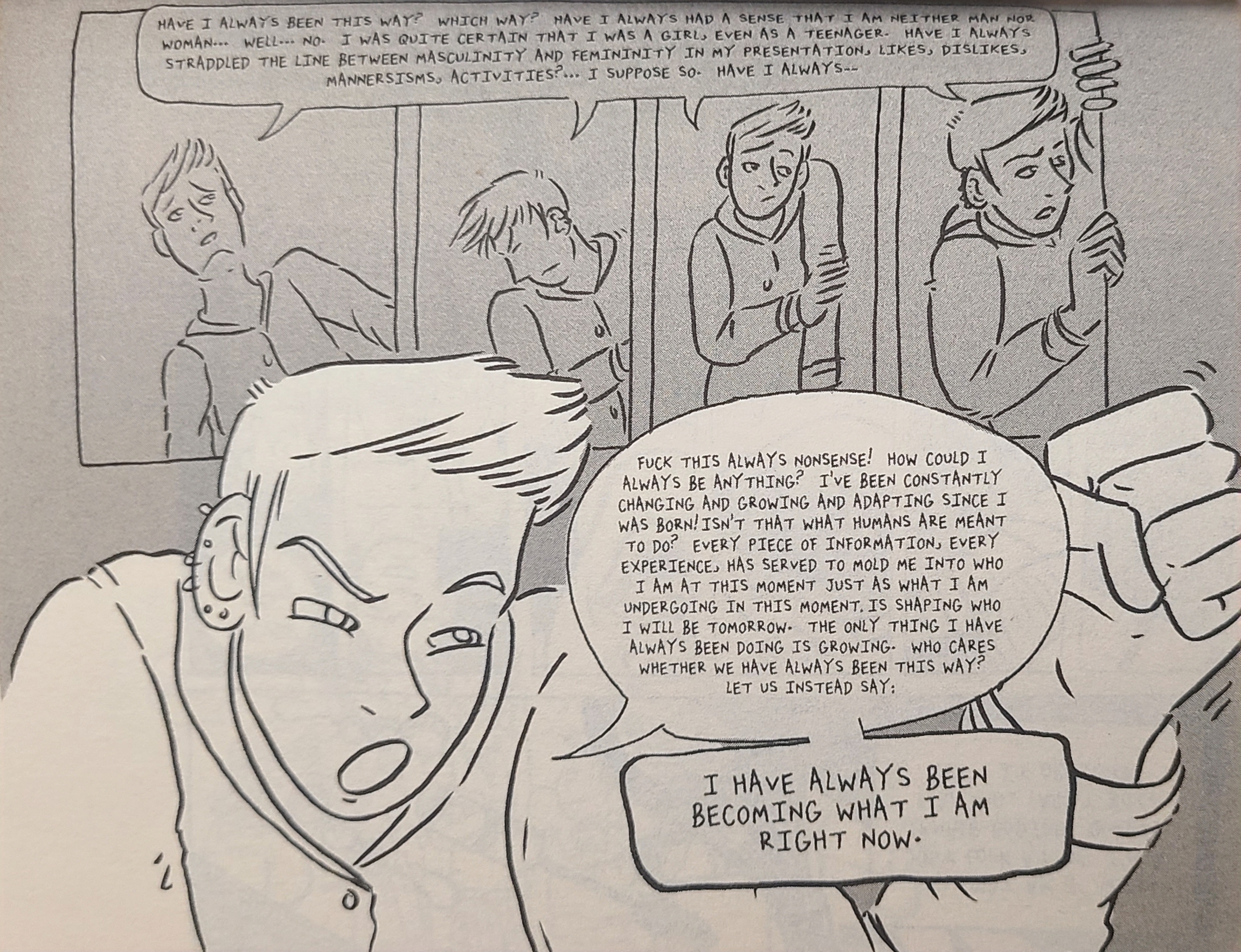
ALT TEXT: An image excerpt from “Gender Outlaws: The Next Generation” page 177. In background: Grayed out images representing an insecure internal monologue. They are saying: “Have I always been this way? Which way? Have I always had a sense that I am neither man nor woman… well… no. I was quite certain that I was a girl, even as a teenager. Have I always straddled the line between masculinity and femininity in my presentation, likes, dislikes, mannerisms, activities? …I suppose so. Have I always…”

The internal monologue is cut off by the person in the forefront, saying, “Fuck this ALWAYS nonsense! How could I always be anything? I’ve been constantly changing and growing and adapting since I was born! Isn’t that what humans are meant to do? Every piece of information, every experience, has served to mold me into who I am at this moment just as what I am undergoing in this moment is shaping who I will be tomorrow. The only thing I have always been doing is growing. Who cares whether we have always been this way? Let us instead say: I have always been becoming what I am right now.”

OCD isn’t really cute

OCD is like (and I apologize for what I’m about to do to some of you) The Game. Always there, but not a problem until it becomes a conscious thought. And then it’s on replay; like The Game, trying not to think of it only makes it worse.

Years ago, I was luckily “exited” from The Game. Although I’ve not seen this ever described as an “official” rule or solution to The Game, I choose to believe that one could be “exited”. Since The Game functions a lot like OCD does (at least, for me), it’s not some cute mind game that we all play together, it’s a reminder that my brain doesn’t work the same way everyone else’s does. I have a million little “The Games” I’m playing constantly in my head—if a pencil is turned toward me, if I notice it, it has to be turned away. If the “Best By” date has passed and I notice it, I have to throw it out. Well, I don’t have to, but my brain will make it seem like the end of the world if I don’t (and that’s on magical thinking, which isn’t as fun as it sounds).

Diagram by me!

There’s more, too: intrusive thoughts, which are not what TikTok makes them out to be; object personification, which leads me to hoarding, unable to give away anything because I fear it ending up trashed, abused, or unloved (which is of course made worse when coupled with ADHD and impulse buying). Like many others, I have to do things in equal measure to my body. If I chew my nails (as I have a bad habit of doing), I have to chew equally on both sides of my mouth, and then the whole nail has to be smooth, which often means I’m stuck chewing on my nails until it’s too painful to continue. Or I have to step on the stairs evenly, which might make me go back and walk back down the stairs if I wasn’t able to get enough steps on my left foot.

The thoughts are easiest to stop when you don’t even give them the chance to talk; you look away from what triggers the obsession, you walk away, leave the room, remove yourself from the trigger, and the voice doesn’t get the chance to talk. You look like a madperson when you literally plug your ears and say, “La la la!” loudly, but you do what you have to to block the thoughts from forming. Blocking them is hard, but resisting is harder.

It’s not fun talking about OCD, I know. I understand the looks of discomfort, fascination, scrutiny, disbelief when I talk about why I do what I do or the process of my thinking. It’s as crazy to you as it is to me. I know how alien it is to many; it’s clear from how I’m treated.

The Game is a reminder that I do not belong to the same world as everyone else; that I cannot escape this, even in the most normal of moments, even in elementary school games. That, at the end of the day, most people can decide whether or not they want to be a part of The Game, but I have a voice in the back of my head telling me society will literally collapse if I allow myself to exit The Game.

But someone exited me from The Game, so I don’t have to play it ever again. Years of therapy and learning how to cope with OCD have helped me learn that I can stop those thoughts on my own (most of the time; I’m still getting stronger).

If you’ve read through all this, I hope this helps you understand a bit more how OCD can work (and it can be more or less extreme than it is for me than it is for others). And, if you need to be exited from The Game too, consider this your official invitation to stop playing the game. I promise, nothing bad will happen.

Let me make my silly little choices, and you can make yours.

Let me make my silly little choices, and you can make yours.

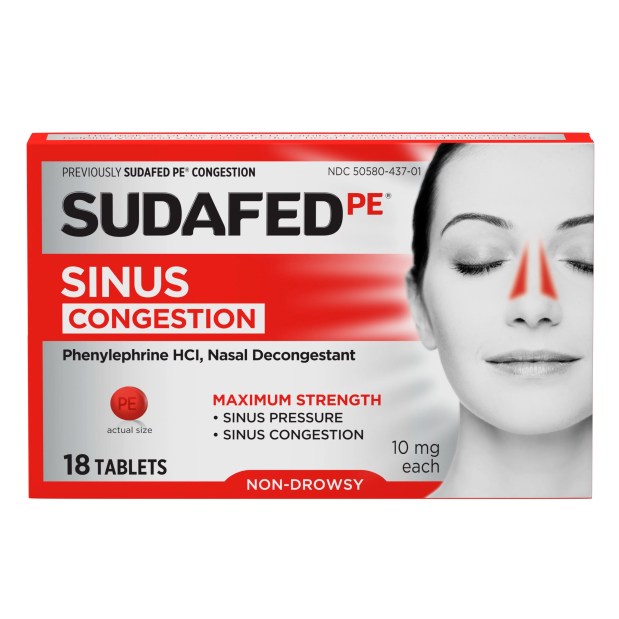
Front cover of the Sudafed PE OTC box.

Recently, an FDA panel announced that Sudafed PE and other decongestants are, essentially, ineffective. Since this announcement, I’ve seen countless articles pop up on my Google News feed about removing Sudafed PE, Mucinex, and Benadryl from the shelves. The argument to remove the medicines is that we shouldn’t be selling ineffective products–but are they really ineffective? An argument can be made that these are exceptionally effective placebos (sugar pills/ineffective medicine).

The placebo effect is well documented; even when a patient knows they are taking a placebo, sometimes just taking a pill helps to trick the body into the desired effect. Bodies and minds are weird, and whatever works, works. Even if Sudafed and its relatives are little more than placebos, I think they should be allowed to stay on the shelves. After all, the placebo effect can reduce symptoms by up to 50%, and that’s more than enough to convince me.

For all the many ailments I have–visible and invisible, temporary and chronic–very few have effective and fast solutions. There is no Xanax for depression, no Zofran for migraines, but there is Sudafed for a stuffy nose. Maybe it’s silly to continue to take something that has been proven not to work, but I swear I feel my sinuses clear up minutes after taking Sudafed. It allows me to get a restful sleep instead of battling with the correct sleeping position that allows me to breathe.

With the lack of effective medications available for a variety of illnesses, I am frustrated by the attempt to remove existing medications instead of putting new ones on the market. While I am not necessarily a fan of being stuffed full of pills, I like having the hope that maybe there is an accessible medication out there that will work for me. When the number of approved medications is even further limited, frustrated and exhausted people like me turn to home remedies and endless concoctions of honey, sea salt, herbs, and usually get roped into the wellness industry once or twice.

If Sudafed doesn’t work for general populace, there is nothing I can do about it. But whether it’s the placebo effect at work or there really is some merit to Sudafed, let me decide how to spend my money. Taking Sudafed off the shelves leaves me one less remedy for a restful night–and when I’m combating so many other ailments for a moment of peace, this tiny relief is a huge victory for me. Leave the silly little pill on the silly little shelf and let me make my silly little choice; you are free to pass it in the aisle if you wish, but leave some for me.

What about the “right-to-live?”

I remember when Jahi McMath died—for the second time. 

Senior year of high school, I came across an article about Jahi McMath, a 13-year-old Black girl who was declared brain dead after her tonsils were removed. It was Jahi’s first surgery, and she was scared. She didn’t want to go through with it, but her mom convinced her it would make her life easier (Jahi had sleep apnea, and removing her enlarged tonsils was intended to help). After speaking with the doctor, Jahi consented to the surgery, and she was fine for about an hour afterwards.

Jahi’s blood vessels were unusually close to the surface of her throat; the doctor had noted this in his chart for her, but the post-op staff was unaware. So when Jahi started coughing up blood, they didn’t see it as the alarm that it was, although Jahi’s family did. They repeatedly raised the alarms for her, but no one listened until her heart stopped.

Jahi was declared brain dead; her brain had stopped functioning due to the massive blood loss. In California, brain death is legal death. But Jahi’s family didn’t accept that. Her mother, Nailah, was convinced Jahi was still alive; Jahi responded to some stimuli and questions. Nailah asked Jahi if she wanted to be taken off life support, and Jahi said no through physical movements her mother taught her.

In the long legal battle that followed, Nailah and her family were forced to flee the state with Jahi under threat of legal action and jail time. Nailah’s insistence that Jahi was alive, and refusal to take her off life support, violated California’s medical ethics, so they went to New Jersey, where families can reject the notion of brain death on religious grounds—Nailah technically “kidnapped” Jahi to do this. There, Jahi had at-home around-the-clock medical support from nurses and doctors who were willing to lose their medical license or be shunned from the medical community; the doctors that treated Jahi were treated as quacks by the medical community. In the view of the community at large, you cannot treat a body that is already dead, and although Jahi’s body was not dead, her brain technically was. The California hospital where Jahi had been declared dead consistently disavowed the McMath family’s efforts and actively disparaged them for “desecrating a body.” But they were wrong.

With consistent care, and rogue researchers willing to look into her case, Jahi was able to exhibit signs of life, brainwave activity, and even underwent puberty. In 2017, a neurologist at UCLA independently confirmed that Jahi was no longer “brain dead.”

Jahi died—for the final time—in June of 2018, not even six months after the New Yorker article was published due to internal bleeding from abdominal complications. Despite overwhelming evidence, the hospital that issued Jahi’s death certificate refused to ever accept Jahi’s recovery and overturn her death certificate.

In 2020, I, much like Jahi, was preparing to go into surgery to get my tonsils removed for sleep apnea, just as she had been. Her name haunted the back of my mind in the days counting down to my surgery, but I, just like Jahi, spoke with my surgeon and asked him how many times he had done the surgery, what the risks were, how long he had been a surgeon. I had the insight that a 20-year-old had and a 13-year-old didn’t, but we were in the beginning of a pandemic, in the middle of the shutdown, and my mom wasn’t even allowed in the waiting room with me. Though I was nearly certain I would be fine (my surgeon routinely did much more complex and precise surgeries, like removing tumors that had grown into the blood vessels of the throat), I was alone when I frantically pulled the anesthesiologist aside and had to shamefully admit that I had been taking quinine pills until yesterday morning, a stupid superstition I had bought into as a way to stave off a Covid infection.

Quinine, for those unaware, is an herbal supplement that used to be used as a “cure all” back in the days of the Black Plague and the Spanish Flu. It didn’t work back then, but I’m a big believer in the placebo effect, and I needed to take something to put my mind at ease. One of the side effects of quinine—that I didn’t know until the morning before my surgery when I actually read the bottle—is that it can thin your blood. This makes you a higher risk for surgery; you’re more likely to bleed uncontrollably because the blood is much harder to coagulate. The bottle said to stop taking quinine two weeks before surgery. Feeling like I was going to cry, and possibly even about to die, I waited anxiously to be taken back and prayed that I would wake up afterwards.

Obviously, I did, or I wouldn’t be writing this right now. But I’m aware how lucky I was, and am. Jahi’s case is in direct opposition to Terry Schiavo’s: Terry Schiavo was a White woman declared brain dead who the hospital refused to stop treating, whereas Jahi was falsely declared brain dead and refused further treatment. Jahi’s family noticed this too; they knew if Jahi had been White, she would have likely received the attention she needed, and even if she had still been declared brain dead, her family’s choices would have been respected. Having come after both of them, and being light-skinned myself, I know my family would have had the respect and space they needed to make whatever decision for me they felt was right if my surgery had gone wrong.

Still, it haunts me; Jahi’s story is barely told outside of fringe medical pieces, but Terry Schiavo’s is well-known enough to be casually referenced in feminist writings. Who gets the right-to-live? Who is allowed to die? Why are our bodies’ needs and wishes ignored depending on the kind of body we inhabit? I hope Jahi is resting peacefully now, but I carry the anger and fear of what was allowed to happen to her.