
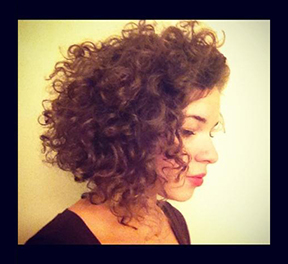
I feel I can safely say that the majority of women I have crossed paths with throughout my lifetime have, at one point or another, completely obsessed over the locks on their heads. What a woman does or does not do with the “filamentous bio-material” that grows from follicles in the skin on one’s skull seems to carry heavy social messages to the world around us.
I believe my hair tells a long and continuous story. The really ridiculous and really awesome things I have done to my hair are like little mental chapter markers; the hairstyles I’ve had are connected to memories of personal struggles and important events that have taken place throughout my lifetime. On one level, the long story of the obsessions I’ve had with my hair and what I have chosen to do with it is purely personal. Yet on another level, a much larger level, this post about the relationship I have with my hair can reflect the many struggles and external pressures that a large number of American women share.
I have a long history of bad haircuts and strange hair colors. Like many women, my relationship with my hair is deep and difficult to explain. I started dying it, chopping at it, and straightening it as soon as I got the “o.k.” for blonde highlights from my parents when I was in middle school. Of course my awareness of my hair and other people’s hair began at a much earlier age (a different story all together), but my relationship with my hair began when I could change it as I pleased.
In my teen years my hair reflected internal changes and personal obstacles: I cut it when I had emotional breakdowns, bleached it blonde after I broke up with my first serious boyfriend, buzzed it all off after taking my first Women’s Studies course (no seriously, I really did), and then grew it out big and curly when I envied the long, beautiful locks of women around me. I can look at a photograph of myself and remember exactly what my life was like at that point in time simply by what my hair looked like.
There was a year when I drastically changed my hair every few months (I thought of it as a creative outlet). My poor hair couldn’t keep up. I eventually fried my hair with all the color processing and I cut it all off to “start over” with my natural hair color…only to dye it after a year and a half, regret it, and cut it all off again. I am now trying to grow it out again…it’s exhausting, really.
My hair and I have a very complex, emotional, and non-committal relationship.
I know I’m not the only one who has cried after a bad dye job or been annoyed when a hair stylist cut off more than “just a little trim.” I don’t know when it happened but at some point the relationship I had with my hair completely changed; it became an expensive chore, a source of insecurity or envy, something I have to deal with every morning. It’s astounding how much time, effort, money, and energy I myself, as well as others, have put into the stuff that grows out of our heads.
The relationships that women have with their hair are long, deep, and complex. Our stories and experiences are shaped and influenced by capitalism, patriarchal societies, the media, race, culture, age, beauty ideals, current trends, social class, time periods, religious beliefs, etc.
As I reflect upon these experiences with my tresses I find myself wondering: Do I control my hair or does my hair control me? How much of this relationship with my hair is influenced by the society I live in? How much of it is internal?
————— EDIT 9/23 —————
I came across this song while listening to an online radio station. I looked it up and there were a variety of videos to pick from! (I was very excited) It completely applies to the topic of hair and identity.
“I Am Not My Hair” by India Arie ft. Akon
I chose this video over the others because I feel that Akon’s contribution is important. His lines in the song serve as a wonderful reminder that the relationship between a person’s hair and their identity, as well as how society perceives or treats a person based on their hair, applies to men as well.
Lyrics:
[Akon]
See I can kinda recall
Little ways back small tryin’ to bawl
Always been black and my hair I tried it all
I even went flat, had a gumdee curly top and all the crap, now
Tryin’ to be appreciated
Nappy headed brothers never had no ladies
Then I hit by the barber shop real quick
Had em give me little twist and it drove them crazy
And then I couldn’t get no job
No corporate wouldn’t hire no dreadlocks
Then I thought about my dogs on the block
Kinda understand why they chose a stealin’ rock
Was it the hair that got me this far? (uh-huh)
All these girls these cribs these cars (uh-huh)
Hate to say it but it seem so flawed
Cause success didn’t come ’till i cut it all off (uh-huh)
[India Arie]
Little girl with the press and curl
Age eight I got a Jheri curl
Thirteen then I got a relaxer
I was a source of so much laughter
Fifteen when it all broke off
Eighteen and then I went all natural
February two thousand and two I
Went and did what I had to do
Cause it was time to change my life
To become the women that I am inside
Ninety-seven dreadlocks all gone
Looked in the mirror for the first time and saw that
Hey…
[Chorus]
I am not my hair
I am not this skin
I am not your ex-pec-tations no no
I am not my hair
I am not this skin
I am a soul that lives within
[India Arie]
Good hair means curls and waves
Bad hair means you look like a slave
At the turn of the century
It’s time for us to redefine who we be
You can shave it off like a South African beauty
Or get in on lock like Bob Marley
You can rock it straight like Oprah Winfrey
If its not what’s on your head
It’s what’s underneath and say
Hey….
[Chorus]
[Akon]
Who cares if you don’t like that
With nothin’ to lose post it with a wave cap
When the cops tryin’ to harass
Cause I got waves
But he’s sayin’ nothin’ like that
Not in my days (noo…)
Now you gotta change all feeling’s
Based on one another by their appearance
Yes, India I feel ya girl
Now go on and talk the rest of the world
[India Arie]
(oh, oh, oh)
Does the way I wear my hair make me a better person?
(Whoa, whoa, whoa)
Does the way I wear my hair make me a better friend? nooo…
(Whoa, whoa, whoa)
Does the way I wear my hair determine my integrity?
(Whoa, whoa, whoa)
I am expressing my creativity…
[India Arie]
Breast cancer and chemotherapy
Took away her crown and glory
She promised God if she was to survive
She would enjoy everyday of her life ooh…
On national television
Her diamond eyes are sparkling
Bald headed like a full moon shining
Singing out to the whole wide world like
Hey…
[Chorus 2x]


I think this is a really fascinating question, especially as we analyze the intersectional body politics that figure into any discussion about hair. For example, if I were to answer the question for myself, I would say that I am in control of my hair, rather than vice versa. It is important to note, however, that my answer is completely informed by my race and privileged position, because I am white and have relatively straight, easily managed hair. But if we look at the example we recently discussed in class of schools banning Black children from wearing their hair in “afro-puffs and small twisted braids,” it becomes obvious that institutions are attempting to control people of color through the legislation of their hair. I think that, ultimately, the answer to this question is dependent on many factors, but the impact of race, gender, and the individual’s adherence to beauty ideals cannot be understated.
I love how you take the question that we talked about a lot at the beginning of class – are we a body or do we have a body – and used it to talk about your hair. (I also appreciate knowing that I’m not the only one that cries after bad hair dyes/hair cuts/etc.)
I am definitely not sure that I have an answer to this question, but your use of the word “control” reminded me of Arthur Frank’s continuum of predictability to contingency, which I do think also applies to bodies that aren’t sick. Hair is often easier to control than our bodies. When I want to change something about my appearance, I immediately look to my hair. Perhaps it’s a way to exercise control over one part of the body that isn’t always controllable?
Very relatable post. Although I’ve never come close to bleaching or dying my hair, I understand the feeling of losing a significant amount of hair from a “little trim” from a hairstylist, and constantly being frustrated with the outcome of my hair in general. A women’s hair is truly a personal love/hate relationship, and to answer your question, I think that it may go both ways. At times your hair might control you by how its appearance dictates your outcome of emotion, and you control your hair by changing its style when you experience certain milestones in your life.
This post really hit home for me. When I moved out of my parent’s house last year, I dyed my hair blue as an act of independence, because as an adult living on my own, I could call the shots and do things I had always wanted to do, dyeing my entire head an unnatural color being one of them. For the 10 months that I kept my turquoise locks, my hair became a part of my identity in a way that I had never experienced before. It became my “signature.” People knew me as “the mermaid.” I became slightly more visible in queer spaces due to my alternative hairstyle (I had an undercut at the time as well, which meant half of my hair was long, and the other half cropped close to my scalp). My “sea punk” hair also meant much more attention in public, especially from boys who used my hair color as an invitation to start a conversation and hit on me. People would yell across the street to tell me they loved my hair, drag queens told me they wanted to “scalp me for lace fronts,” and I received daily comparisons to celebrities like Katy Perry and Nicki Minaj. In the beginning these compliments were flattering, but towards the end of my career as a blue-haired babe, they were expected, and almost annoying.
My recent switch to an auburn shade was mostly done because I was sick of the attention, but also because I made the personal choice to fit in at my new internship with the state government. My supervisor even told me that she liked my hair color, but I received strange looks from my coworkers because I did not present myself conservatively, and I felt like I would be taken more seriously as a young professional with my hair dyed a more natural hue.
Like the author of this post, I connect my hairstyles to important life events. In my case, transitioning from blue to dark red hair symbolized growing up and entering a professional world that may impact my future career. I’m still compared to famous faces, including Ariana Grande and Ariel from the Little Mermaid, but the only comments I get are from people who knew the blue-haired me and are seeing my red hair for the first time. Although the difference in how people interacted with me after I changed colors was jarring and took some getting used to, it made me realize how much something as superficial as my hair impacted my image.
I am one that is really big on hair although growing up I really didn’t care how my hair looked. I would say that I get it from my mom. My hair always has to be done now and I refuse to go out if it does not look at least half way decent even if the rest of me looks like I just woke and through some clothes on. For me and my mom I would say that our hair somewhat controls us especially since it completes our ensemble. It’s never a good look to go out with your hair undone you never know who you might run into and most people notice either your hair or outfit first.
I totally relate to what you’re saying about controlling our hair, though I’ve never dyed my hair or given it a drastic cut. The way I control my hair is to flatten it with a 410 degree flat-iron each day. As someone with naturally coarse, crazy, curly, spring-y hair, it definitely feels like it’s a foreign object I was cursed with. Until I started ironing it daily a few years ago, I was a constant lightning rod for politically insensitive, ignorant comments from adults and children alike (“How come you have Jewish hair but not a Jewish nose?”; “If I put a pencil in your hair, will it stay there?”). For a kid, having that hair is like a social death sentence, and nothing my mom could say about how it “reflects my heritage” or how “curls are kisses from God” (really) could help me not feel like an outsider. When I first started straightening my hair, it felt amazing because I finally felt “one” with my hair; we were existing in perfect harmony. But I’ve started to notice that years of straightening is really weakening my hair… it’s as if my hair is speaking back and intends to have the final say. So I guess I’m a “cartesian dualist” here. This hair is not ME and doesn’t reflect me in any way, I’m just stuck with it!