
Pronouns. Pronouns are things that we learned about in grade school and for most people, something they haven’t thought about since (unless we get into learning other languages but that brings up something else entirely). Pronouns are almost always read off the body, which is funny because they actually have nothing to do with bodies. Pronouns are related to gender, so within the gender binary, it makes sense that he/him/his or she/her/hers are the only pronouns people know, and are almost always the pronouns that people read off of others’ bodies. I’m gonna let you in on a little thing called “there are more than two genders” (it’s shocking, I know. I’ll let you think about that for a minute).
transgender
Princess Joules
A few days ago, I have rediscovered one of my favorite YouTube bloggers, Princess Joules (Julie Vu). Princess Joules has been documenting her transition from male-to-female for about 3 years. About 5 months ago, she went under sex reassignment surgery and made a complete transition. What I love about her videos is that she is honest about her experiences. In the video below, she tells us about her feelings as she is an hour away from surgery.In class, we’ve read about how a transgender person must have a psychological assessment done before they are approved for sex reassignment surgery. I personally felt that it was upsetting that they had to prove that surgery was necessary; society should not be able to police our bodies, especially when we know ourselves best. However, Princess Joules tells us the truth about her feelings – something that most of us would not expect…
After seeing this video, a few questions came to mind:
- Before Princess Joules came out as transgender, she came out as a gay male. I want to know if surgery changed her perception of her own sexuality. Because she believes that, internally, she is a female and belongs in a female body, and she is now a legal female, is her sexuality labelled as straight?
- How do most transgender people define their sexuality after their transition into their true selves?
- If we completely got rid of gender roles, gender, and sexuality (LGBT), how would we define our self?
Fictional Reality: the Danger of Matter over Mind
I think at this point in my life, I can safely say that I owe most of my coping mechanisms to the vast amounts of fantasy fiction that I’ve read. Cartesian dualism has been an integral part of the way in which I built my world, and up until this point has been the only way in which I know how to reconcile what happens inside of my head and what happens in the outside world.
Rearranging the Order
The other day, I had my sister come visit me at school (it was under the pretense of free grilled cheese afterwards, so I was all for it). After the small 2-room tour of the entire apartment, we came to my room and settled in for a chat. Nothing serious, just the normal “How are classes going?”, “How are things at home?” type of talk. However, a few minutes later, her eyes glanced over to my open closet where a few button up polos and some sweatshirts were the only hanging garments.
“What are those?”
The Great Wall of Vagina
Artist Jamie McCartney is trying to start a sexual revolution… but not the kind we usually think of.

He is attempting through art to change female body perceptions and show us that every woman’s vulvas are normal. McCartney is a life cast artist; he spent five years collecting casts of volunteers’ vulva mounds and has turned the result into The Great Wall of Vagina.
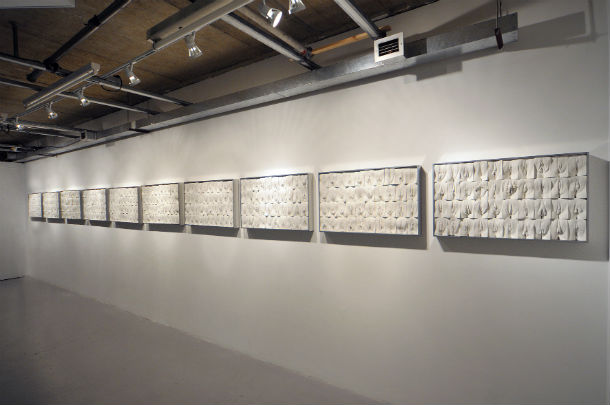
The work includes 400 casts, as accurate as photographs, displayed in ten wall panels. They range in age from 18 to 76 and include mothers and daughters, identical twins, transgendered men and women, women pre and post natal, and another one pre and post labiaplasty. It is impressive and at times overwhelming, but by reducing the body part to a simple white plaster cast, he removes the sexualization we would typically attach to such a display. His use of spectacle shows us how absolutely diverse each and every woman’s vulva is – on the website it mentions how each one is as unique as a face. And they are!

“For many women their genital appearance is a source of anxiety and I was in a unique position to do something about that.” - Jamie McCartney
There are several things I find interesting about this art project. First, by bombarding us with 400 vulvas in a small space, he reduces the body to a single part, from a view many of us have never seen. And while we ARE viewing the diversity and differences in vulvas, it also manages to emphasize the similarities. We see the similarities in our differences.
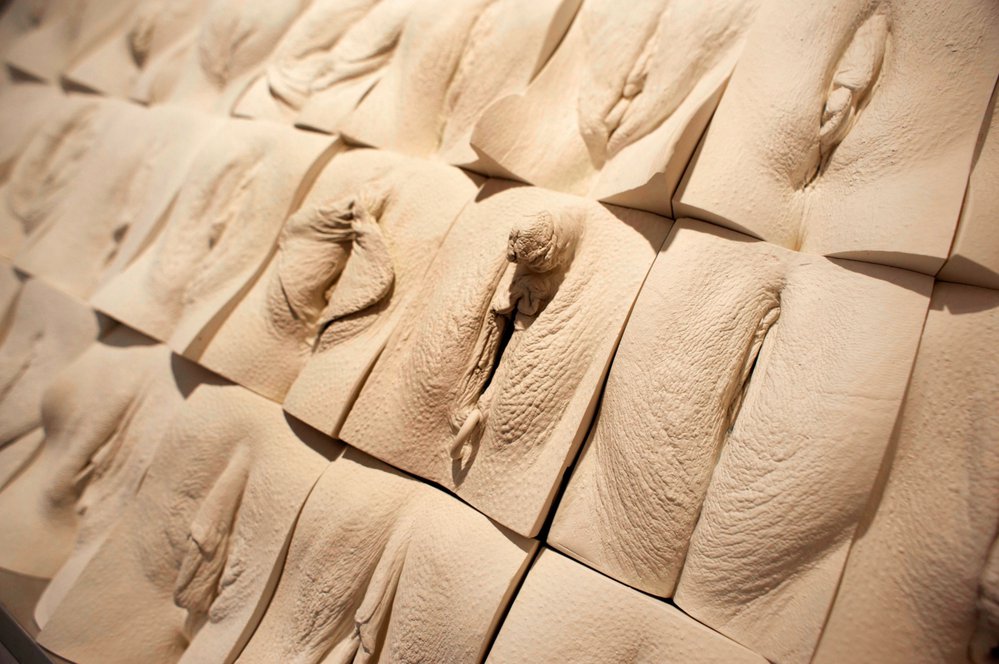
And second, if women are shocked and surprised at the diversity shown here – why is that? Is it simply because most heterosexual women haven’t seen other women’s open vulvas? Or is it the “pornification” of our modern culture? If labiaplasties are on the rise, do you think an exhibit like this would help stop that trend? Do you think hetereosexual men and lesbians are surprised by this diversity?
So, would you go see the show? And if you are the owner of a vulva, are you looking for one that looks like yours?

“It’s time our society grew up around these issues and I’m certain that art has a role to play.” - Jamie McCartney
The Phallic Titty Manifesto: Queer Sex and the Naming of Parts
Transitioning is often seen through a medical lens, marked by physical changes to the body including hormone replacement therapy and sex reassignment surgery. While transitioning clearly demonstrates the fluidity of gender, the body, and how gender and the body interact and are perceived, the locations of sex on the body are often viewed as static. For someone to have fully transitioned, their gender and biological sex would seemingly “match.” I am in support of people doing whatever it is they need to do to feel good about their gender and I am in no way against this type of transitioning. However, what I believe is problematic is how this is typically seen as the default for trans* people. Not all trans* people transition or transition in this particular way.
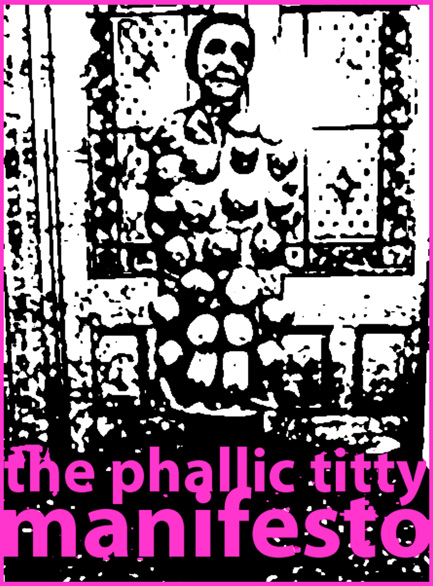
The Phallic Titty Manifesto, a zine by a friend Jackie Wang
discusses the ambiguity of flesh, tits as dicks and dicks as clits, erotic lactation, Judith Butler, pregnant bodies, Louise Bourgeois, the lesbian phallus, unmaking and remaking bodies, expanding erogenous zones, and queer sex.
Through a queer lens, sex is no longer isolated to biological parts associated with our sex at birth or if they are their weight no longer holds. In this sense, there is a radical capability to transition or transgresses gender norms while still seemingly embodying the sex you were assigned at birth.
This makes me think of the usage of terms “female-bodied” and “male-bodied.” I have typically heard them used in the context of referring to trans*, genderqueer, and non-gender conforming folks. While someone will refer to someone with “they/their” pronouns in one breath, they will use “female-bodied” or “male-bodied” to refer to them in another. While I think this is subjective, dependent on the specific person and how they like to be referred to, I think this is extremely interesting. From this example, it is clear how deeply embedded sex and gender are in physical bodies. I think at times terms like these can (unintentionally) reinscribe the gender binary, in which some folks clearly do not identify with. If someone is trans*, why wouldn’t they be trans*-bodied (or however they would like to be referred)? Do you think it is inherently impossible to view the body, specifically sex on the body as fluid?

