“American Able” – Challenging Media Representations of Disability

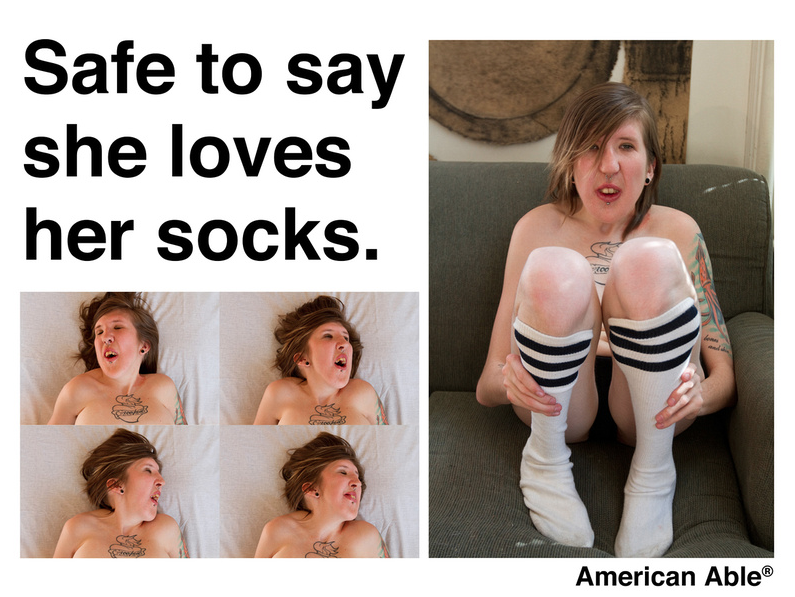
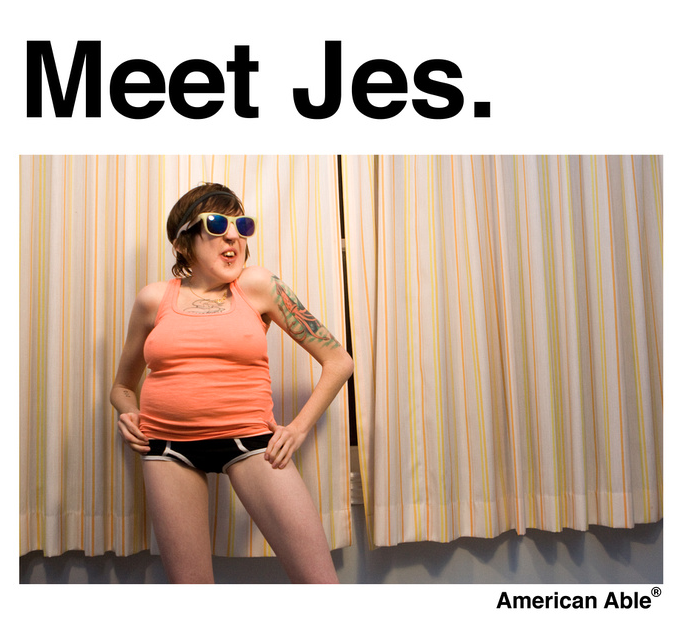
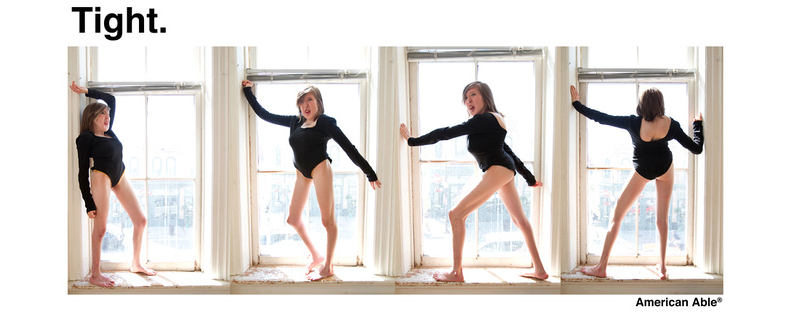
Here’s a description of the project from the the artist Holly Norris’ website:

“American Able” intends to, through spoof, reveal the ways in which women with disabilities are made invisible in advertising and mass media. I chose American Apparel not just for their notable style, but also for their claims that many of their models are just ‘every day’ women who are employees, friends and fans of the company. However, these women fit particular body types. Their campaigns are highly sexualized and feature women who are generally thin, and who appear to be able-bodied. Women with disabilities go unrepresented, not only in American Apparel advertising, but also in most of popular culture. Rarely, if ever, are women with disabilities portrayed in anything other than an asexual manner, for ‘disabled’ bodies are largely perceived as ‘undesirable.’ In a society where sexuality is created and performed over and over within popular culture, the invisibility of women with disabilities in many ways denies their sexuality, particularly within a public context.

Too often, the pervasive influence of imagery in mass media goes unexamined, consumed en masse by the public. However, this imagery has real, oppressive effects on people who are continuously ‘othered’ by society. The model, Jes Sachse, and I intend to reveal these stories by placing her in a position where women with disabilities are typically excluded.

I think this project is extremely fascinating in its critiques of advertising and mass media, specifically American Apparel, and the projects counter-depictions of disability.

How is Norris’ explanation of the invisibility of disabled bodies in mass media, including the de-sexualization and undesirability often seen intrinsic to disability, parallel to Garland-Thomson’s “Integrating Disability, Transforming Feminist Theory”? Do you believe that the depictions of disability in American Able are revolutionary? Can these counter-depictions of disabled bodies truly change advertising and mass media and the ways in which we view disability in our society?

Some of the following images by be not safe for work (NSFW).
Androgyny

Often, we talk about “beauty standards” as a single set of rules, as though they can be internalized and followed the way one might follow the rules of grammar or mathematics.  Beauty standards have very real consequences for those who break them and also those who don’t, and they are so pervasive as to seem universal.  But they aren’t universal.

Take, for example, the context of the fashion industry.  Granted, there are plenty of harmful aspects of consumerism and misogyny in fashion in general.  Still, fashion is, purportedly, an art that pushes boundaries, even if it has inherited the unfortunate boundaries of the society of which it is a part.  This is an essay in itself.  What is interesting for the purposes of this post is how the beauty standards for fashion models differ from those for the average person in a given culture.  The purpose of fashion is to push boundaries, and so it continually shapes the beauty standards and trends for average people and then changes them.

Similarly, models are not held to the same set of standards.  Successful models have a certain set of common characteristics (tall, thin), as well as something that makes them “stand out”: a sharp nose, strong brow, angular jaw line.    At the same time, the desire for models who are tall and thin has necessarily led to an increase in models with androgynous bodies.  Perhaps the most popular androgynous model at the moment is Andrej Pejic, who in one season walked five men’s shows and four women’s shows.

His body seems to be proof that even biology is not dichotomous.  One would expect this to be more threatening, yet Andrej reports a happy, carefree childhood.  His mother is doting, his brother is supportive, and the hardest part of his teenage years, he says, was figuring out who he was.  The freedom that he seems to have felt from pressure to look or act a certain way, the ability to decide for himself who he wanted to be, is remarkable.  The following interview shows him to be level-headed and surprisingly unaffected by his sudden success as a model.

In the context of fashion, androgyny seems more acceptable, relatively speaking.  What do you think makes this the case?  Is this a positive move, or does it just reflect a fetishization of “unusual” bodies?

The Body in Poetry.


The video is Andrea Gibson preforming her poem, “I Sing the Body Electric, Especially When the Power’s Out”. I thought this was fantastic because it does self-consciously reflect the ways in which we take our bodies for granted until something is wrong. She points out that she wrote the poem when her body was hurting her – this is a reflexive way to recognize that the body exists. Her poem, however, extends pass that and praises the body as a machine in poetry. The imagery really counts towards her overall message. Body parts are representative of their function and ultimately, their worth.

The body does so much, but we also picture the internal features as something much more pristine. The use of heart beats keeping rhythm, of the mouth as a fire escape, and the smoke in her lungs points to the ability of the internal body to ampify our natural processes. What resonated with me the most were the lines about her injuring her body and the doctor assuming it was for attention. I feel like that’s one of the ground rules we’re expected to take about the body: we’re blessed to have it and should appreciate everything it does, so those who do modify the body are transcending the whole “body is a temple” concept