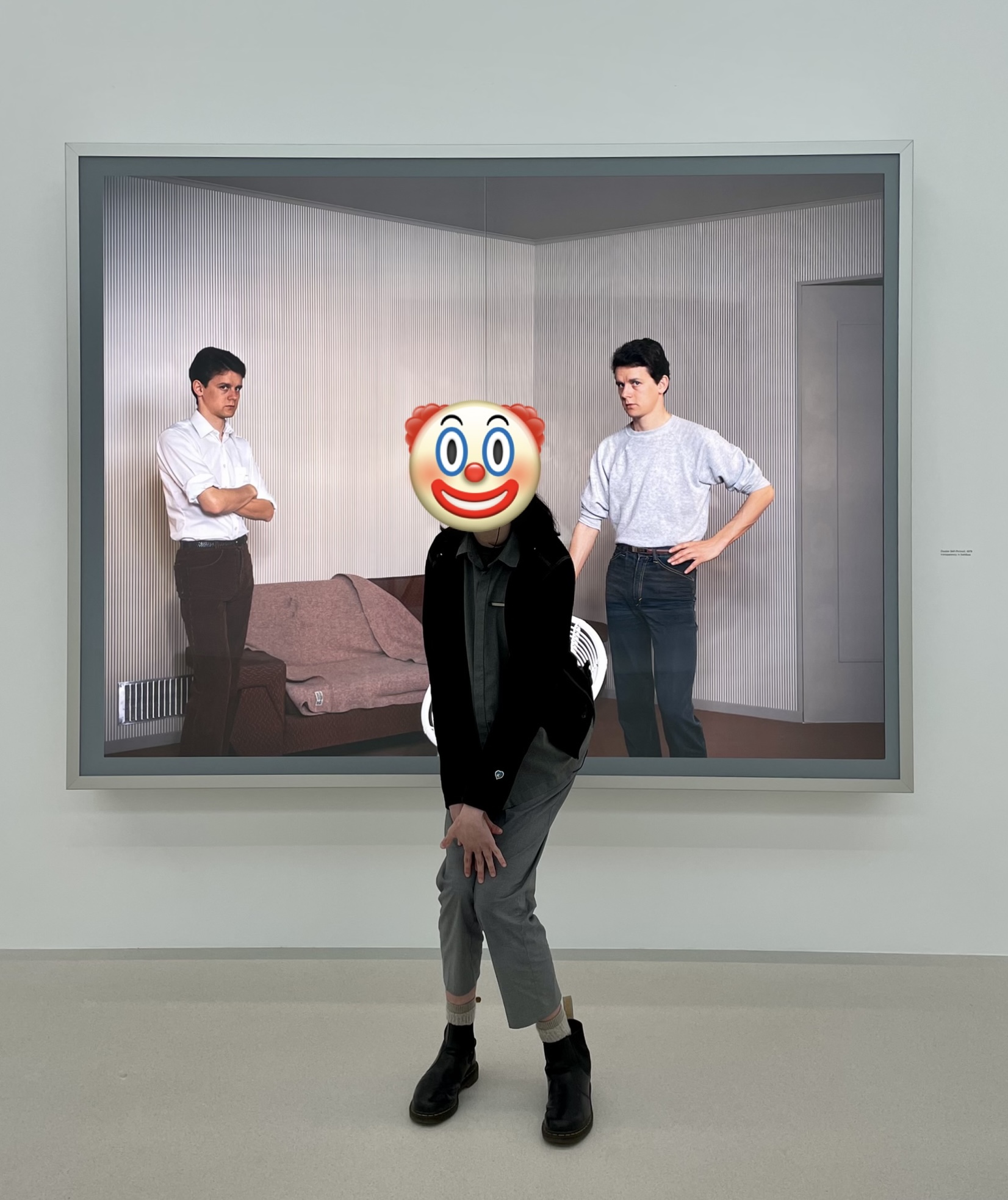
Your two identical fathers and I would like to have a word with you. (The author and Jeff Wall’s Double Self-Portrait, 1979. The flooring in this image: terrazzo.)
Concrete Most of the walls are made from concrete, pre-cast into panels and weathered outdoors in North Carolina. The floors of only two rooms are made of concrete: one exhibit room and the main loading dock. The loading dock is where we’d gather to hear the featured artists speak, our employee status granting exclusive access to the secrets of their practice. The sound would bounce off the walls and concrete floor so much that I had to strain to understand. The head curator once introduced us guides to a visiting artist as “walking, talking wall labels.” I’ll never forget the rage I felt in that moment. 6/10. Not especially comfortable nor remarkable.
The other day I tried to explain to my roommate that it was a privilege to not have to work while you are in college so you can afford the next semester and she took offense to my statement because, when you point out people’s privileges that’s what happens. They start talking about all the things they have done throughout their life and all the other disadvantages they face that have nothing to do with the topic at hand, so they seem less privileged. But we forget just because you are not privileged in one area does not mean that in another area you aren’t. But she neglected to understand my point of view.
Preparing myself the night before to wake up at 6am, and going to sleep early while she is still out with friends until midnight hours. Don’t get me started with the after-work hustle, friends getting upset with you because “you don’t ever hang out with us” are the same friends who only have school to worry about because the only time you have when you aren’t in class or doing the homework you are at work. The constant exhaustion and feeling of emptiness when you get off and try to wind down, just to have to prepare for your next days at work. The actual work is less exhausting that the “consequences” of working. The worry about if you got enough hours to pay off the school before the semester ends, but also have to save up for the following semester. The worry about if you are going to be dropped by your friend group because you are constantly socially unavailable and when you are you have no energy because you just got off of work. The worry about if you are going to be written up because you were having a bad day so you were emotionless during your shift heavily relies on customer service.
Working while you are in school is so mentally and physically draining to the point where you miss classes sometimes because you can’t get out of bed, which later affects your attendance score and you’ve missed a lesson. On top of that, it is very easy to fall behind on schoolwork. You pick a shift over an assignment because the 1 hour you have between the end of your shift and when the assignment is due “is enough time.” Constantly turning in sloppy work or half-finished work or even not being able to do the work at all. Having to email professors that you might be late to their class or not show up because your shift ends 15 minutes before class starts because you worked in between class periods since every cent on your paycheck counts.
So, when my roommate told me that not having to work during school wasn’t a privilege it kind of hurt because she sees firsthand how my work schedule is constantly fighting with my school schedule. How I don’t get out of bed on Sundays until well into the afternoon because I don’t have work that day but go to bed early because I have work the next. She sees the mental and physical exhaustion but still asked if I want to go out when my answer is always no, but then she complains that I’m never around. But she is the same person who expects me to buy the food, soap, trash bags, dish detergent, regular detergent, cleaning supplies, etc. because she doesn’t have a job not only that, but she offers up the stuff I buy to others in our hall i.e., cooking oil, pans, eggs, detergent, feminine products, etc. when she didn’t pay for it. I don’t mind sharing but she shares like it’s hers to give away. I also do most of the cleaning when I get off. I feel like someone’s wife and going “home” is when my second shift begins.
The loose definition of emotional labor is when you have to manage or suppress your emotions. This can be in any environment or around anyone including your family, friends and significant others. It’s used to fulfill the “requirements” or act how you SHOULD act. I grew up in a household where anxiety is just stress that’ll go away causing me to take on a lot of emotional labor in a lot of different environments. I am now in my very early 20’s and hadn’t been diagnosed with anxiety until just the beginning of this year after struggling with it for at least six years. I don’t think I realized how much additional emotional labor I was doing for the last couple of years. Since My family didn’t support the idea of me struggling with anxiety and I was undiagnosed, I often second-guessed and gaslit myself into thinking that I probably didn’t have anxiety, that I was just complaining more than everyone else. Forcing myself to deal with the struggles of anxiety while trying to keep up with the norms of being a 20 year old such as having a job, going to school, and trying to hang out with friends was completely overwhelming. I however felt that I had to push through those feelings so I wouldn’t be behind. A lot of the emotional labor that I encountered was self-inflicted; I was never forced into suppressing my emotions at work, school, or with friends. It was myself that felt the need to suppress my feelings so that I could be “better” at whatever task I was doing. This eventually caught up to me because I was skipping classes, breaking down in school bathrooms, and even at work i would have such bad panic attacks that they almost ended up taking to the emergency room because I couldn’t get myself to calm down, but after twenty minutes of being okay, i forced myself to go back to work despite really needing to take a nap. This is just an example of how I would cause emotional labor on myself. With that, there was also the emotional labor that comes with a job, especially ones that are heavy with customer service. I was forced to replace my intrusive thoughts and anxiety with a smile and be super attentive at all parts of the day. On days when I needed to give myself care, I had to give it to someone else because I was too scared to call out sick because technically I wasn’t sick. I mean I wasn’t even diagnosed so I didn’t even know if I was overreacting or not. At the beginning of this year I got diagnosed with anxiety and I have since been learning how to lighten the amount of emotional labor at my work so that I am not harming myself more than benefitting myself. I now do check-ins with myself and see where my head is at because I now know that if I continue to suppress the stress that comes with my work, it can result in a very bad panic/anxiety attack that can wipe out my energy for the day. I wish that I had gotten help earlier so I could have learned more tools to help manage my expectations of myself and lighten my emotional labor in every environment. To conclude my post, although we naturally experience emotional labor no matter where we are, there has been a period of time when i was taking on more emotional labor than i could handle because I wasn’t listening to my own body and its needs (such as taking a day off or requesting more time for an assignment).
P.S. as someone who has been working in different environments and wasn’t able to get diagnosed for a very long time because of financial and family support; take a day off at work sometimes just because you need it. I promise you nothing is going to change and they wont be disappointed in you. Even if you don’t have anxiety, you still need to make sure you have time to yourself!
A world accessible to everyone! A claim that all people are approaching when going anywhere in the streets. A disability in a person affects everyone who surrounds this person. To support my statement, I would provide my personal experience.
Thankfully, I do not have any disabilities that hold me back from doing any day-to-day activity but my cousin does. I do not know her medical condition by name but she has trouble talking, shakiness and walking. The combination of the last two makes her walking up stairs a hard time and does require some help. Sadly there are multiple places where there are multiple stairs and it’s the only way to reach them without making a mile run around to go through a ramp which would make it easier for her and the person going with her as it is a worry that she does not have to make huge physical necessities to reach x places.
Stairs are not a problem that helds her back from going up or down to a certain place but as I mentioned it does require a lot more effort from her and we, as her family, are thankful for this because this is an issue that not all people are able to confront. It is a fact that there are multiple different disabilities that do not abilitate people to go up or down steps.
The best place or scenario could be UMBC’s campus. It is located on a hill and it has full stairs, actually I counted them and there were more than 150, where the ramps are located at the administrative building entrance and the library which both go all around campus (at least from what I’ve seen. Imagining me showing my cousin the campus is stressful walking all those steps up and down (which we could go around but she is very stubborn with this aspect). The campus is a simple example but the world is full of the same or similar situations and usually the simple excuses to avoid changes are “go all around there are ramps there” or “it is too costly”.
I hope at some point people really think for everyone’s abilities and disabilities when constructing common areas.
Pregnancy is often celebrated, it’s a large spectacle with parties and extreme positivity. It’s presented in such a good light, so wonderful and magical. But then the pain comes, something will feed off your body to allow its own to grow, you’ll be surrounded by strangers as you have to force it from your womb and then you have to pay for it. That does not sound very wonderful at all… And if you’re a person with ovaries this will be expected from you.
There are many aspects of pregnancy that are unappealing to me that I feel aren’t discussed enough. Physically, your body changes. Pregnancy takes a huge toll on your body as you are literally creating a new life. You could experience skin deep changes such as stretch marks, weight gain, hair loss and breasts sagging. To serious health effects including but not limited to: teeth rot, blood pressure increase, bladder issues, dislocated hips and heart failure. There is no list of risks easily accessible, as pregnancy and women’s pain is largely romanticized.
I’m doing an application for an internship. It asks me–strictly for diversity data collection, it clarifies (I am suspicious)–if I have a disability. It then lists disabilities, most of them things I understand to be disabilities in the conventional sense, things I would list when asked for some examples of disability. I’m skimming the list for no real reason because I know I don’t have a disability. I get to the bottom: Anxiety, Depression. I pause. I have those things–in a clinical, diagnostic capacity, I have those things. I’ve never been confronted with the direct possibility that on me they are disabilities.
I remember in high school having a 504 plan recommended by my therapist that I would have to review with each teacher I had providing me with academic accommodations because my anxiety heavily impacted my performance in school. I google “504 plan” and The DO-IT (Disabilities, Opportunities, Internetworking, and Technology) Center at the University of Washington, Seattle tells me that a 504 plan “is a plan developed to ensure that a child who has a disability identified under the law […] that will ensure their academic success and access to the learning environment.” Oh. I guess I never considered it a plan for disability when I had it. It seemed more like a plan to make up for the fact that I couldn’t function like my peers, which I guess could define a disability. I never thought to legitimize that by naming it as one–others in my 504 testing groups had real disabilities, it seemed to me, and I could recognize that but didn’t find it appropriate to use a word so weighty for my experiences when I didn’t think mine were that bad.
The social model decides that “disability is something imposed on top of our impairments,” and it’s this that gives me pause filling out the form–is there another thing on top of my impairments? I think about what the thing would look like; the model tells me it’s a disadvantage brought on by social and cultural expectations of a body, of functionality. I have an impairment, and there are impeding expectations of productivity I am sometimes unable to meet because of these impairments, and it seems I can syllogistically conclude that this is a disability. But it feels like I’m missing some step in the middle. Drawing this conclusion beckons me to be aware of its gaps, and the ways my particular experience mitigates the effects of impairment; my socioeconomic standing provides me with health insurance that covers the cost of therapy and medication, and the support from my family allows me to find ways to cope with my impairment and be successful in spite of it. It still feels weird for me to claim a label so historically contingent and significant for those whose goals in their everyday lives are significantly impeded by a world that won’t accommodate them. Then again, my qualification for a 504 plan classified me as an individual with a disability. I have a tendency to distrust bureaucratic categorizations of identity, though, and recognize they’re more so for convenience and classification than anything. Plus I don’t have a 504 plan anymore in college, largely because I was too lazy to set one up, and I’m excelling in school regardless. I don’t know. I pause and click “No, I do not have a disability.”
I have been trying to get an autism diagnosis for 21-years. Well, not quite the entire time. I didn’t even know what autism was when I was going to see an autism specialist. I was 8-years old and I thought I was just going to see a nice lady who let me play with puzzles and asked me about school and my friends. Of course I knew I was seeing a doctor, but I didn’t understand what it meant at the time. When my parents were considering getting me diagnosed they told me I would have to take a bunch of long tests and talk to strangers, something I am definitely not into. Also I excelled in school and was able to keep one or two friendships. I think the biggest issue was the money, was it really worth it to pay thousands of dollars to get a piece of paper saying I was autistic? Outwardly, I was doing pretty well and I think most people though I was just an awkward kid.
If you are using the bathroom and someone walks in, do you stop peeing? For me, I stop. I try to make as little noise as possible because people can’t know that I, a human being, pees.
Let’s say we’re all at the same starting line, we did the same stretches, have similar good quality running shoes, practiced (some harder than others), and yet when the announcer says “Go!” I have to let others get a 30 second head start. He says go and the straight white males take off with the confidence only a straight white male could have. A couple seconds later black men get going, white women follow suit, the LGBTQ+ community, people of color, and people with disabilities are finally able to start sprinting to catch up. This is a very general list and the roadblocks people face to reaching that finish line could continue.
The preschool I attended did documentary-style videos throughout the school year and by the end of it, would sit us down in front of the camera and ask us what we wanted to be in the future. Without any hesitation, I answered that I wanted to be a mother. Growing up, I never let go of that dream. Of course, now, I have a career I’m pursuing and am receiving my education toward it, but I would still love to be a mom and raise my kids.




 Unruly Bodies