“You Can Either Be Fat and Jolly, or a Skinny Bitch.”

TW: Fat used as an insult to add emphasis


It’s a line that reads as dramatic. Offensive. Controversy for the sake of controversy. After all, The Big C is a show from the tail end of the notoriously fatphobic 2000s. However, Cathy’s right, and Gay’s article brought this now iconic scene back to the forefront of my mind.

Fat people are not allowed to be human beings. That’s the long and short of it. Society does not allow them to be complex, fully-fledged individuals with thoughts and feelings of their own. Instead, fat people are only seen as one thing. Fat. Their weight becomes the focus of every conversation, even when it has nothing to do with what’s actually being discussed. As Gay so succinctly put it: “Fat, much like skin color, is something you cannot hide.”

My use of the third person makes it seem like I’m offering the perspective of an individual outside of this experience. That couldn’t be further from the truth.

From the ages of 5–18, I was considered morbidly obese. “Husky” clothes were the norm for me. Many of my family nicknames were related to being “chubby” and “gluttonous”, names that still follow me to this day. My mother would complain constantly about how quickly I was outgrowing the clothes she would buy me. Even though she never explicitly blamed it on my weight, I knew she wanted to. It wasn’t until middle school, though, that I truly felt the ostracism begin.

Fat is not considered “attractive”, at least within the white supremacist American framework we live in. Despite my living in a predominantly black community, that framework was still upheld. Middle school is where social hierarchies become inextricable from the rest of your life, and they’re especially shallow then because everyone’s still learning them. So guess what becomes the single most important thing to have during your adolescent years? Pretty privilege. Good luck trying to access that, fatty!

It’s impossible to describe the experience of growing up “fat” and “unattractive” to a person who grew up “healthy” and “attractive”. It’s rarely a dramatic, Carrie-esque nightmare, though that can be the experience of some. Rather, it’s exclusion in small ways. Being overlooked, teased, rejected, and seen as less desirable by my peers became so common to me that it started to seem… normal. Somewhere in 6th grade, I reached the emotionless determination that I simply didn’t have a chance. I would never find love. I would never be pursued. I would always be alone. What a fucked up conclusion to reach at the ripe age of 11, right? Even more odd, though, was the role I was now expected to fulfill: The DUFF. Or, Designated Ugly Fat Friend, for the uninitiated.

This is where we circle back to the titular quote. Anyone who grew up fat knows that you’re only allowed to be funny. If you want any kind of social standing amongst your peers, you must perform the role of jester. Anything other than that is a cardinal sin. Don’t get too bold though, piggy.

You’re only allowed to “jokingly” insult people fatter or uglier than you, cause guess what becomes the point of focus when you try to punch above your weight? Having a bad day and can’t be everyone’s comedian? Too bad, unless you want to learn that all of that social capital is conditional. That’s not to say you can’t have genuine friends, but you’ll very quickly get used to feeling invisible, even if you’re right next to them.

Just as developmentally important is young love. Or at the very least, romantic attention/experiences. …Should I hold in my laugh? That’s the point of being the jester. No one takes you seriously! You’ll yearn for the idea of being pursued, but the closest you’ll get is vicariously living through your friends. Confessions? Dates? Partners? Aw, that’s cute. Only people get to experience love. And you’re not a person. You’re a fat person. Who gave you the right to be multifaceted?

What’s left after the show’s over, though? When you’re laying in bed after another day’s work of distracting people from your body, even though you know it’s all they’ll ever see, what happens in your mind?

Don’t we deserve more than this?

Aren’t we more than our weight?

Am I not, too, a human being?

…

…

…

What, you thought you could be intellectual and fat too?
How Much Of a Persons Decision to Change Their Body Is Truly An Individual Choice?

People often say body decisions are completely personal but we’re consistently surrounded by expectations about what bodies should look like. Society has placed an intangible wall to separate what we claim as a “normal” body. This constantly makes those that society deems as “fat” wonder where personal desire ends and social pressure begins to set in and the complexities that are involved within. The almost paradoxical and complex structure of this topic was very enticing to me while reading Roxane Gay’s pieces of literature: “My Body Is a Cage of My Own Making,” and “What Fullness is.” Gay very articulately and creatively demonstrates her message of acceptance vs discomfort and how the body can change from a source of protection and acceptance, to a limitation, and the overall complexity. Gay understands that she shouldn’t have to necessarily change herself in order to satisfy society, but the contradiction is that she doesn’t always feel comfortable living in her own body. What she knows vs what she feels is extremely important. Someone can recognize the unrealistic and normalized standards of today’s society but still feel somewhat pressured by it. The phenomenology within this concept is clear to recognize when we acknowledge if we are able to separate how we feel about ourselves from how other people see us. Gay uses common examples where society is quite literally built around the “normal” body and how it’s hard to ignore one’s own limitations. Airplanes, chairs, stages, and clothing were all used within her piece and developed into the idea that even though she is aware she should intellectually “not have to change my body for society,” she believes that “living in this body can still be difficult.”

Gay eventually chooses weight loss surgery but presents the decision as not completely separated and independent from society. She realizes that “I could change my fat body faster than this culture will change.” Even though she chose to go through with the surgery on her own terms she spent years of being told directly and indirectly that her body is the problem. The cultural connections she makes to strengthen her argument involve heavily around social media and beauty standards, medical systems and assumptions about weight, and the overall expectations placed on women’s bodies. It posed a question within me to recognize if our body preferences are entirely our own.

Even though Gay got the surgery, she described the before and after shift and the experience that came with it. Surgery changes her body but doesn’t necessarily fix everything, she explains that “everything has changed, but everything is exactly the same.” She is still the same person even after surgery with the same insecurities, desires, fears, and trauma. She explained the struggle after surgery how food wasn’t simply food anymore. Before she used food as a coping mechanism-for sadness, comfort, happiness, loneliness, etc. However, surgery removed a huge coping mechanism for her but not the feelings that created the need for that mechanism.

Gay’s individual experience provided a lens for a larger cultural problem. Her writing complicates yet brings to light the contradictions regarding the personal choice of changing our bodies because of the way we understand and experience our bodies is constantly shaped by social norms, physical spaces, institutions and other peoples expectations.

Who Decided What “Normal” Is?

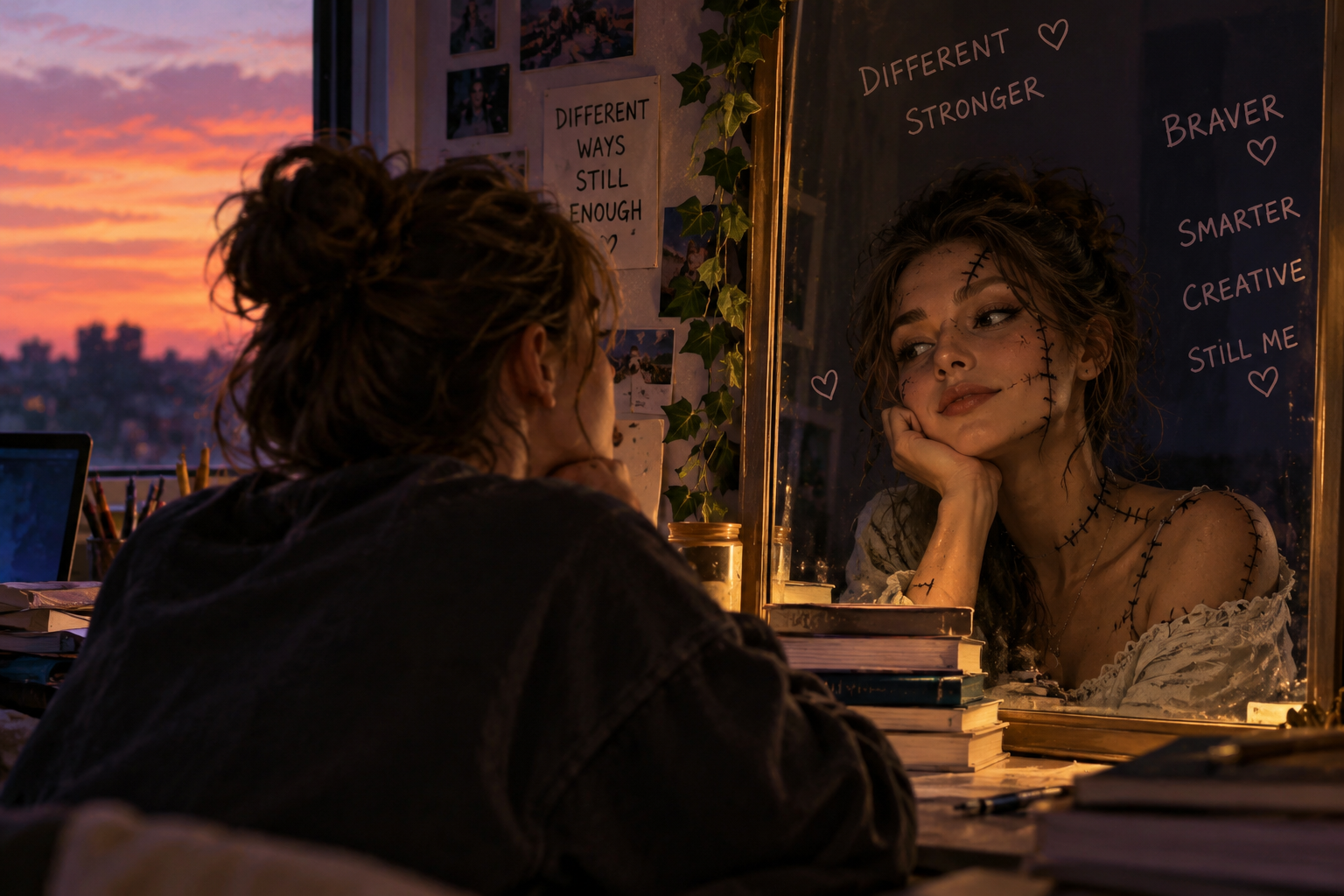
When I first read Susan Stryker’s “My Words to Victor Frankenstein,” I honestly wasn’t really sure what to expect. I thought it was going to be mostly about Frankenstein and being seen as a “monster,” but it ended up being more about how people are treated when they don’t fit into what society sees as normal. I thought it was interesting how Stryker took the idea of being a monster and basically made it into something empowering instead of something negative. That part actually made me think about my own experiences with learning. I have had to find different ways to learn and get things done because of my learning disabilities, and technology has helped me a lot with that. Sometimes I used to feel like needing a different way of doing something meant I wasn’t as capable as other people, but I’ve realized that everyone just learns and does things differently.

Another thing I liked about the reading was how Stryker didn’t seem interested in changing herself just to make other people more comfortable. She took the things that made her different and made them part of who she was. I think that is something a lot of people can relate to, even if their experiences are completely different. In college, I’ve definitely realized that there isn’t really one “right” way to learn, think, or be successful. Everyone has their own stuff going on that you might not see just by looking at them. I didn’t understand every part of the reading right away, but I liked that it made me think about how quickly people judge things they don’t understand. It also made me think that being different doesn’t automatically mean something is wrong with you. Sometimes it just means you have to find your own way of doing things.

Choosing My Many Selves

“Ion know, but they say my attitude change every time I change my weave.” – City Girls.

That’s how I feel every time I look at myself in the mirror and I have my new hair in. I feel like a different version of me.

[Read More]

I have loose curls that make me feel more island and tropical, and I wear that when the weather’s nice, or I have my straight hair that I wear in the winter, and I just comb it with my fingers and you can’t tell me anything. Being East African as well, a lot of people can’t really pinpoint where you’re from, so I get lots of different assumptions as to what my ethnicity can be. It’s a mini version of what happened to Adichie with her roommate. My identity isn’t consistent. Every day when I wake up, I choose which layer of me to identify with most, depending on my mood and how I feel.

In “The Danger of a Single Story,” Adichie talks about how a single story is when people reduce someone to one narrative. Her roommate pitied her, was surprised by her English, and assumed she couldn’t use a stove. She also admits she held a single story herself about Fide’s family, who she only saw as poor, until she saw the basket his brother made. Her identity is multi-layered. I picture her as your African auntie one day, and your award-winning, very educated writer another day. It doesn’t mean she can’t be both.

I found hair to be a perfect example, because as a Black woman, changing your hair gives you a certain confidence, and it softens or toughens up your appearance. You could go for something bold and eye-catching, or something so people just don’t look at you. When you look in the mirror you can decide, “I want to wear this hair with this outfit, and I want to give off this vibe,” or I could do something else. The difference is that I’m choosing my many selves. At moments, Adichie and MJ had one self chosen for them, until they took the narrative back. But I can’t control how other people read me. Whether my hair is curly or straight, people still guess at my ethnicity, and Adichie’s point is that whoever has the power decides which story sticks.

In “Namesake,” MJ’s experience of people judging their identity shows how harmful it can be when others decide how you’re allowed to express yourself. For MJ, it wasn’t about being a tomboy and not being a girl or a guy. They were themselves. That is how they wanted to dress, that is how they wanted to carry themselves. It didn’t have to be about gender until people made it about that. MJ didn’t realize they were an “it” until other people defined them that way. MJ’s partner was the one who was pregnant, and MJ chose the name “baba” for their role. Just because they didn’t conform to gender norms doesn’t mean that they can’t be a parent as well. Is parenthood limited to a woman and a man?

I don’t mean to complicate hair, but I probably overcomplicated it on purpose. You could be whoever you want, as long as you’re the one choosing. Making identity a bigger deal than what it is might stress my hair stylist out, because I like to change my identity every day. So the next time I change my hair, I might be a little ruder. Watch out for that. How do you feel when other people decide who you are instead of you?

Head of The Table

Women in Sports

I’m sure many of you have seen the Sydney Sweeney sports gambling ad. When I saw this ad for the first time, it got me thinking about gender roles in society and a lot of topics discussed in our class.

It’s more marketable to have a topless woman holding footballs saying she knows sports rather than showing a female athlete. The line “You think you know sports? Prove it” felt like a this is how we get men to gamble. This is the only way women in sports could be appealing to men.

Continue reading →

Gender Norms: A Family Heirloom

I was 12 years old when I first experienced aversion to my family’s concept of gender. It was fall 2019, and I was staying with family in New York City for a weekend. I have a clear memory of being in the shower when my older cousin walked into the bathroom to get something. I don’t remember what I said to her, but I must’ve expressed the extreme discomfort I felt at the time, because I remember her responding with something like “we have all the same parts. Why does it matter?” I just wanted to have some privacy during the 10 or so minutes I was in the bathroom, but apparently it was okay for my cousin to come because we were both girls, because “we have the same parts”. I didn’t know it at the time, but this was the start of my years-long critique of my family’s version of womanhood.

Continue reading →

The thoughts that divide us

Anywhere in the U.S., you will find that the underpaid, under-benefited jobs are saturated with people of color. Never mind the reasons behind white people being offered the higher-paying and often less physically strenuous positions; the more controllable concern stems from the places where passersby are falling short. The unreasonable expectations placed on workers, particularly workers of color, by the users of their services make it clear that we engage in the receiving of care by service workers in an entitled manner.

Continue reading →

Fairytale Indoctrination

** For this blog post, I will be focusing on the perspective and experience of girls and/or femme presenting people. However, I also acknowledge, appreciate and hold space for the damage that is done to little boys and masc. presenting people as well. **

Childhood stories and fairytales do a lot more than just entertain us. They quietly build the blueprint and script for how we’re expected to act, look, and feel as we move through the “innocence” of childhood and into the vulgarity of adulthood. Children are depicted as “women” and portrayed in these fantastical stories as helpless, passive, and submissive objects for others, usually men, to enjoy.

Continue reading →