Burping, Modesty, and the War in her Head

The current image has no alternative text. The file name is: download.jpg

Why? Why does she have to sit up, sit right, sit tight and not take up space?  Why just because she has a larger chest does she have to “cover up” because god forbid there be a man around and stare at her.  But also yeah she should sit tight and right because that’s who she is. That’s what she was taught but that’s also what she believes.  Not wanting to fit into that docile body stereotype but also why not.  What if she wants to be that 1960’s nun wife.  What if she wants to cover up her body so that other people don’t have that access to her.  These two conflicting worlds colliding together in her brain not knowing which one to conform with.  Does she say forget societal norms and burp in public because she can or does she hold it all in til she gets behind closed doors.  Does she want to actually go against society though because what’s so wrong with wanting to cover up and be pure and be content with not being so out there.  But why is this such a struggle?  Why is this such a debate? Why can’t she just live her life without having the weight of society and her own beliefs and her own thoughts on her shoulder.  Who cares what the world thinks?!!  Actually she does. But she doesn’t. What if she was raised differently?  Would she still think like this, would she still think that these two ideas of her body still couldn’t become one identity.  What If her thoughts would be different or beliefs would align with the worlds or the stereotypical society. 

Reproductive + Emotional Labor = Wishing I was a Boy

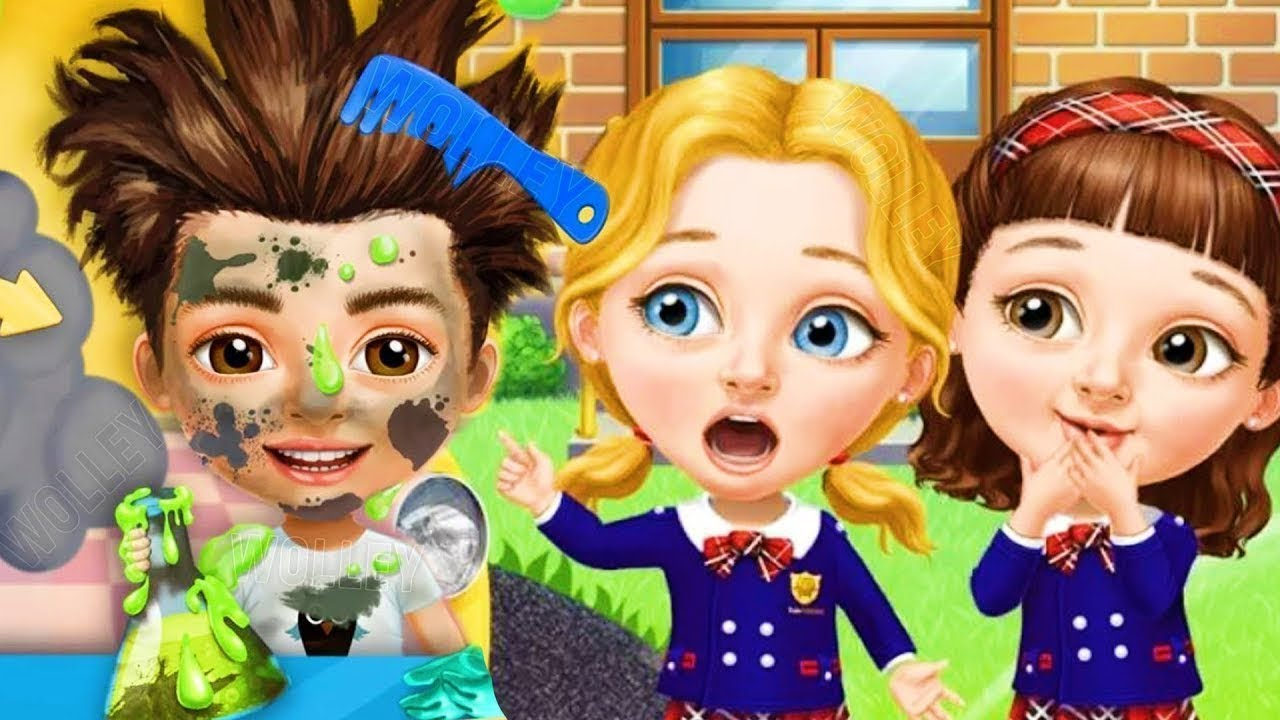
(Image of a boy who looks dirty while doing science while two girls who look clean are surprised and giggle) – Crazy picture by the way

I grew up as a big sister. This role consisted of my unpaid labor, such as housework and childcare. In my house lived my single mom who worked 12+ hours a day and my little sister that is 5 years younger than me. Growing up, my friends never wanted to come over because my mom would ask us to clean the house and I was never in a position to say no. At other friends’ houses, it was always to clean up after ourselves which I especially didn’t mind doing. But one day, I realized that boys my age were rarely given this responsibility.

It feels so dumb to think that I was so upset about cleaning, but the extent of unequal treatment I felt still persists today. I saw my male classmates running around outside while the girls stayed behind and pushed in our chairs, put our stuff away, and followed directions. I saw my friends’ brothers run to play video games right after a meal while my friends and I would scrape our plates and at least put them in the sink. I saw my male cousins never once offer to do dishes, and my aunt always accepted that she would after spending hours cooking a dinner that she didn’t even eat. 

On top of that, my parents have always expected me, as the big sister, to understand why they hate each other. My divorced parents put me in the middle of their ‘friendly communication’ for 15 years. I’ve heard whining from both sides about how awful and unreasonable the other is being, and I am supposed to give advice and agree. When I ignore it, they feel bad but continue a few hours later. It’s a loop I’ve been stuck in that gets better until it doesn’t (and trust me, I’ve tried EVERYTHING).

All the emotional and reproductive labor I have done in my life makes me wish I was born a boy (I’m delighted to think that all of the mental anguish I’ve been through could be resolved if so). Although it’s an unrealistic thought, it lets me imagine what could’ve been, without my life’s pervasive reproductive and emotional labor. I wish I was a boy without a care in the world, who could eat mud pies and play with worms. Instead, I had to be clean and calm which has defined my past.

You Must Be This Tall to Ride

Content Warning: Height dysphoria, transphobia

I recently joined the millions of users on Tinder, a social networking app that allows for mutually interested individuals to communicate if they are within a predetermined distance. Tinder functions simply. Users are presented one-by-one with other profiles—which include up to six photos, age, distance, and a brief text description—and are given two options: swipe left to “dislike” and thereby remove the profile as a potential match, or swipe right to “like.” If both users have mutually swiped right, the application allows for text communication between the two profiles to occur.

While the app can be used to find friends, Tinder is most frequently used as a dating services app. As I have swiped through profiles and read their short descriptions over the past few weeks, I have picked up on certain trends in the information users present to potential romantic and/or sexual partners. One of the most frequent descriptors used is height, revealing what many view as an important physical factor. This mark of importance ranges from implicit, such as simply listing one’s height, to extremely explicit, in which I’ve seen a profile’s description read, “Do not swipe right if you are under 5’10”.”

A recent national study showed that 48.9% of the heterosexual women surveyed wanted to only date men taller than them (Yancey & Emerson 62). Height preference was important to the heterosexual men surveyed as well, but not as important, with 1.3% wanting to only date women taller than them and 13.5% wanting to only date women shorter than them.

Height is clearly an important characteristic when it comes to choosing a partner, yet there has been some debate as to whether this is due to biological tendencies (evolutionary perspective) or social expectations. Ultimately, these gendered-height expectations are rooted in patriarchy. The women surveyed in the study often listed protection and security as reasons to why they prefer taller men (Yancey & Emerson 62). Others stated that a taller man made them feel more “feminine.” The men surveyed in the study who set upper limits for height were “not considering physical or sexual difficulties but societal expectations” (Yancey & Emerson 66). These men did not explicitly speak on traditional gender roles, but they did convey a desire to avoid possible stigma. Men were “reinforcing societal expectations with their higher height limit just as women reinforced those expectations with their lower height limit” (Yancey & Emerson 66).

Like many gender norms, height expectations have the harshest impact on the transgender community. Height dysphoria, an invasive dissatisfaction and discomfort with one’s height, is a frequently seen dilemma among online transgender support forums. Height is very difficult to amend, and because it is wrongfully associated with masculinity and femininity, transgender individuals suffer greatly. Posts in these online forums express a sense of futility. While it can be achievable to possess societally-deemed masculine traits such as hair growth, muscular strength, and body parts, height is nearly impossible to change. Some responders recommend shoes with platforms or boosters. Others simply recommend an attitude adjustment.

This attitude adjustment should not be the responsibility of the trans community, but rather those who have the privilege to actively challenge gender norms free from danger, particularly white, cis, and heterosexual individuals. It is human and understandable to have height expectations, as patriarchy is deeply embedded and can be difficult to unearth, but I ask the reader to truly consider their own expectations and from where they have been created. Just as we work to untangle the mess of patriarchy in our coursework, conversation, and minds, we must also work to distance ourselves from harmful gendered-height expectations.

Works Cited

Yancey, George, and Michael O. Emerson. “Does Height Matter? An Examination Of Height

Preferences In Romantic Coupling.” Journal Of Family Issues 37.1 (2016): 53. Publisher

Provided Full Text Searching File. Web. 29 Sept. 2016.

Women in Public ≠ Public Property *TW assault*

I’ve been thinking a lot lately about the issue of women’s bodies being viewed as public property. From cat calls to groping, it seems that many men have a clear sense of entitlement to women’s bodies in public spaces. This way of thinking and acting is incredibly prevalent in our society, and the cultural encouragement of this behavior is especially disturbing. I recently watched several videos by Stuart Edge and Andrew Hales that completely condone this type of behavior by harassing women and then playing it off as a fun joke.

Continue reading