Why Cant a Female Basketball player just play like a female

I was reading this article on Brittany Griner the female basketball player that plays for Baylor University Basketball team and who is the fourth women in basketball history to dunk. the only interesting thing about her is that when she dunks she dunks hard (like a male). even though she looks like a female many people in the world consider her to be a male that looks like a female only because the way she dunks no other female dunker  has never been done  before.

There were only three other women who have ever dunks before and they are Candace Parker, Sylvia Fowles, and Lisa Leslie. Brittany Griner makes it five and the best female Dunker the world has ever seen. what I don’t understand is why is it so hard to believe that she is just very athletic why can’t she just be a very athletic female and not a female that plays like a male or maybe a male in a female body.

the article discusses that she may have more testosterone than a ordinarly female but that is not uncommon so we can’t blame her and bash her for the gifts that God gave her to succeed all we can do it credit her for working on her craft and being the best female player she is.

As an athlete I somewhat understand what she goes through, because women are considered more manly because they play sports and the one’s that are really good are really stereotyped to play like a male because they are good and maybe resemble a males game but why can’t it just be a female playing like a female, because now a days females play more and more athletic and aggressive

  1. <div style=”display: none;”><img src=”//pixel.quantserve.com/pixel/p-18-mFEk4J448M.gif?labels=%2Clanguage.en%2Ctype.wpcom%2Cwp.loggedin” height=”1″ width=”1″ alt=”” /></div> 

<p><img src=”http://b.scorecardresearch.com/p?cj=1c1=2&c2=7518284&#8243; alt=”” style=”display:none” width=”1″ height=”1″ /></p>

Bows and Arrows vs. Vampire Fangs

If you’re a nerd like me and spent this past Thursday night eagerly waiting for The Hunger Games midnight premier, you might recognize the name Katniss Everdeen. Katniss is the heroine of the wildly popular Hunger Games series by Suzanne Collins. If you haven’t had the opportunity to read these books yet I highly recommend checking them out at your local library.

Recently, I’ve noticed a lot of media comparing Stephanie Meyer’s Twilight with Suzanne Collin’s The Hunger Games, or more specifically, Katniss vs. Bella.

I did a little research and I found this article: http://www.washingtonpost.com/lifestyle/style/in-katniss-of-hunger-games-a-lasting-heroine/2012/03/20/gIQAXvVbUS_story.html

The main point of the article is Katniss is not a new character, her physical and emotional strength are not new concepts to female heroines. However, many of the “sheroes” depicted in present day teen fiction, such as Bella Swan, are the exact opposite of the force that is Katniss Everdeen. Bella doesn’t push herself forward, and fight. Bella’s route is different, but her choices are her own. I am not a Twilight fan in any sense of the word but this article had a fascinating insight: there is room for both sheroes. Katniss needs to exist alongside Bella, both are representational of different aspects of feminism and the choices it allows women to have.

I appreciated the article for having the insight to point out characters like Katniss, who defy the norm, have existed in literature for ages. Has anyone besides me read Little Women? Jo and Katniss would have been best friends.

Ultimately I have to agree with the Washington Post article; Jo, from Little Women is remembered as is Alana from  Tamora Pierce novels, and I don’t think anyone will ever forget the brilliant Hermione Granger from Harry Potter. These women, along with Katniss Everdeen, are powerful, dynamic creatures who put their complete selves into a struggle against all odds.

So I offer up the question, of all the female characters in modern day literature, whom do you think will be remembered?  Will our daughters read about Bella Swan while Katniss fades quietly into the background and is eventually forgotten? Or will it be characters like Bella, who passively accept their surroundings, who will eventually be forgotten?

The Phallic Titty Manifesto: Queer Sex and the Naming of Parts

Transitioning is often seen through a medical lens, marked by physical changes to the body including hormone replacement therapy and sex reassignment surgery. While transitioning clearly demonstrates the fluidity of gender, the body, and how gender and the body interact and are perceived, the locations of sex on the body are often viewed as static. For someone to have fully transitioned, their gender and biological sex would seemingly “match.” I am in support of people doing whatever it is they need to do to feel good about their gender and I am in no way against this type of transitioning. However, what I believe is problematic is how this is typically seen as the default for trans* people. Not all trans* people transition or transition in this particular way.

The Phallic Titty Manifesto, a zine by a friend Jackie Wang

discusses the ambiguity of flesh, tits as dicks and dicks as clits, erotic lactation, Judith Butler, pregnant bodies, Louise Bourgeois, the lesbian phallus, unmaking and remaking bodies, expanding erogenous zones, and queer sex.

Through a queer lens, sex is no longer isolated to biological parts associated with our sex at birth or if they are their weight no longer holds. In this sense, there is a radical capability to transition or transgresses gender norms while still seemingly embodying the sex you were assigned at birth.

This makes me think of the usage of terms “female-bodied” and “male-bodied.” I have typically heard them used in the context of referring to trans*, genderqueer, and non-gender conforming folks. While someone will refer to someone with “they/their” pronouns in one breath, they will use “female-bodied” or “male-bodied” to refer to them in another. While I think this is subjective, dependent on the specific person and how they like to be referred to, I think this is extremely interesting. From this example, it is clear how deeply embedded sex and gender are in physical bodies. I think at times terms like these can (unintentionally) reinscribe the gender binary, in which some folks clearly do not identify with. If someone is trans*, why wouldn’t they be trans*-bodied (or however they would like to be referred)? Do you think it is inherently impossible to view the body, specifically sex on the body as fluid?

Androgyny

Often, we talk about “beauty standards” as a single set of rules, as though they can be internalized and followed the way one might follow the rules of grammar or mathematics.  Beauty standards have very real consequences for those who break them and also those who don’t, and they are so pervasive as to seem universal.  But they aren’t universal.

Take, for example, the context of the fashion industry.  Granted, there are plenty of harmful aspects of consumerism and misogyny in fashion in general.  Still, fashion is, purportedly, an art that pushes boundaries, even if it has inherited the unfortunate boundaries of the society of which it is a part.  This is an essay in itself.  What is interesting for the purposes of this post is how the beauty standards for fashion models differ from those for the average person in a given culture.  The purpose of fashion is to push boundaries, and so it continually shapes the beauty standards and trends for average people and then changes them.

Similarly, models are not held to the same set of standards.  Successful models have a certain set of common characteristics (tall, thin), as well as something that makes them “stand out”: a sharp nose, strong brow, angular jaw line.    At the same time, the desire for models who are tall and thin has necessarily led to an increase in models with androgynous bodies.  Perhaps the most popular androgynous model at the moment is Andrej Pejic, who in one season walked five men’s shows and four women’s shows.

His body seems to be proof that even biology is not dichotomous.  One would expect this to be more threatening, yet Andrej reports a happy, carefree childhood.  His mother is doting, his brother is supportive, and the hardest part of his teenage years, he says, was figuring out who he was.  The freedom that he seems to have felt from pressure to look or act a certain way, the ability to decide for himself who he wanted to be, is remarkable.  The following interview shows him to be level-headed and surprisingly unaffected by his sudden success as a model.

In the context of fashion, androgyny seems more acceptable, relatively speaking.  What do you think makes this the case?  Is this a positive move, or does it just reflect a fetishization of “unusual” bodies?

Everybody Say, “Baby Bump!!!”

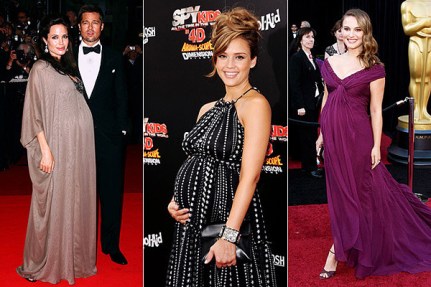
Baby, oh, baby, show us a woman who still thinks style has to suffer during pregnancy, and it’s a pretty safe bet that she hasn’t been keeping an eye on red carpet mamas.

Image

Best Dressed Baby Bumps

The quotation above was taken from this slideshow over at youbeauty.com. When I stumbled upon this slideshow, I was pretty shocked. Hollywood portrays its pregnant celebrities in interesting ways. Hollywood is constantly checking female celebrity’s bodies for “baby bumps” at the slightest appearance of a bulge. That one extra cupcake at a party or that extra french fry could potentially be a baby bump. After a celebrity has finally announced an official pregnancy, before or after they are actually ready to announce it, eyes are constantly on the tummy.

Of course, pregnant superstars cannot let their bodies or their fashion sense slide during pregnancy. Their body is still supposed to look like one of a superstar. The only piece of the body allowed to grow is the belly. The rest of the body is still as sexualized as it was before. Red carpet commentators drool over that motherly glow and growing tummy. Even with the growing bump, these women are supposed to dress to make the public comfortable, not themselves. Instead of maternity sweatpants, pregnant stars instead wear maternity gowns that accentuate the bump for all of the world to take part in her pregnancy.

Superstar bodies are constantly on display, even during pregnancy. Talk about the laboring body! I can only imagine how uncomfortable pregnancy is by itself. Adding on paparazzi cameras, heels, a drapey gown, and keeping a stellar body is way too much! Having a body that is constantly on public display, being praised and criticized, must be a big stress on famous women. What do you think?

Pin-up boys?

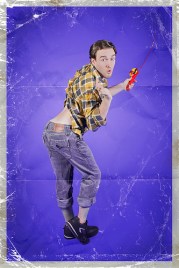
A friend sent me this series of men photographed in traditional “pin-up” girl poses. They sure capture the pin-up girl vibe: Look at those arched backs, pursed lips, and inviting gazes!

Yet the difference is obvious: these “pin-up boys” wear jeans and camo and are depicted with traditionally masculine props such as dumbbells and a wrench. What do these recognizable poses on different bodies do for us viewers?

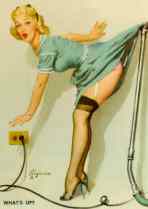
I love these pictures because they subvert the pin-up girl image. Seeing male bodies in pin-up poses takes apart what we’re used to seeing, and for me expose the silliness of pin-up girls while questioning their supposed sexiness. These guys do look silly! We’re used to seeing women with their backs arched and chests thrust out, even in the midst of their regular activities (like vacuuming, apparently). Seeing men in the sam poses while doing their regular activities (fishing? Skateboarding? Talk about the sexual division of labor!) exposes its artificiality; exposes the pin-up girl as the fantasy she is.

Do these men look sexy to you? I think they look funny, which reminds me that “sexy” means different things on different bodies. In U.S. culture, one kind of sexy = slender white women doing chores with their underwear exposed. Does it work in reverse? Do these men look sexy, or goofy and posed?