The Micropenis

I know that as a class we are a pretty open group of people, but because this is a public blog (and because I am unsure how people will feel about me posting pictures) I am going to refrain from doing so for this particular post, however, if you are interested in finding pictures they are very easy to come across online. I will also warn you that the sites I have posted do contain graphic pictures, so don’t visit them if you don’t want to see the pictures.

Interestingly enough, I stumbled upon this topic after our class discussion of a utopian society in which all babies were born with the possibility of all inheriting any genetic traits from the entire population. A conflict arose when two groups of people argued whether or not they should “exclude the negative traits” without ever specifying what those negative traits are or might be. Well, I figure this is easily something that could be seen as a “negative trait”- the microphallus or micropenis.

According to http://www.micropenis.biz/p/micropenis-information.html  and Wikipedia, a micropenis can be defined as “an erect penis that is 2.5 standard deviations less than the average human penis size”. However, the two sites differ on what the average erect human penis size is. The first site defines a micropenis as being 9 centimeters or 3.5 inches or less, while the second site defines it as 7 centimeters or 2.5 inches or less. According to the websites, 0.5-0.6% of the male population has this condition. But does having a condition mean that you suffer from it?

It is possible. Even the author of micropenis.biz says that he “suffers” from the condition. Some people think they no longer suffer if the condition goes away with some form of treatment.

In the 1960s and 70s sex reassignment surgery was recommended for the micropenis condition, and if the parents consented, the testes would be removed, an artificial vagina would be constructed, and the boy would be raised as a girl. Even at our very own Johns Hopkins Hospital they performed 12 of these surgeries. However, these surgeries were based on three assumptions that are now in question:

  1. gender identity and sex differences were solely a matter of social learning rather than biology.
  2. a male with a penis too small to put into a vagina could not find a satisfactory social and sexual place in society.
  3. a functionally acceptable vagina could be constructed surgically

Because intersex individuals and some of these patients believe that children’s sex organs, sexual identity, and gender identity shouldn’t be decided for them, or regretted the surgeries that have been performed on them, many of these surgeries have stopped and parents are waiting until their children are old enough to make the decisions for themselves.

Stress Kills, or “I don’t have time for a body”

At some point this semester I began screaming at my boyfriend, “I don’t have time for a body!” I was having a pulsating migraine, my skin was breaking out, I had had no sex drive for weeks, and had an endocrinologist appointment and blood test the next morning prior to three classes that day. I was having an anxiety attack at 1a.m.

Everyone says college is stressful. I have found that no longer having the body of a twenty year old makes it exhausting. Running around a hilly campus, trying to get to class on time, parking about a mile from any buildings. All of this physical activity is also time consuming, adding stress to days packed with classes, work, homework, making dinner, buying cat food, paying bills, keeping in touch with friends and family, attempting to relax, and trying even harder to sleep. I often find my inner dialogue about stress going something like: “It’s because I’m a woman” or “It’s because I’m not upper middle class.” I have many found my stress triggers to generally be gender or class oriented.

I found the following documentary on stress very interesting. The director, John Heminway posits stress as not only as detrimental to mental health, but as someting that can kill the body over time  through exposure to dangerous levels of stress hormones. It also argues that stress levels are relational to class structure, with lower rung workers experiencing higher, and more deadly, levels of stress hormones. The documentary follows Stanford University Neurobiologist Robert Supalski in his studies of stress hormone levels of baboons in Kenya. He measured both adrenaline and glucocorticoids in these baboons and found differing levels according to the gender and social class of the baboons. The non-alpha males have higher stress hormones than the alpha males. When most of the alpha males died off due to tuberculosis infection, the stress levels of all the other baboons in the group went down. This documentary is very much worth watching, I believe all parts of it are on youtube and hope you can check it out.

Viola Davis: Oscar Loss, Natural Hair Win

Viola Davis, an award winning black actress, recently starred in the movie The Help. At the 2012 Oscars, Viola appeared on the Red Carpet glowing and debuting her natural hair. The media, of course, made this a into a huge story. When asked what made her decide to wear her natural hair to the Oscars, she stated that h

er husband encouraged her to do so.

I believe that Viola Davis was radiant and confident that night. She was absolutely beautiful. Many black women and young girls appreciated seeing natural hair on the red carpet. Wendy Williams, radio talk show host turned television host, did not feel the same way. On her self titled talk show, Wendy Williams insinuated that the Davis’ TWA (teeny weeny afro) made her look mannish, like the history teacher in the 70’s sitcom “Room 222”. At another time, Williams stated that Davis’ hair was just not professional. Many black women were appalled at her statements. They felt that Williams was attacking black women. As you can see in the picture on the left, Davis display of natural beauty was inspirational to black women and girls; and, Williams blatantly shot it down on national television to an audience who probably does not understand natural black hair to begin with.

Black hair has so much politics attached to it. In the past, black women have felt restricted by white beauty standards of straight or wavy hair that is often unnatural to them. I, like many others, am appalled that a black woman would scorn another black woman for displaying her natural beauty. “Natural” hair is our hair. Kinky, curly, wavy, coarse, whatever, it is our hair. I am encouraged by the fact that so many black women have decided to transgress white beauty standards and free themselves from chemical relaxers, letting their own unique beauty shine. Viola Davis certainly took a stand at the Oscars and became even more of an inspiration to black women.

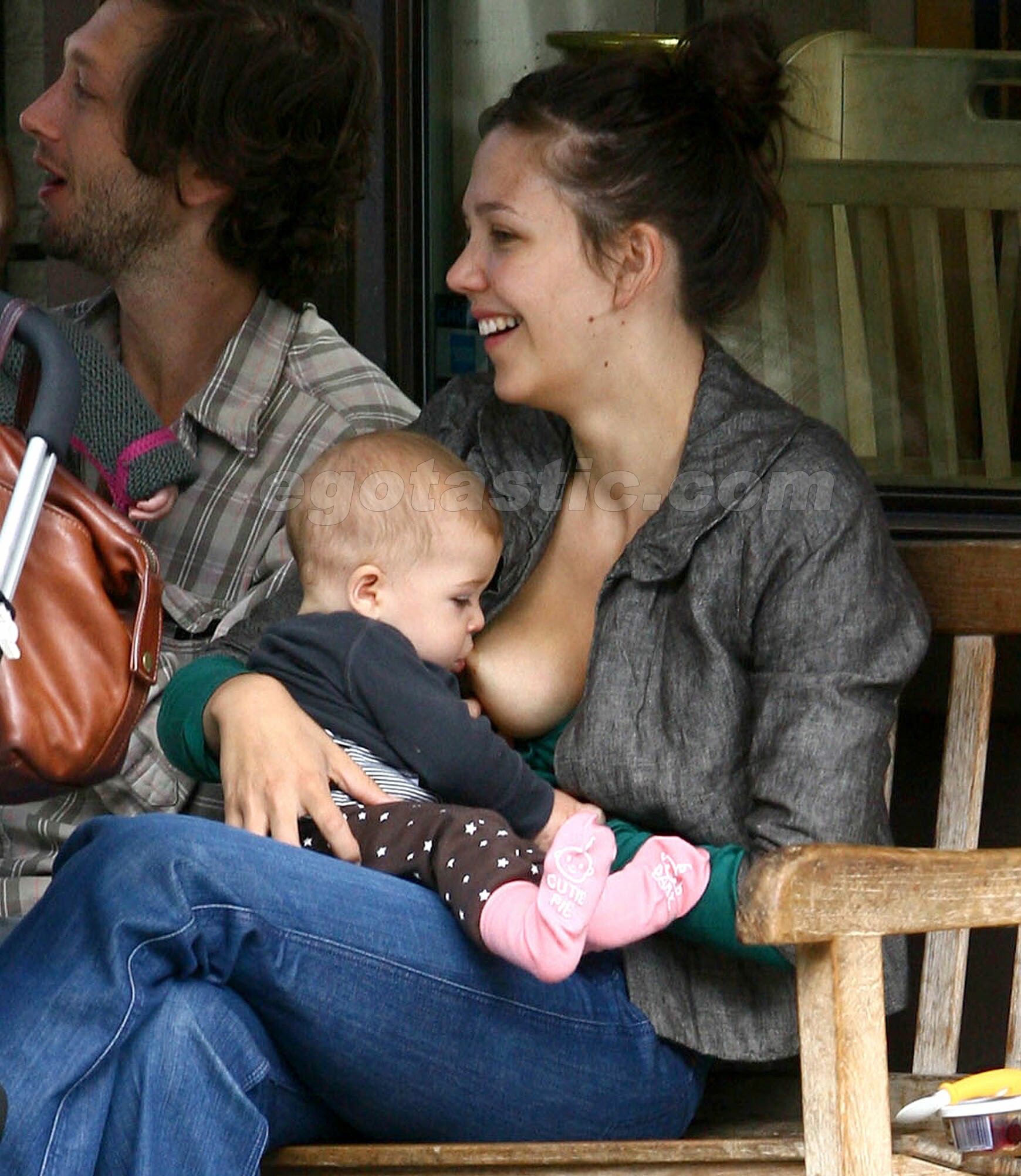
What is up with all the breastfeeding hate lately?

Facebook is deleting personal pictures of Mom’s breastfeeding and calling them obscene.

Moms are being ordered to cover up in malls and Target if they are breastfeeding.

Isn’t breastfeeding what women are encouraged to do?  Hasn’t the healthy party line been to breastfeed for at least the first few months to build immunity in babies?  Some communities are encouraging women to breastfeed to help curb childhood obesity.  There are proven health benefits for both the child and mother.  So, women are being told to breastfeed on the one hand and then told they can’t do it anywhere but in their homes on the other.  If they want to breastfeed in public, they must hide themselves away in a bathroom.  How dare they offend anyone with the view of their children breastfeeding!

Maggie Gyllenhaal breastfeeding

Women spend their entire lives held up as sexual beings, as objects.  But where does that end when a woman becomes a mother and wants to breastfeed her child?  Hasn’t the image of “the mother” become one that is without sexuality?  Maybe breastfeeding blurs that line for some.  We see this attitude in breast cancer awareness campaigns crying to “Save the boobies!” as well.  Women’s worth is in their sexuality and if they use their breasts to feed their children (some might say the breasts most primal and “natural” purpose) they are being viewed under that same sexual gaze.  Is our society so sexually repressed (and obsessed) that we can’t separate breasts from being sexual objects?

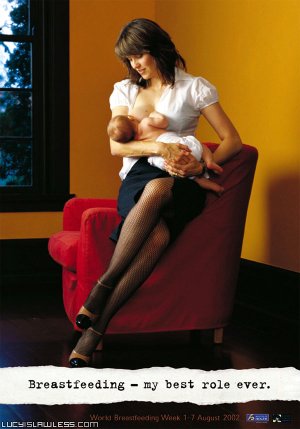
Part of the British campaign to encourage breastfeeding

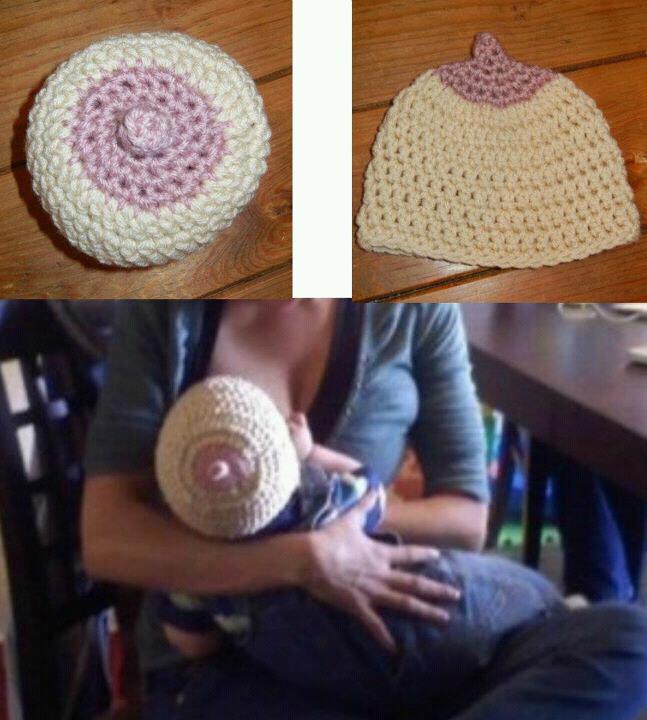
Many breastfeeding moms are taking to activism to try and bring awareness to the issue.  Recently on etsy, an innovative breastfeeding mom created a crocheted “boobie beanie.”  They can be made in any skin tone and nipple shade, to match your own.

The Boobie Beanie!

Other mom’s are holding “breastfeed-in’s,” at facebook’s corporate headquarters or at local malls.  Celebrities have also taken to the cause, breastfeeding in public and allowing the paparazzi to take pictures of them with their children.  In Britain, they even had a celebrity campaign to encourage breastfeeding.  Unfortunately, until we as a society can move past this constant sexualization of breasts, I fear things will still be difficult for breastfeeding mommies.

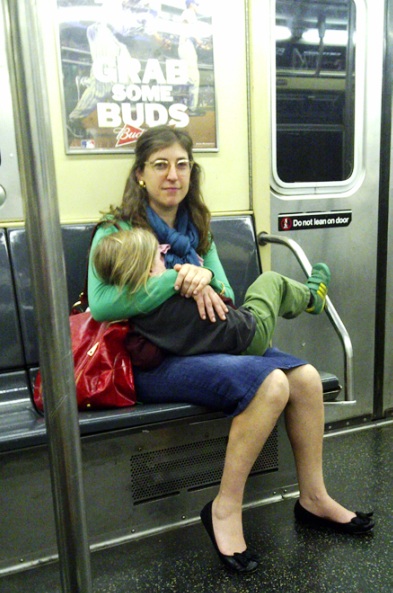
Mayim Bailik breastfeeding on the subway in NYC.


Making “Private Parts” Public

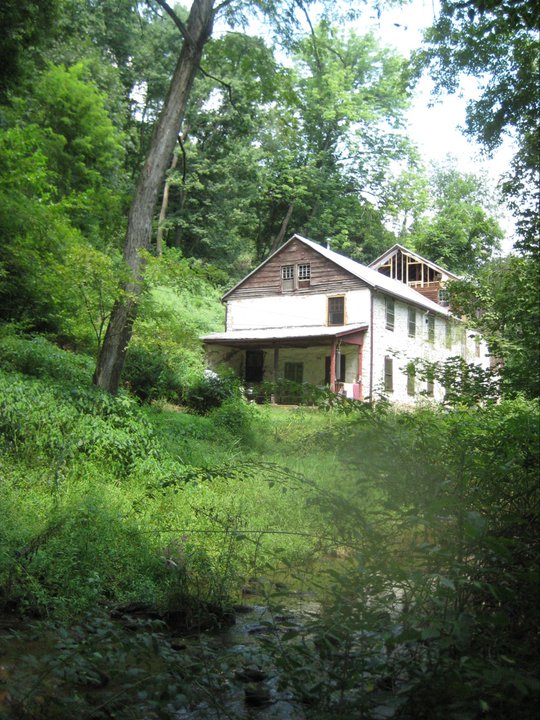
Over the summer I was an intern in the gardens at an intentional community called Heathcote. Intentional communities are essentially communes but the members do not have a shared income or business, so the members have outside jobs.  I instantly felt at home with the members, a group of older radicals and hairy second-wave feminists. One Saturday evening  the community was hosting a hot tub party in their handmade cob hot tub that sits over a fire. Although I was not interested in getting in, considering it was the middle of the summer and extremely hot, I was interested in attending the party to enjoy some conversation and vegan marshmallows. The party was taking place about a 10 minute walk through the woods from where my room was. As I approached I started to notice something was odd, everyone in the hot tub was naked.         I was stunned. These people I had gotten to know so well through everyday interactions were now baring it all in front of me. Going into this internship I was not expecting to see my boss, the intern coordinator, naked. My own reaction to the nudity of the community members was surprising to me. I needed to analyze why I felt so uncomfortable about this.
My first thought was that I felt uncomfortable because no one has warned me in advance that clothing was optional, and perhaps they should have. But, what was the real reason for my discomfort? The human body itself is simply raw material, however it is also packed with meaning given by society. The body is sexualized; society has created a framework in which certain body parts are not to be shown to the public. Even in more enclosed and safe environments, like the one I was in, to many is thought to be eccentric. Sexualized body parts are labeled with words like “private” and are expected to stay that way unless that are being used for arousal.
Something many young people rarely see is a naked average-sized body, imperfections, cellulite, and all. When “plus-sized” women are shown in the media, like in the Dove Campaign for Real Beauty,  the images of the body are distorted with airbrushing, thus creating a false idea of what a “real” body looks like. Because of my instilled sexualized associations and my lack of experience in seeing what real naked bodies look like, my experience at the hot tub party was an awkward one.

Dove Real Women Beauty Commercial

Someone sent me this video on an interesting transformation between the way someone really looks and how they turn a “regular person” into a model. It shows a woman sitting in a chair and you see her go from an average person to them doing her hair and make-up, and finally taking a picture, photoshopping it, and putting it on a billboard. These are the images that we show to our society, yet nobody sees a problem with it.

Have no fear though, Dove is out to set the record straight. They want you to know that Dove is there for you, for real women! They want you to trust them to show real images of real women and make you feel better about yourself. No matter what the media shows, Dove is there for you and they believe in the beauty of every woman.

One thing that’s interesting to me though is that it’s a Dove commercial about promoting real women and real beauty, yet when you watch their other commercials, their models are thin and beautiful and promote the stereotypes of beauty that our society has put before us. I have an issue with the company pretending that they care about “real people” and “real beauty” when the way they act defies that. This makes me think that Dove is simply using a tactic to try and prove a point, or to get people who don’t like commercials or the media to start turning to them for an “unbiased” or “unconventional” model of what beauty is.

I think they are playing our society and using unconventional forms of beauty to attract new customers and promote their products. Now, instead of using conventional beauty to attract women by saying “if you use our products you will be this beautiful,” they are using the scheme “if you’re a real woman, you’re beautiful the way you are, and we support women being beautiful just like you, so knowing that we support REAL BEAUTY, you should buy and use our products.”

I think this is a real problem that needs to be addressed by society, but I don’t think doing it to promote your product is a fair way of doing that. Our concept of beauty clearly needs to change, but this is not the way to do it. Someone with nothing to gain has to put out a video or a commercial like this.