The Adipositivity Project

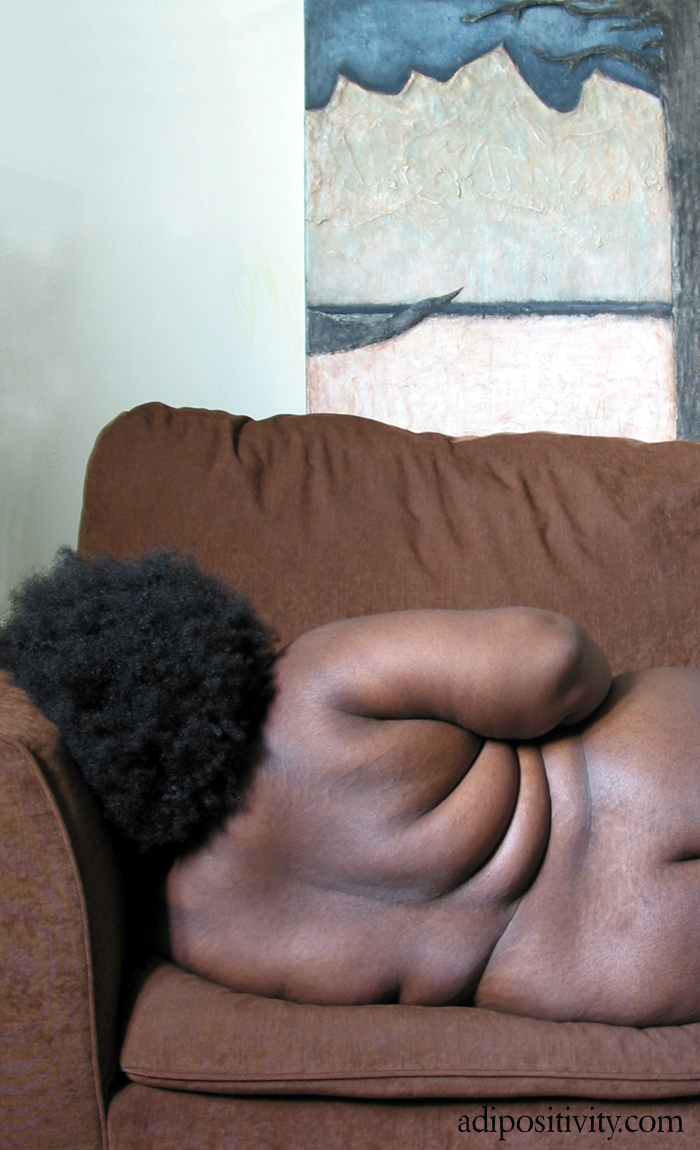
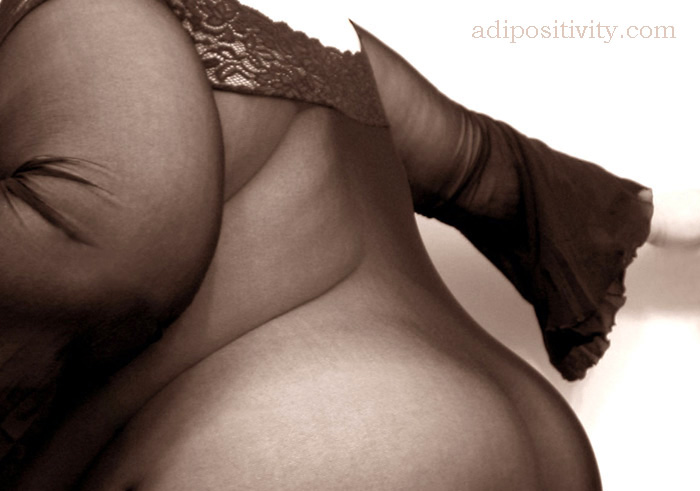
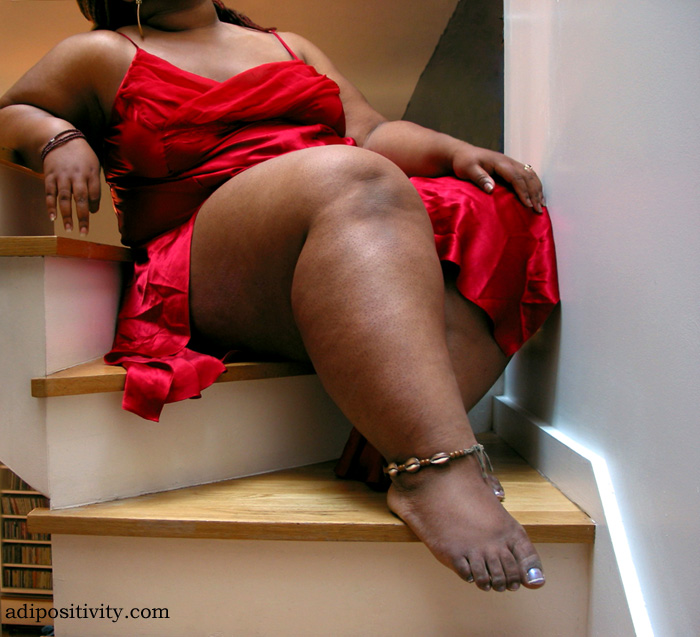
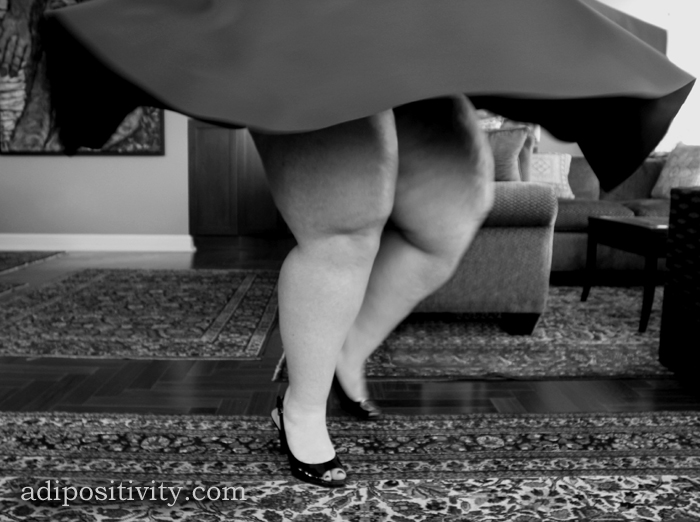
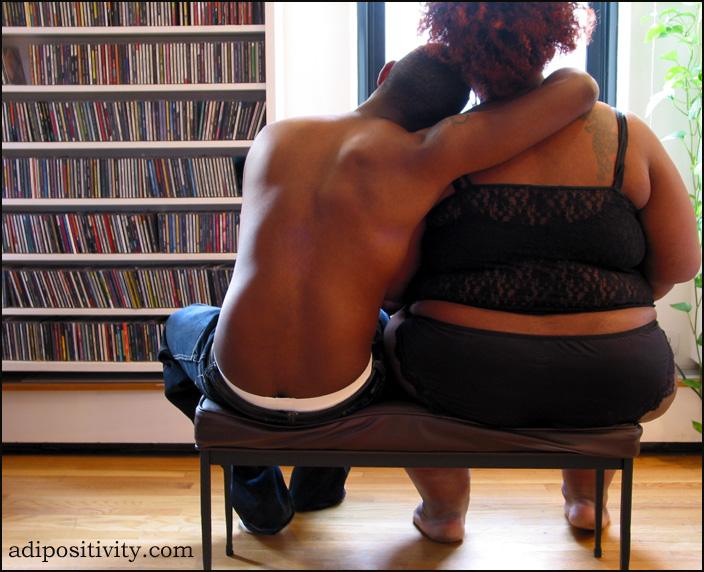
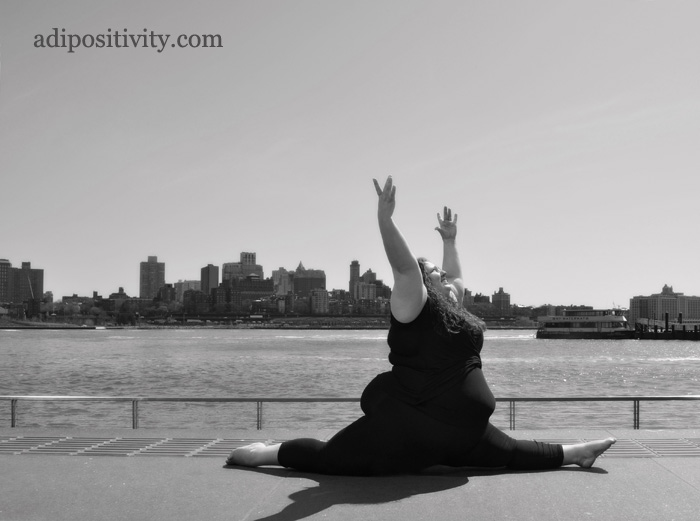
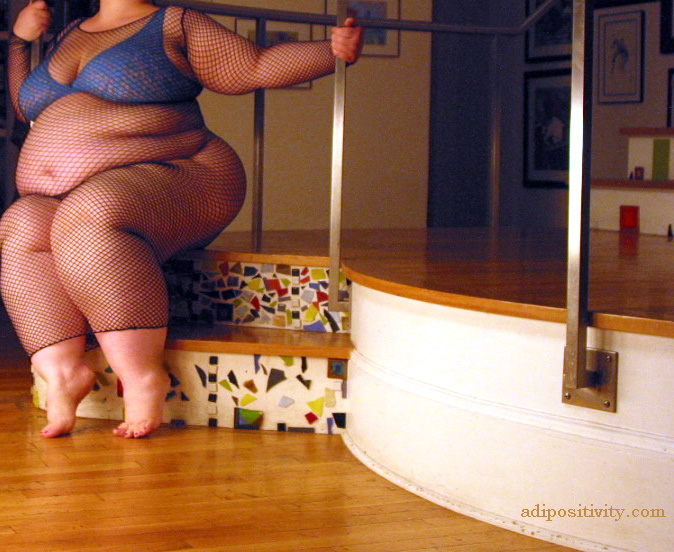
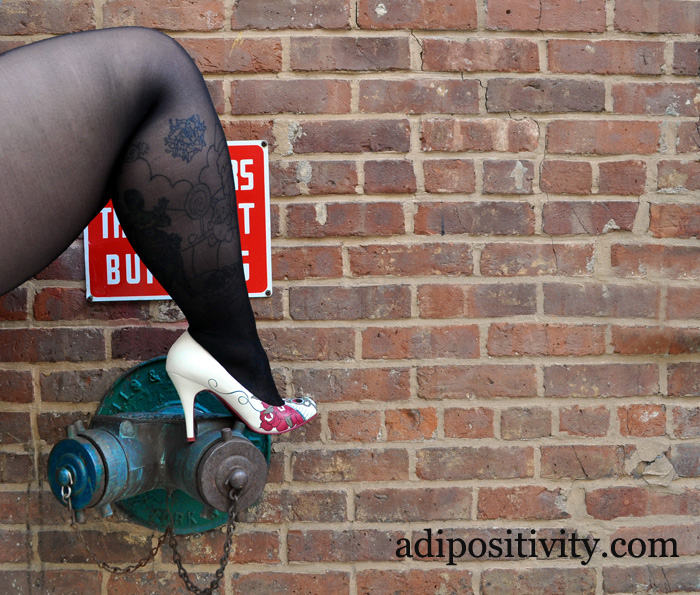
I’ve been aware of The Adipositivity Project for a number of years.  Most people who float around Fat Acceptance circles online are aware of it, but when I’ve shown it to friends who aren’t aware of FA, it’s always surprised them.  I thought, given the reading for our next class, this was at least visually on topic.  I’m also always a fan of activism through art and you can’t say Substantia Jones’ photographs aren’t beautiful or radical.   Many of the photographs are nudes, so beware if you decide to click through.  I’ve pulled some of the more modest ones to show the intent of the images.

Adipose: Of or relating to fat.

Positivity: Characterized by or displaying acceptance or affirmation.

MISSION:
 The Adipositivity Project aims to promote size acceptance, not by listing the merits of big people, or detailing examples of excellence (these things are easily seen all around us), but rather, through a visual display of fat physicality. The sort that’s normally unseen.

The hope is to widen definitions of physical beauty. Literally.

The photographs here are close details of the fat female form, without the inclusion of faces. One reason for this is to coax observers into imagining they’re looking at the fat women in their own lives, ideally then accepting them as having aesthetic appeal which, for better or worse, often translates into more complete forms of acceptance.

The women you see in these images are educators, executives, mothers, musicians, professionals, performers, artists, activists, clerks, and writers. They are perhaps even the women you’ve clucked at on the subway, rolled your eyes at in the market, or joked about with your friends.

This is what they look like with their clothes off.

Some are showing you their bodies proudly. Others timidly. And some quite reluctantly. But they all share a determination in altering commonly accepted notions of a narrow and specific beauty ideal.
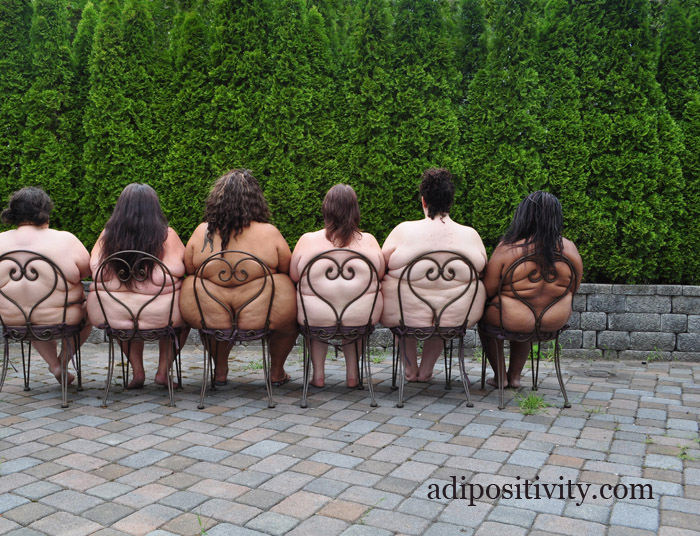
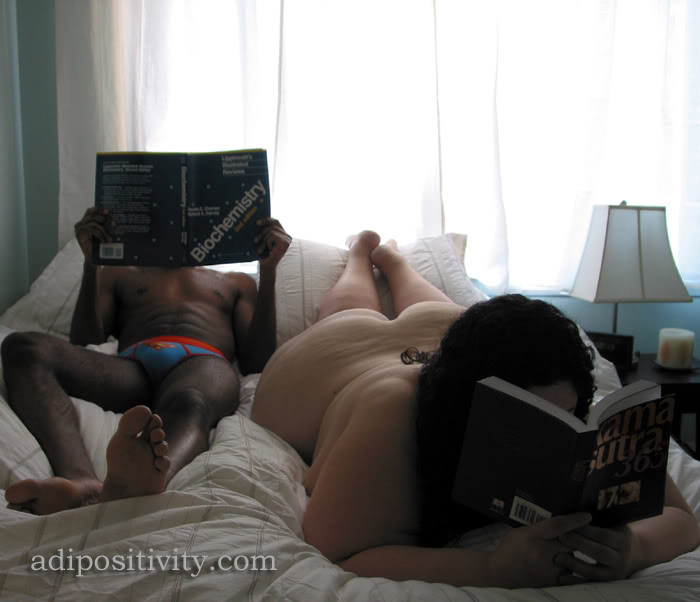
I love this project, especially considering the attempts by the media to include “real” bodies through the use of marketing like the Dove Campaign for Real Beauty and “plus size” (really a size 6-12) models, and how different these fat people look from those culturally approved fat bodies.  These aren’t the media portrayed idea of what is “real” (and how problematic is that word in regards to any person?).  These (mostly) women, according to the BMI (another problematic method of judgment!), are obese, or more likely morbidly obese (sometimes called Death Fat in the FA community).  Most of them probably weigh somewhere in the neighborhood of 200 or 300 or even 400 pounds – yet I don’t think they look like the stereotypical bed-ridden mordibly obese person most non-fats think of when they hear those numbers. Or maybe they do look like those ZOMG FAT people to you.
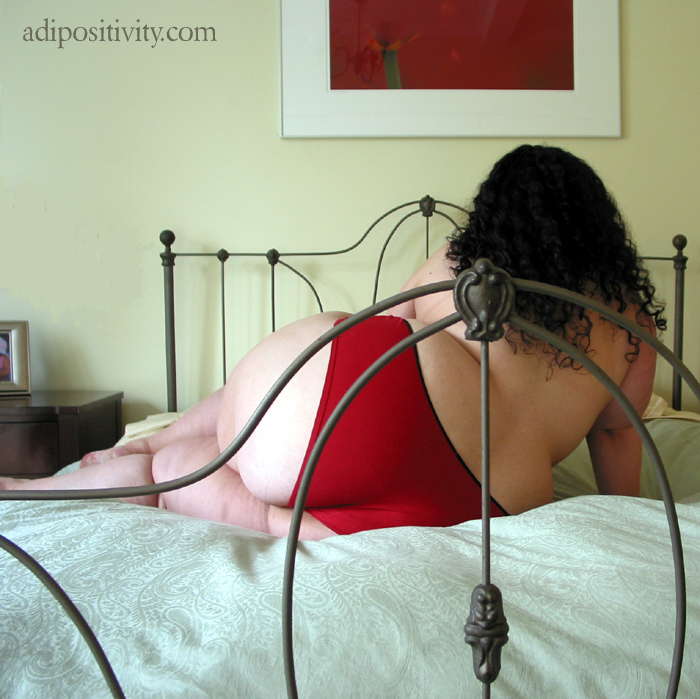
However you see them, these people are fat, but they have accepted the bodies they have and are living their lives in them.
The Micropenis

I know that as a class we are a pretty open group of people, but because this is a public blog (and because I am unsure how people will feel about me posting pictures) I am going to refrain from doing so for this particular post, however, if you are interested in finding pictures they are very easy to come across online. I will also warn you that the sites I have posted do contain graphic pictures, so don’t visit them if you don’t want to see the pictures.

Interestingly enough, I stumbled upon this topic after our class discussion of a utopian society in which all babies were born with the possibility of all inheriting any genetic traits from the entire population. A conflict arose when two groups of people argued whether or not they should “exclude the negative traits” without ever specifying what those negative traits are or might be. Well, I figure this is easily something that could be seen as a “negative trait”- the microphallus or micropenis.

According to http://www.micropenis.biz/p/micropenis-information.html  and Wikipedia, a micropenis can be defined as “an erect penis that is 2.5 standard deviations less than the average human penis size”. However, the two sites differ on what the average erect human penis size is. The first site defines a micropenis as being 9 centimeters or 3.5 inches or less, while the second site defines it as 7 centimeters or 2.5 inches or less. According to the websites, 0.5-0.6% of the male population has this condition. But does having a condition mean that you suffer from it?

It is possible. Even the author of micropenis.biz says that he “suffers” from the condition. Some people think they no longer suffer if the condition goes away with some form of treatment.

In the 1960s and 70s sex reassignment surgery was recommended for the micropenis condition, and if the parents consented, the testes would be removed, an artificial vagina would be constructed, and the boy would be raised as a girl. Even at our very own Johns Hopkins Hospital they performed 12 of these surgeries. However, these surgeries were based on three assumptions that are now in question:

  1. gender identity and sex differences were solely a matter of social learning rather than biology.
  2. a male with a penis too small to put into a vagina could not find a satisfactory social and sexual place in society.
  3. a functionally acceptable vagina could be constructed surgically

Because intersex individuals and some of these patients believe that children’s sex organs, sexual identity, and gender identity shouldn’t be decided for them, or regretted the surgeries that have been performed on them, many of these surgeries have stopped and parents are waiting until their children are old enough to make the decisions for themselves.

Obesity in our current generation

Obesity is prevalent in our current generation especially among women due to a variety of factors. Ironically, the price of eating out is cheaper than cooking food in your own kitchen. For example, the price of a cheeseburger is cheaper than a salad. Trying to buy organic food which is considered more healthy for our bodies is more expensive than fast food that is easily accessible. If we go to McDonald’s we can get a cheeseburger from the dollar menu but if we walk into Whole Foods market, a salad can range from $5 to $10. Ironically, employees at Whole Foods who weigh less are given a greater discount than their fellow employees whose BMI are above a certain range. Although this is supposed to be seen as motivation and an incentive for their workers to become more “healthy” it seems discriminatory. Their thinner workers receive an additional 10% off their discount for having a lower body mass. Therefore, if your BMI is above 30, you get to keep your original 20% employee discount, but “thinner” co-workers get as much as a 30% discount.

For some people it is harder to lose weight due to restrictions from their body or even genetic disorders. Also, looking at our society in the United States our portions for food are larger than countries everywhere else. Everyone’s lifestyles are different and so the convenience of getting cheaper and fast food is easier than attempting to cook a healthier meal that is more costly. When I went to Korea, their McDonald’s big mac was half the size of our big mac in the states and they didn’t even have the option to get larger sized fries. Only in the United States do we have the option to “super size” and it seems that our lifestyles provoke this problem of obesity.

A Strange Kind of Mirror

This post could be triggering for people who struggle with body image.

Or maybe not.  That’s the question.

My Body Gallery first appeared on the internet sometime around August 2011, judging by the number of posts written about it on other websites during that time (see: Jezebel, The Hairpin, NY Daily News, Yahoo, and more).  The basic idea is that women upload pictures of themselves and then categorize them based on their height, weight, pant size, shirt size, and perceived body type.  Other women can then search the site by their height and weight, and to see what that looks like on other women.  According to the website, the point is to allow “other women to see that the world is not a place of cookie cutters,” because women “are all different in our body shape and size as well as our place in our journey to loving our bodies exactly as they are, not as we (or others) think they should be.”

Initially, though I recognized that the site obviously had its problems, and that it could be difficult and triggering for people who already had a history of or an inclination to compare themselves to others, I found the site interesting.  It could be helpful for people who have an “ideal” weight to see that their ideal might be different in reality.  There are not a lot of people of my height and weight, on this website or otherwise, especially considering the number of people that uploaded pictures for, say, 5’5″ and 120 pounds.   I like knowing that there are other people who look like me (and, notably, all of the people in that category appear to be white).  If sleeves are never long enough and pants are rarely made in your size (and, when they are, they’re never labeled “regular”), or if you have to order your shoes from a niche company who makes them large enough, or you have to shop in a “special” store, or you’re always hitting your head or ducking, or you’re not tall enough to ride the roller coasters, it can be comforting to know that you’re not the only one.  But good luck if you’re 5’5″ and 360 pounds.  Apparently, there is no one else like you.

So that, then, is one of the problems.  Even if the site continues to exists for several more years, even if people continue to submit their pictures to it by the thousands, it will never encompass the entirety of bodily experience.  It is possible to search for any weight by an interval of ten pounds between 100 and 500 pounds.  That’s a decent range, but there are not many people in the larger or less frequent categories.  They are possibly the people who would benefit most from knowing that there are others with similar bodies.  On the other hand, seeing that there are no pictures in your category- but plenty that are 5’5″ and 120 pounds- only reenforces those feelings of deviance.

Then there’s the fact that the pictures are almost entirely of white people, which in part reflects the general whiteness of representation on the internet.

And the fact that, even though women are not “cookie cutters,” they’re still trying to categorize women into categories of weight, and more tightly into categories of “body type,” which is apparently limited to pears, apples, bananas, and hourglasses.  I have never personally met anyone shaped like a banana.  If you do identify as banana-shaped, I certainly don’t want to deny your experience, but I imagine it would be hard to stand, and harder to walk (Have you ever tried to stand a banana up?  All you get is bruised bananas.).

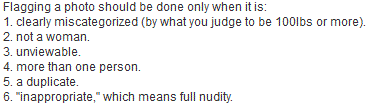
"Flagging a photo should only be done when it is: 1. clearly miscategorized (by which you judge to be 100 lbs. or more) 2. not a woman 3. unviewable 4. more than one person 5. a duplicate 6. "inappropriate," which means full nudity

Are people uploading pictures of dogs?

And then there’s the thing that bothers me most.  This site is for “real women.”  The is an alarming amount of shaming of skinny people within the “body positivity” movement, and plenty of dialogues that replace current beauty standards with other beauty standards- for example, that “real women have curves.”  Worse, the site appears to be only for women, and since whether or not a picture is of a woman is decided by how other members “judge” it, I worry that the site is only for ciswomen.

So, what do you think?  Is this more helpful than harmful?  Do you plan to upload your picture?

Get Naked to Fight Negative Body Image!

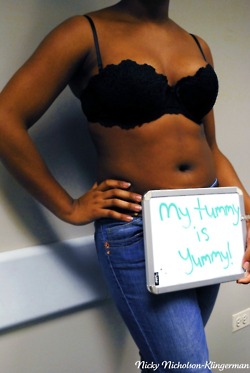
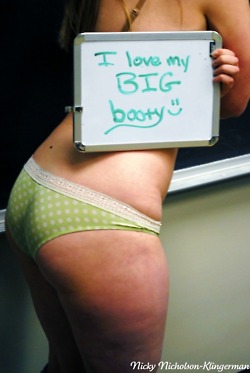
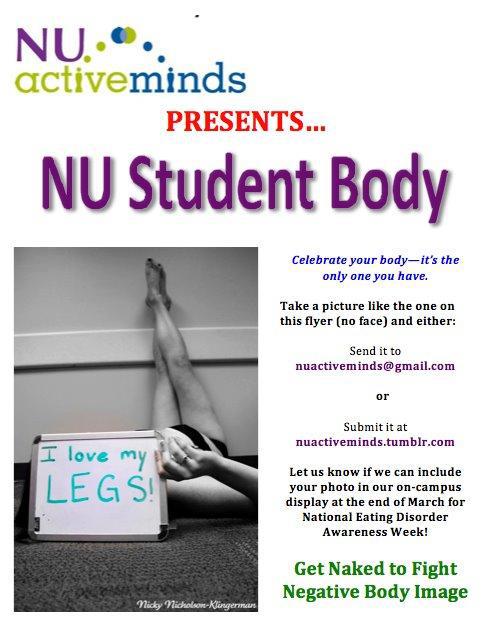
My sister, Lisa, goes to Northwestern University and put the poster to the right on her facebook page. I glanced at it, and immediately loved the idea. A student organization “Active Minds” is asking average students at the University to submit pictures of themselves with their clothing off (without showing anything inappropriate) and without showing their faces to put a cute slogan on a whiteboard or paper and say something positive about that part of their body. I asked her if there were more pictures like the one in this poster. She said yes, go HERE. So I did.

The pictures on this blog are the ones I found on that website. I loved the clever ways people wrote about their bodies and that everyone seems comfortable in their own skin. In a way, it reminds me of the POST SECRET website where people anonymously send in secrets about themselves they’ve never told anyone, and they are viewable publicly on the internet. But unlike PostSecret, this community is just college kids and they’re saying that instead of giving in to the public perception of how bodies “should” be, this is simply the way they are and they’re proud of that and they’re willing to put it in a public place.

I can’t wait to see the kinds of pictures people post, and am also curious to see if anyone will send in a picture of a scar they’re proud of, or if people will send in pictures of their tattoos or piercings like what we’ve discussed in class. I am going to continue to follow this project even after I post this blog and I encourage you to do the same.

The goal of this project by Northwestern University’s “Active Minds” is that they will have lots of pictures of average people who like their bodies the way they are and they will be displayed at the university for National Eating Disorder Awareness Week at the end of March. I couldn’t be happier with this idea.

As a child, I was a ballet dancer, and I was severely underweight. But I thought I looked great because the standard in that environment was, and is, that you are not supposed to have excessive body weight, even in areas like your hips and breasts where you should be gaining weight at puberty. I was exposed to eating disorders at a very young age and know several people who have suffered and nearly died from them.I really like the idea that they’re promoting eating disorder awareness and simultaneously promoting a positive body image. In fact, I like the idea so much I want to start something like this at UMBC. So my question is, if I did, would you join me, and do you think other people would join in?

Holistic Embodiment

Are humans their bodies or are we separate entities from our body? The Cartesian ideology alleges that the mind and body are separate entities. In contrast, the dogma of holistic embodiment states there is a strong alliance between the self and the body. In essence, the holistic viewpoint explicitly states that humans’ are their bodies. Many people in this country believe in the latter of these viewpoints. They express themselves through their bodies and concern themselves with how others perceive them.

One of the last acceptable forms of discrimination within this country is prejudice against overweight or obese individuals. There is a common connotation that overweight or obese individuals are perceived to be lazy and unattractive.  Conversely, People considered to be skinny or of ideal weight are regarded as beautiful and hardworking. Few people want to carry the stigma of being overweight. As a result, the implication of size drives a good majority of people to become obsessed about their weight. Many people try to mitigate this issue by employing quick fix strategies such as consuming weight loss pills and exercising extensively.

The booming industry of weight control and weight loss regiments demonstrates our acceptance of the holistic ideology.  Our obsession with body image illustrates that we believe our “selves” are directly tied to our bodies. The notion that we are our bodies suggests that we cannot accept negative impressions of ourselves. Many people feel as that in order to be more confident about their selfhood they must conform to what is deemed beautiful and acceptable.

In America, the acceptable view of beauty has narrow constraints and many are now falling short of because of the rapidly growing overweight population. With the ideal size of Americans changing; will the standard of beauty adjust as well? More importantly why do we rely so heavily on our outer appearances to dictate our confidence and selfhood?

Everybody Say, “Baby Bump!!!”

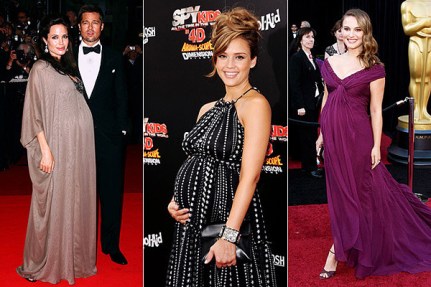
Baby, oh, baby, show us a woman who still thinks style has to suffer during pregnancy, and it’s a pretty safe bet that she hasn’t been keeping an eye on red carpet mamas.

Image

Best Dressed Baby Bumps

The quotation above was taken from this slideshow over at youbeauty.com. When I stumbled upon this slideshow, I was pretty shocked. Hollywood portrays its pregnant celebrities in interesting ways. Hollywood is constantly checking female celebrity’s bodies for “baby bumps” at the slightest appearance of a bulge. That one extra cupcake at a party or that extra french fry could potentially be a baby bump. After a celebrity has finally announced an official pregnancy, before or after they are actually ready to announce it, eyes are constantly on the tummy.

Of course, pregnant superstars cannot let their bodies or their fashion sense slide during pregnancy. Their body is still supposed to look like one of a superstar. The only piece of the body allowed to grow is the belly. The rest of the body is still as sexualized as it was before. Red carpet commentators drool over that motherly glow and growing tummy. Even with the growing bump, these women are supposed to dress to make the public comfortable, not themselves. Instead of maternity sweatpants, pregnant stars instead wear maternity gowns that accentuate the bump for all of the world to take part in her pregnancy.

Superstar bodies are constantly on display, even during pregnancy. Talk about the laboring body! I can only imagine how uncomfortable pregnancy is by itself. Adding on paparazzi cameras, heels, a drapey gown, and keeping a stellar body is way too much! Having a body that is constantly on public display, being praised and criticized, must be a big stress on famous women. What do you think?