
I was recently perusing the world wide webs when I came across an article entitled “7 Things To Look At When You Feel Bad About Your Body“. I encourage everyone to go read it now. Right this minute and then come back here…Go ahead…I’ll wait… (Warning: Contains bodies, in various forms and fashions)
size

Whatever Happened to Embracing One’s Curves!?
So after going through the Fat Bodies section in General Women Studies Class, I was left a bit uneasy. And you can’t blame me, like how can I accept the fact that the media wants to control what women put in their mouths and constantly blame regular women for the way they look? It’s all pure nonsense. Whatever happened to embracing one’s curves, however they look, big or small? I just don’t understand it. It frustrates me greatly.
The nonpliment – “Oh my gosh, you lost so much weight!”
 Sitting in my “to-read” list for a bit was this article. It caught my eye because of what we have been talking about in class for our fat studies unit. Now that I read it, I am SO glad I did.
During our conversation last week, we talked about the really important idea of keeping the lives of fat people at the center of our analysis. One of the other points from class that really stuck with me was that it’s not just enough to focus on loving our own bodies and encouraging people to love their bodies, but we also need to respect and love other people’s bodies of all shapes, to accept, to affirm, and to abandon size-judgement. Continue reading
Note of Absence for 10/9
I’m not going to class today.
I can’t say that it’s because I have a fever, or because I had a dentist appointment, or because anybody died.
I’m not going because of the sensations I feel when we talk about fatness. The sickness and the overwhelming feeling of inadequacy (that has always been pushed in to my mentality from various points in my life) always crop up as we talk about our fat, or not so fat bodies. It’s inevitable, this distinct sucking feeling, as if my gut has become a vacuum, and I can zip myself away like a fancy reusable grocery bag.
We talk critically about the hegemonic institutions that create these body ideals. We complain together, air our grievances, we nod and shake our heads together. We are a good class, a good group of people who can empathize and understand each other’s problems, but that’s not enough to save me from wanting to shrink into my backpack and cry in a bathroom stall.
My body and me: the original arranged marriage
As long as I’ve been alive, I’ve been some version of overweight. I was my mom’s biggest baby. There was the “baby fat” phase (which I tried to ride to middle school, much to my embarrassment); the “I’m gaining weight because of puberty but it hasn’t decided where to live yet” phase of middle and early high school; the “I may not actually be overweight but I’m so disgusted with that tiny bit of belly fat that I’m pretty sure I’m obese” phase that seems pretty rampant in American high schools; the “shit, now I really AM overweight because I decided to take birth control and I put on 50 pounds in 3 months” phase of panic, terror and depression; the “I’ve stopped trying to stop gaining weight” phase where I saw numbers over 200; the “I had a baby and despite gaining hardly any weight with pregnancy I’ve managed to get even bigger postpartum” phase that’s pretty popular with new moms; and my personal favorite, the “oh my god, this is the biggest I’ve ever been ever in my life and I’m completely freaking out” phase of morbid obesity that has consumed my adult life.
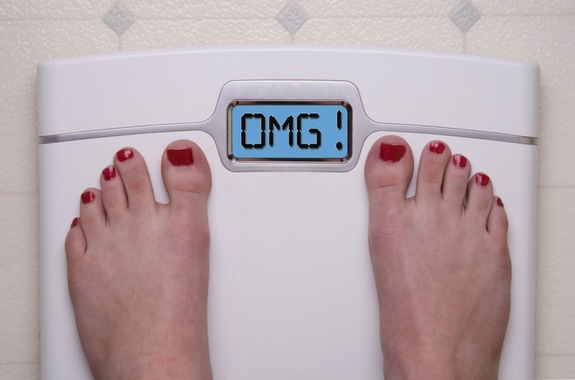
Basically. Though my scale isn’t this clever. And I have better toes.
Sensing a trend? Continue reading
Shrinking Women
I recently came across a Youtube video entitled “Shrinking Women,” which is a piece of slam poetry written and performed by Lily Myers. It discusses the topic of bodies and the space they take up. I found this piece to be profound and it immediately reminded me of this course.
“Boobs Don’t Work That Way”…No really, they don’t!!!
 Images such as these pervade comic book character art. Women are normally in sexy, revealing outfits; and, their bodies are often doing some pretty impossible things. A blog called Boobs Don’t Work That Way brings awareness to how ridiculously women are portrayed in comic books. The picture of Wonder Woman displayed here is not unique. Attempting to make her sexier, she is drawn into this impossible pose where her breasts and behind are shown at the same time. Also, her breasts are extremely large, and there is no way that her costume could logically support them. The commentary on the blog regarding this picture is as follows:
“It always freaks me out when boobs are drawn as almost a separate entity. This one looks like it’s about to pop off and and start a solo career.”
Other interesting points the blogger makes include the way fabric unrealistically stretches over breasts in some costumes, suctioning itself to each breast individually, the fact that nipples rarely have areolas in comics, and that breasts are not always perky and perfectly spherical.
I find it interesting that beauty for women in comic books is literally impossible for us as humans. The beauty standard is completely unrealistic. Do comic book artists feel that women will not be sexy without their impossible breasts? Or do they enjoy creating a fantasy woman? I’m not personally sure which reason correctly demonstrate how artists feel, or if there are other reasons. The blog is not being updated, but the pictures and commentary are excellent. Check it out!
A Mother’s Love
While doing my normal “news checkup” on CNN I came across this article that made me think.
The article is about mother’s with overweight toddlers who see it as normal, meaning they don’t realize that their child is overweight/obese. As mothers we want to see our children healthy and happy. But what does that translate to visually. What makes us know or believe our child is healthy and happy. Is it noticing some sort of growth and development as they transition through the phases of life? Is it noticing that their shoes don’t fit and they’re growing out of their shirts and attributing it to them growing up?
Whatever the reasoning behind a mother’s sometimes flawed view of their child, it is becoming a concern. A lot of these women don’t realize that their child is overweight which causes problems in and of itself. It isn’t just cute little baby fat. What can we do to correct these parents’ skewed views of their children in order to promote a healthier society? Because obesity rates are skyrocketing in our society. And we all know that children are vulnerable in many ways. How we raise them is important because it’s usually an indicator of how life will turn out for them. If they are obese as toddlers then it will not necessarily be something they grow out of. And this could be extremely dangerous with our already ridiculous obesity rates.
http://thechart.blogs.cnn.com/2012/05/07/9-in-10-moms-see-overweight-toddlers-as-normal/?hpt=he_c2
Dysmorphic Friends
One of my closest friends is a fashion stylist. She chooses outfits, hair, makeup, and general looks or moods for photoshoots for natural makeup companies and independent designers. I have modelled for her in the past even though I am not a model and don’t look like a magazine model. I also model for my own Etsy store, selling vintage clothing. My friend has had eating disorders since puberty and I have not. I feel that her eating disorders are a sign of privilege and she feels that my “poverty genes” and post thyroid cancer synthetic metabolism are a sign of privilege. The arguments are frequent and comical.
I feel that it would be insulting to her profession and life’s path to say that her involvement with fashion feeds her disorder, so I often try to tell her eating disorders are a result of a sexist, competitive capitalism, a first world problem, and that if she stops aestheticizng the super young and super thin, wheat colored waify girls with vacant expressions, she won’t hold herself up for comparison to them. I tell her to keep her job but change her aesthetic, make it weirder, and I tell her she’s a misogynist. Then I go on like a hypocrite and smooth out my hair, put makeup on, and have my boyfriend shoot photos of me for Etsy, to make money. And I do make money. But recently, editing and cropping photos of myself, I feel like I look OOLLDD. So I call my friend and ask her for a disorder that will make me less old, less short, less frizzy, less dark, less tired. And there isn’t one. I’m really not sure what I’m aestheticising, but even though I’m perfectly happy with my weight I still feel the need to critically tear apart whatever I can about my own image, down to my assymetrical smile or uneven hair texture or slightly more almond shaped right eye than left one. Little little minute stupid details. All while knowing that I’m making this image public by my own free will, by my need to pay the bills and put gas in my car to get to school. Because those waify wheat colored girls are out there, and my tiny little capitalist enterprise is knowingly in competition with them, and growing up in the 80s and 90s, between Debbie Gibson and Kate Moss, I never felt that my features were pure or innocent, only exotic and “olive olive olive”, and now getting older.
Can a woman be this self-critical and also be a feminist?
Are you tough enough to compete with the guys??
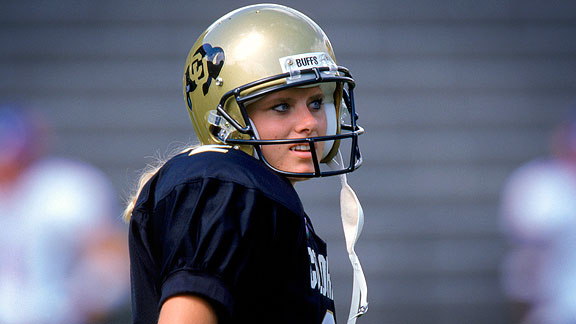 I was reading this article on espn discussing women trying to break the barrier and play football. when I started reading it I became excited that this is even a topic on espn because I know a lot of women who really enjoy playing this sport. Women who do play for a team that is not an all women’s league are mainly kickers for their program which is coincidentally the less contact position.
What I guess I don’t understand is why men feel they need to subject women as this delicate flower that will get crushed if they play football. there are very tough women out here who are even as tough as their male counterparts. Another thing that interested me is that their would be conflicts off the field if women were to play in the NFL. one thing that really stuck out was the lockeroom and how most of the bonding goes on their. even though that is true im sure the coaches and the players can find a way to bond with the opposite sex outside of the lockeroom, it has already been proven because men and women do it everyday. I don’t think that the lockeroom is the biggest situation so I think they are just trying to find ways to keep women out of the only sport that is male dominated.
another problem I have is when they discussed coaches telling females they can’t play football in high school because they don’t want them to get hurt. is that a stereotype or what i think if we were given the chance a lot of women can beat a man at any sport and hit and run with the best of them.
I guess with me being an athlete and playing football when I was younger, I just don’t see the problem with a female joining the sport

