The way a lot of people see me versus how I see myself is very fractured. On the outside, you may see a woman, feminine features, a ‘small’ frame. On the inside, you’ll see a pile of flesh, literally. That’s all I see myself as, a pile of flesh with a pink bow on top to signal to outsiders that I am feminine. But what does it mean if I still see myself as a feminine thing but not a woman?
I still like to participate in things that are aesthetically feminine, I still love the color pink, I still love painting my nails and doing my hair, and trying out makeup. But I want absolutely nothing to do with tasks that are seen as traditionally ‘woman’, I DO NOT want to have to depend on someone else, I DO NOT want to be nurturing and selfless all the time, and I DO NOT want to care for kids, I don’t even like the thought of my body going through a menstrual cycle. I know that not every woman does these things that I just listed off, but many people assume that to be a woman, you have to have a desire to do at least one of them. Most would argue that these feelings aren’t that big of an issue; after all, I do have a choice of whether or not I can do those things. But it’s the fact that people’s outside perceptions will never match how I feel on the inside. Roxane Gay talks about how a lot of people project assumed narratives onto your body without being interested in the truth; while she was referencing how people treat you when you are overweight, this is true for every visible identity. No one will ever look at me and assume that I’m just a person who happens to be feminine; they will always see me embody femininity on the outside and expect me to fulfil the role of a ‘woman’. What makes it worse is that I’ll never be able to explain away that woman label; it doesn’t matter if I try and act selfish, it doesn’t matter if I look like the Babadook if it was supposed to represent processed sugars instead of grief. If i dont look like a man, then I must be a woman.
From one to ten, how would you rate my looks? I’ve been asked this by so many friends of mine and even asked it myself. Subconsciously wanting to rate my looks on a scale made by society’s world of what “beautiful” is. I haven’t always struggled with my self image as much as I do now. I used to be pretty alright with how I look and I used to not care about how I look at myself. But, that didn’t last very long.
One day at school, I saw a few boys talking. Usually I would ignore them and go play by myself, but I knew these guys, they were my friends! I wanted to talk to them. When I walked over, they were talking about some of the girls in our class, who they thought were the prettiest. I didn’t really understand why but I wanted to know how they thought about me, as a girl.
They said “But yea, you aren’t like a girl girl. You wear shorts and pants! You’re basically one of us. You aren’t really on the pretty scale.”
For some reason it made me happy but also why? I felt a flash of annoyance and inferiority. I stopped talking to them after and I started to look at myself more. I wore a lot of black, I wore a lot of T-shirts, I wore a lot of things unbecoming of a young girl. That was the first time I felt self-conscious of how I looked to everyone. I wondered if everyone saw me like that. As just “a lesser guy” because I wasn’t exactly a guy but I didn’t really look like a girl.
“She was letting me know that however long I lasted, she would last longer. She would not be bested by a fat ass.” – Roxane Gay
So many girls are pitted against each other, to see who is the prettiest, who is the skinniest and who is just better than each other. They have to present themselves in a certain way to even be considered a girl but it’s also a competition to see who is the most pretty, the most beautiful, the most skinny. To girls who don’t fit into any of those categories, they aren’t seen as girls at all. You feel inferior to other girls, which builds resentment to them, to everyone. A constant unseen competition between women.
Growing up in P.G. County, Maryland, black is all I knew. My teachers were black, my doctors were black, and the cops were black. I’ve met people with hundreds of years of ancestry here, from Haiti, Ghana, Brazil, different shades, personalities, sizes, the whole nine yards. I have a broad perspective of black people, and my eyes are truly opened to how many stories reside in the black diaspora. However, I find that if you ask many black immigrants in America about African Americans, you will hear one single story: criminals, gangsters, scammers. People who are dangerous and uneducated. Even on the other side of the coin, many will say similar things about Africans: ugly, cheap, uneducated, and can barely speak English. Each culture has its stories, and despite being so similar, the black diaspora finds itself so split from one another.
The stories seen online and perpetuated by the media have taken such a heavy toll on my community that groups that could look like siblings find themselves constantly at odds with one another. I remember one day I had gotten twists for the very first time; when I came home, my house was on fire. My parents looked at me with solemn disappointment and shame. The reitered over and over that I looked like “all those criminals out there”, and I wouldn’t get hired looking like this. The same hairstyles unique to us, that our own ancestors created and practiced for generations, were being watered down to a criminal identity. What a shame. The same story of violence and ineptitude that has long been used to describe black people is the same story ingrained in my immigrant parents. Despite living in P.G. County for years, despite the great African American people they may interact with so often, that same single story still prevails. What a shame.
I find Chimamanda’s “The Danger of a Single Story” very relatable, because the perceptions that come from only believing a single story have ravaged my community, and I wonder whether or not one day we will open our eyes to read another.
The past few weeks of class have me officially fucked up. It isn’t the class material, our classmates, or even the assignments that have launched me into a rage spiral this time. Instead, it is the crushing reality of growing up, existing and trying to survive in a system that so clearly despises my/our “unruly” bodies. Not only does the system despise my body, but it seeks to control, own and exploit it without consideration. And then, when my worth is all used up, I am as disposable as the next piece of unwanted garbage. This undeniable reality is soul crushing as we argue, defend and protest against the brick wall of patriarchy and white supremacy. Meanwhile absurdity and debauchery abound, and we are force-fed a steady stream of systemic poison and lies.
Unfortunately, for myself and too many others, this is something I have always known and understood. And quite honestly, there have been more years than I would like to admit, where all I could do was internalize the bullshit, just to stay alive. And now, here we are. The United States of Pedophilia reigns supreme and family annihilators are justified and protected. A parade of blame and harassment follows Jane Doe, while the disgusting cowards that raped her seek privacy and understanding. Transgender individuals are vilified as sexual deviants, while yet another straight, white, cis man is arrested for child abuse. And just two months ago, news outlets quietly and unceremoniously announced the recovery of 163 missing children, and no one even noticed.
Today, my rage is ever present. It is caged in compliance and locked in survival. Because of this, I am trying something different for this blog post. I decided to use this assignment as a personal challenge and a small act of resistance. Letting creativity and curiosity lead, I found myself returning to and inspired by the writings of Susan Stryker and Roxane Gay. And so, as cringe as it may be, I wrote a poem in an effort to give a voice to my rage in a cage.
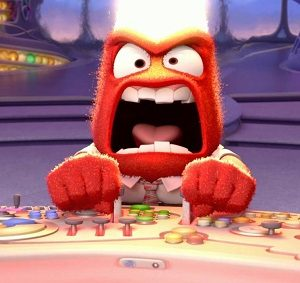
Depicted is the character of “Anger” from the Pixar animated film Inside Out (2015). A short, red, square-shaped character with flams bursting from his head as he screams in rage.
It’s a line that reads as dramatic. Offensive. Controversy for the sake of controversy. After all, The Big C is a show from the tail end of the notoriously fatphobic 2000s. However, Cathy’s right, and Gay’s article brought this now iconic scene back to the forefront of my mind.
Fat people are not allowed to be human beings. That’s the long and short of it. Society does not allow them to be complex, fully-fledged individuals with thoughts and feelings of their own. Instead, fat people are only seen as one thing. Fat. Their weight becomes the focus of every conversation, even when it has nothing to do with what’s actually being discussed. As Gay so succinctly put it: “Fat, much like skin color, is something you cannot hide.”
My use of the third person makes it seem like I’m offering the perspective of an individual outside of this experience. That couldn’t be further from the truth.
From the ages of 5–18, I was considered morbidly obese. “Husky” clothes were the norm for me. Many of my family nicknames were related to being “chubby” and “gluttonous”, names that still follow me to this day. My mother would complain constantly about how quickly I was outgrowing the clothes she would buy me. Even though she never explicitly blamed it on my weight, I knew she wanted to. It wasn’t until middle school, though, that I truly felt the ostracism begin.
Fat is not considered “attractive”, at least within the white supremacist American framework we live in. Despite my living in a predominantly black community, that framework was still upheld. Middle school is where social hierarchies become inextricable from the rest of your life, and they’re especially shallow then because everyone’s still learning them. So guess what becomes the single most important thing to have during your adolescent years? Pretty privilege. Good luck trying to access that, fatty!
It’s impossible to describe the experience of growing up “fat” and “unattractive” to a person who grew up “healthy” and “attractive”. It’s rarely a dramatic, Carrie-esque nightmare, though that can be the experience of some. Rather, it’s exclusion in small ways. Being overlooked, teased, rejected, and seen as less desirable by my peers became so common to me that it started to seem… normal. Somewhere in 6th grade, I reached the emotionless determination that I simply didn’t have a chance. I would never find love. I would never be pursued. I would always be alone. What a fucked up conclusion to reach at the ripe age of 11, right? Even more odd, though, was the role I was now expected to fulfill: The DUFF. Or, Designated Ugly Fat Friend, for the uninitiated.
This is where we circle back to the titular quote. Anyone who grew up fat knows that you’re only allowed to be funny. If you want any kind of social standing amongst your peers, you must perform the role of jester. Anything other than that is a cardinal sin. Don’t get too bold though, piggy.
You’re only allowed to “jokingly” insult people fatter or uglier than you, cause guess what becomes the point of focus when you try to punch above your weight? Having a bad day and can’t be everyone’s comedian? Too bad, unless you want to learn that all of that social capital is conditional. That’s not to say you can’t have genuine friends, but you’ll very quickly get used to feeling invisible, even if you’re right next to them.
Just as developmentally important is young love. Or at the very least, romantic attention/experiences. …Should I hold in my laugh? That’s the point of being the jester. No one takes you seriously! You’ll yearn for the idea of being pursued, but the closest you’ll get is vicariously living through your friends. Confessions? Dates? Partners? Aw, that’s cute. Only people get to experience love. And you’re not a person. You’re a fat person. Who gave you the right to be multifaceted?
What’s left after the show’s over, though? When you’re laying in bed after another day’s work of distracting people from your body, even though you know it’s all they’ll ever see, what happens in your mind?
Don’t we deserve more than this?
Aren’t we more than our weight?
Am I not, too, a human being?
…
…
…
What, you thought you could be intellectual and fat too?
When the fall semester started, I was determined to go to the gym consistently and start running around my neighborhood. I started doing all this research (Tiktok rabbit holes) on what type of exercising I should do to have my body look a certain way based on my height, weight, and schedule. I looked into Pilates classes, good running shoes, and certain meals to eat.
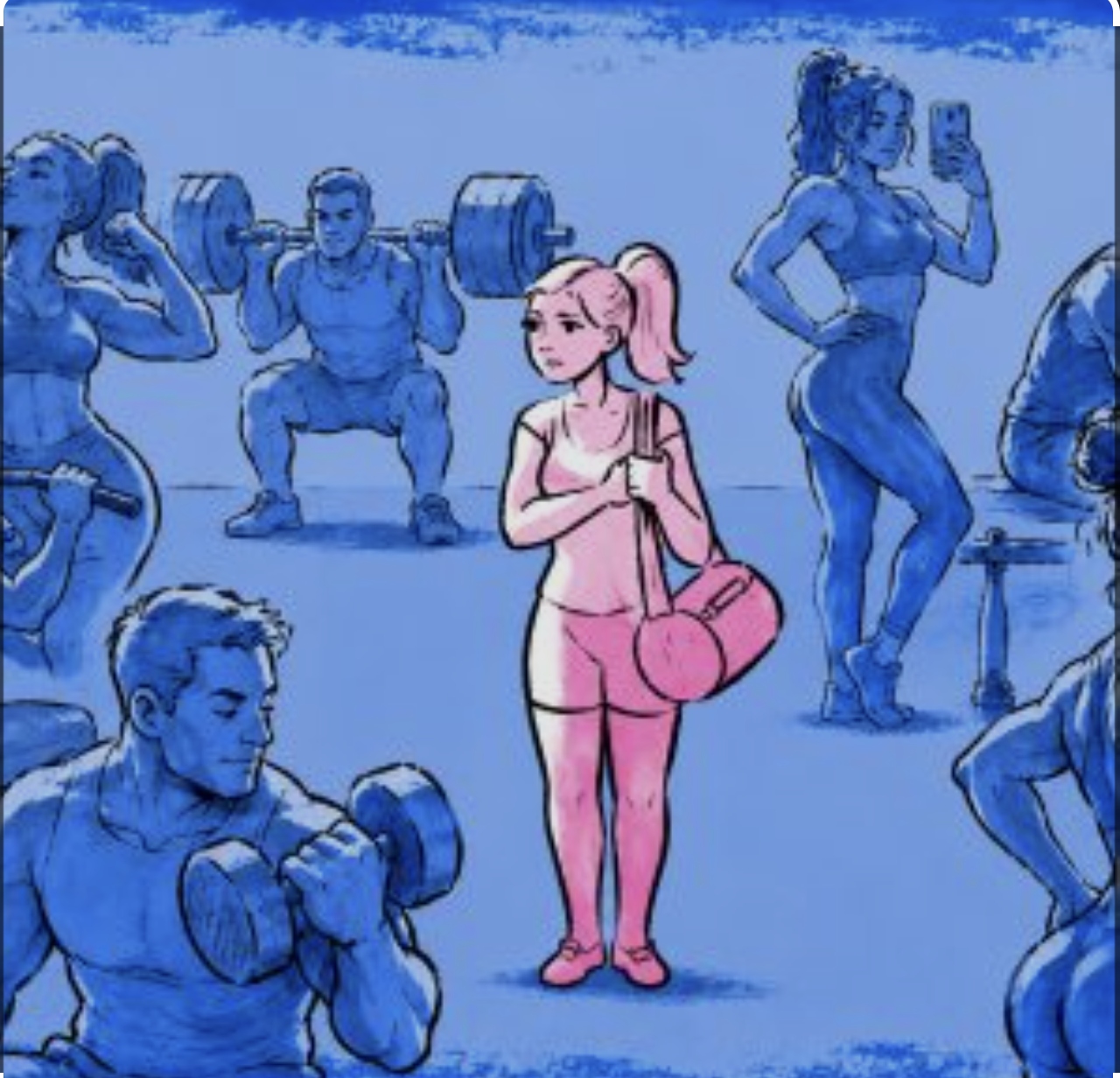
Day 1 came in my 3 split weekly workout schedule, and I was ready. I had a list of exercises to do and a meal plan. However, that morning I started to have a bunch of anxiety. My outfit didn’t look like the cute gym clothes on social media, I had on an old family reunion T-shirt and too small leggings. I had this fear that what if I forgot how to do the exercises properly and someone looks at me and thought I was stupid or could tell that I was new to this. All these thoughts started rushing through my mind to the point where I ended up doing an at- home YouTube workout instead.
Looking back, I realize my anxiety was deeper than just exercising. It was more about how I thought other people would perceive not only my body but how I decided to move it. Social media has created an image of what someone who goes to the gym is supposed to look like, from the clothes they wear to their confidence level with using the equipment. I started comparing myself to that image before I even arrived at the gym.
This experience showed me how culture and societies expectations can shape how people view us and how we view our own bodies. My fear of being judged changed how I experienced my body and my comfortability level of exercising. The gym did not feel like a place to “better myself,” it felt like an award show where everyone was watching me. Fast forward to today, I still do have the fear and overthinking of going to the gym. But rather than not go at all I look on the app to see how busy it is before going. I’m not sure if that’s progress but at least I made it to being in the building.
People often say body decisions are completely personal but we’re consistently surrounded by expectations about what bodies should look like. Society has placed an intangible wall to separate what we claim as a “normal” body. This constantly makes those that society deems as “fat” wonder where personal desire ends and social pressure begins to set in and the complexities that are involved within. The almost paradoxical and complex structure of this topic was very enticing to me while reading Roxane Gay’s pieces of literature: “My Body Is a Cage of My Own Making,” and “What Fullness is.” Gay very articulately and creatively demonstrates her message of acceptance vs discomfort and how the body can change from a source of protection and acceptance, to a limitation, and the overall complexity. Gay understands that she shouldn’t have to necessarily change herself in order to satisfy society, but the contradiction is that she doesn’t always feel comfortable living in her own body. What she knows vs what she feels is extremely important. Someone can recognize the unrealistic and normalized standards of today’s society but still feel somewhat pressured by it. The phenomenology within this concept is clear to recognize when we acknowledge if we are able to separate how we feel about ourselves from how other people see us. Gay uses common examples where society is quite literally built around the “normal” body and how it’s hard to ignore one’s own limitations. Airplanes, chairs, stages, and clothing were all used within her piece and developed into the idea that even though she is aware she should intellectually “not have to change my body for society,” she believes that “living in this body can still be difficult.”
Gay eventually chooses weight loss surgery but presents the decision as not completely separated and independent from society. She realizes that “I could change my fat body faster than this culture will change.” Even though she chose to go through with the surgery on her own terms she spent years of being told directly and indirectly that her body is the problem. The cultural connections she makes to strengthen her argument involve heavily around social media and beauty standards, medical systems and assumptions about weight, and the overall expectations placed on women’s bodies. It posed a question within me to recognize if our body preferences are entirely our own.
Even though Gay got the surgery, she described the before and after shift and the experience that came with it. Surgery changes her body but doesn’t necessarily fix everything, she explains that “everything has changed, but everything is exactly the same.” She is still the same person even after surgery with the same insecurities, desires, fears, and trauma. She explained the struggle after surgery how food wasn’t simply food anymore. Before she used food as a coping mechanism-for sadness, comfort, happiness, loneliness, etc. However, surgery removed a huge coping mechanism for her but not the feelings that created the need for that mechanism.
Gay’s individual experience provided a lens for a larger cultural problem. Her writing complicates yet brings to light the contradictions regarding the personal choice of changing our bodies because of the way we understand and experience our bodies is constantly shaped by social norms, physical spaces, institutions and other peoples expectations.
Freshman year of college all my friends were men. The majority of them went to the gym regularly and would always talk about their weight. Most of them were trying to gain weight. They would talk about how they are 150 lbs and this is the heaviest they have ever been. They would be taller than me but I would still weigh more. I started telling myself I needed to weigh less than this 6 ft man or I am going to be fat.